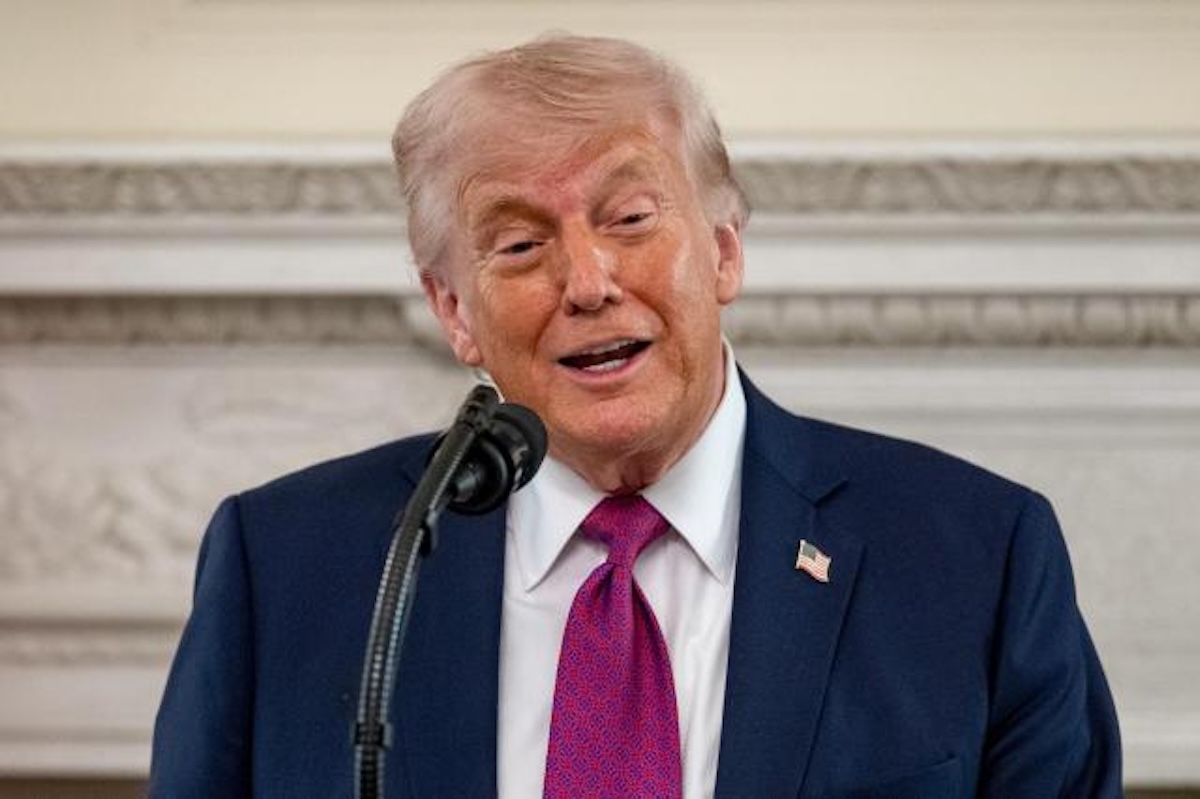
In a Tuesday announcement posted to his Truth Social platform, former U.S. President Donald Trump has extended an existing two-week ceasefire in the U.S.-Israeli military campaign against Iran, though he has ordered U.S. military forces to maintain a strict naval blockade of the country and remain on high alert for potential renewed hostilities.
The ceasefire extension comes just two weeks after Trump threatened to destroy Iran’s “whole civilization” hours before the initial truce took effect. In his post, Trump framed the extension as a response to two key factors: the deep internal political fragmentation within Iran’s government, and a formal request from Pakistan’s top military leader Field Marshal Asim Munir and Prime Minister Shehbaz Sharif to delay new attacks to allow Iranian officials time to draft a unified negotiating proposal.
“I have therefore directed our Military to continue the Blockade and, in all other respects, remain ready and able, and will therefore extend the Ceasefire until such time as their proposal is submitted, and discussions are concluded, one way or the other,” Trump wrote in the statement, offering no fixed end date for the extended truce.
The U.S. naval blockade was implemented after Iran closed the Strait of Hormuz, a critical global chokepoint for international fossil fuel trade connecting the Persian Gulf to the Gulf of Oman. Over the weekend, Trump confirmed that U.S. forces had seized the Touska, a 900-foot Iranian-flagged cargo vessel, as part of the blockade operation.
Regional and policy analysts have painted a grim picture of the current stalemate, warning that the lack of trust between Washington and Tehran leaves the door open for sudden conflict resumption. Trita Parsi, co-founder and executive vice president of the Quincy Institute for Responsible Statecraft, assessed that the current arrangement aligns with the most likely outcome: a frozen conflict with no major breakthroughs. “No deal, no sanctions relief, no nuclear compromise, no return to war, while Iran continues to control the strait,” Parsi said, noting that Trump achieves his core goal of exiting full-scale war while Iran fails to secure its top demand of sanctions lifting, leaving the region in an unstable limbo.
While the United Nations has welcomed the ceasefire extension – with a spokesperson for Secretary-General António Guterres calling it “an important step toward de-escalation and creating critical space for diplomacy and confidence-building between Iran and the United States” – Iranian officials have rejected the status quo and pushed back against the continued blockade.
Drop Site News co-founder Jeremy Scahill reported Tuesday that an anonymous Iranian official confirmed Iran’s core position remains unchanged: full lifting of the U.S. naval blockade is a non-negotiable precondition for any further negotiations. An advisor to Iranian Parliament Speaker Mohammad Bagher Ghalibaf went further, telling Reuters chief national security reporter Phil Stewart that the ceasefire extension is meaningless, and may even be a U.S. tactic to buy time for a surprise offensive. The advisor added that maintaining the blockade is equivalent to military bombardment, and must be met with a military response from Iran.
Sina Toossi, a senior fellow at the Center for International Policy, warned that after two surprise attacks on Iranian soil, hardline factions in Tehran are now pushing for pre-emptive military action against U.S. military and commercial vessels operating near the Strait of Hormuz. “Trust between the sides remains at zero and renewed war could break out at any time,” Toossi stressed. He also dismissed Trump’s framing of the extension as a response to Pakistan’s request, noting “Pakistan isn’t deciding whether the U.S. goes to war with Iran. They’re a conduit, not a driver. More a convenient excuse and diplomatic cover than having any sort of actual influence over Trump on Iran.”
In a pre-extension op-ed for The Guardian, Toossi argued that Iranian officials have little incentive to offer major concessions after holding their ground through the initial U.S.-Israeli offensive. “Having fought what they see as an existential war with the US and Israel and held their ground, Iranian officials see little reason to rush into major concessions. The priority is not a sweeping deal, but reducing the risk of war while preserving core sources of power, from Hormuz to its nuclear program,” he wrote. Toossi added that the most likely long-term outcome is not a full peace deal, but a fragile interim arrangement that manages rather than resolves the conflict, with Iran betting that global economic pressure from energy market disruptions will eventually force the U.S. to back down.
The human and economic costs of the two-month conflict continue to mount. Climate advocacy group 350.org estimates that global consumers and businesses have paid an extra $158.6 billion to $166.9 billion in fuel costs over the first 50 days of the war alone, driven by supply disruptions and price volatility. Since the U.S. and Israel launched their initial offensive in February, thousands of people have been killed across Iran and the broader region, and tens of thousands of Iranian civilian infrastructure sites have suffered significant damage.