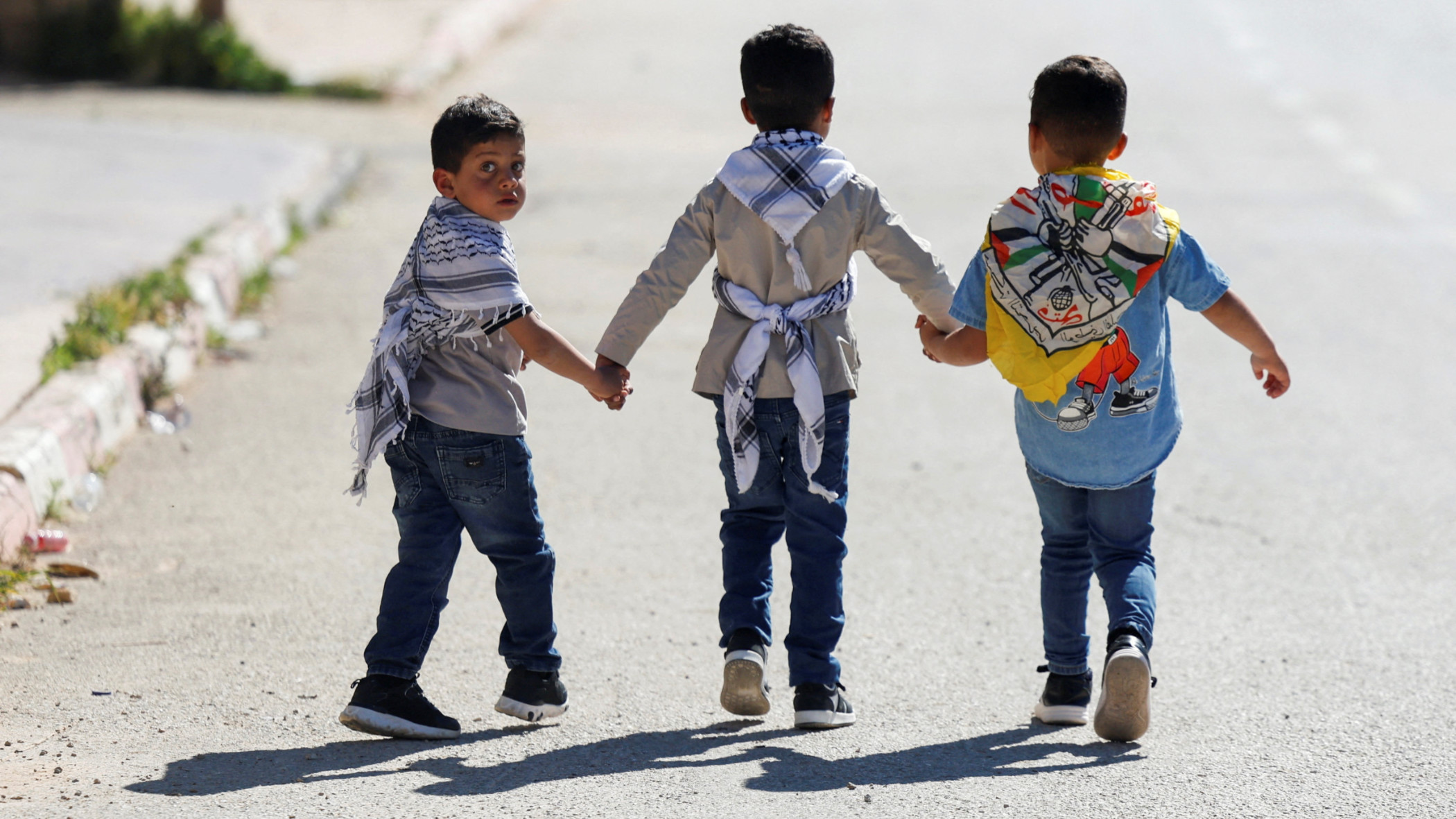
For decades, the annual March of Return has served as a cornerstone of collective action for Palestinians residing within Israel, drawing tens of thousands of participants each year to honor displaced communities and reaffirm their ties to ancestral land. But in 2024, sweeping restrictions imposed by Israeli police forced organizers to completely reimagine the event, transforming the traditional large central gathering into a sprawling network of small, localized tours to dozens of depopulated Palestinian villages.
The annual commemoration marks the Nakba – Arabic for “catastrophe” – the 1948 displacement of hundreds of thousands of Palestinians by Zionist militias during the establishment of the state of Israel, which left hundreds of Palestinian communities destroyed and emptied. For participating Palestinians, these annual gatherings are far more than a memorial: they are a deliberate act of resistance against ongoing efforts to erase Palestinian cultural and historical identity, organizers say.
Negotiations over the event began three months in advance, according to Khaled Awad, spokesperson for the Association for the Defence of the Rights of the Internally Displaced, one of the event’s lead organizing groups. Awad explained that Israeli police initially refused all dialogue with event organizers, issuing explicit warnings that the march would be forcibly dispersed if it moved forward in its traditional format. In response, the association partnered with legal rights group Adalah to file a petition with the Israeli Supreme Court, which ultimately compelled police to enter formal negotiations.
Even after talks began, Awad said organizers faced persistent bureaucratic delays and constantly shifting requirements from law enforcement. The final agreement imposed two major constraints: a hard cap of 1,000 total participants across the entire event – a limit Awad called deeply unreasonable, given that tens of thousands have attended in past years – and a total ban on all Palestinian flags and national symbols, with police justifying the ban on the grounds that such imagery could “provoke unrest.”
Organizers took the warnings of police intervention seriously, as the march has long drawn intergenerational crowds including young children and elderly participants. “We are talking about a space where people come with their children,” Awad noted, adding that organizers prioritized participant safety above all. By the time final approvals were issued, just days before the scheduled event, coordinating a large central gathering was no longer logistically feasible. The decision was made to shift to a decentralized model of small, location-specific tours.
In total, organizers arranged more than 30 separate tours to depopulated village sites across the Galilee and northern Israel, including the former communities of al-Damun, Miar, Maalul, al-Lajjun, and Miska. Turnout varied across locations, with some gatherings drawing only a few dozen participants while others attracted hundreds. The largest gathering, held at al-Damun, drew hundreds of attendees, while smaller sites like Miska hosted around 70 people, mostly family members and descendants of the villages’ original displaced residents.
Among the attendees at Miska was 88-year-old Abu Amjad Shbita, who was forced to flee the village as a child during the 1948 violence and now resides in nearby Tira. Shbita recalled that residents left after warnings from the Arab Liberation Army, as news of Zionist attacks on neighboring villages spread widespread panic. “We left thinking we would come back,” he told the gathered crowd. In the decades that followed, surviving residents of Miska were dispersed across Israel and the broader region, and the village was completely destroyed in the early 1950s. “There is no place without someone from Miska,” Shbita said, adding that the destruction of the village marked the permanent end of his childhood.
The annual commemoration of the Nakba falls each year at the same time as Israel’s celebration of its national independence, a juxtaposition that underscores the competing historical narratives at the heart of the Israeli-Palestinian conflict. For Palestinians, even small, scattered visits to destroyed village sites carry profound weight, serving as a way to preserve collective memory and pass intergenerational stories of displacement and connection to the land down to younger generations.
For Jasmine Shbita, a third-generation descendant of Nakba displaced persons, returning to the ruins of destroyed villages is both an act of memory and imagination. “I keep trying to imagine it as a living place,” she said, explaining that she often visualizes what the village would look like today if it had never been destroyed. Even without physically rebuilding Palestinian communities on the land, she noted, the act of returning and sharing stories holds lasting power. “Even if I don’t build a house, just passing this story to my children means I’ve done my part,” she said. “There is no complete destruction. There are always ruins, and people return to them and try to rebuild meaning from them.”
Though the format of the 2024 March of Return differs dramatically from traditional gatherings, organizers and participants agree that the core message of the event remains unchanged: the ancestral connection of Palestinians to the land of their former communities, and their longstanding demand for the right of return, endures regardless of the scale of the annual gathering.