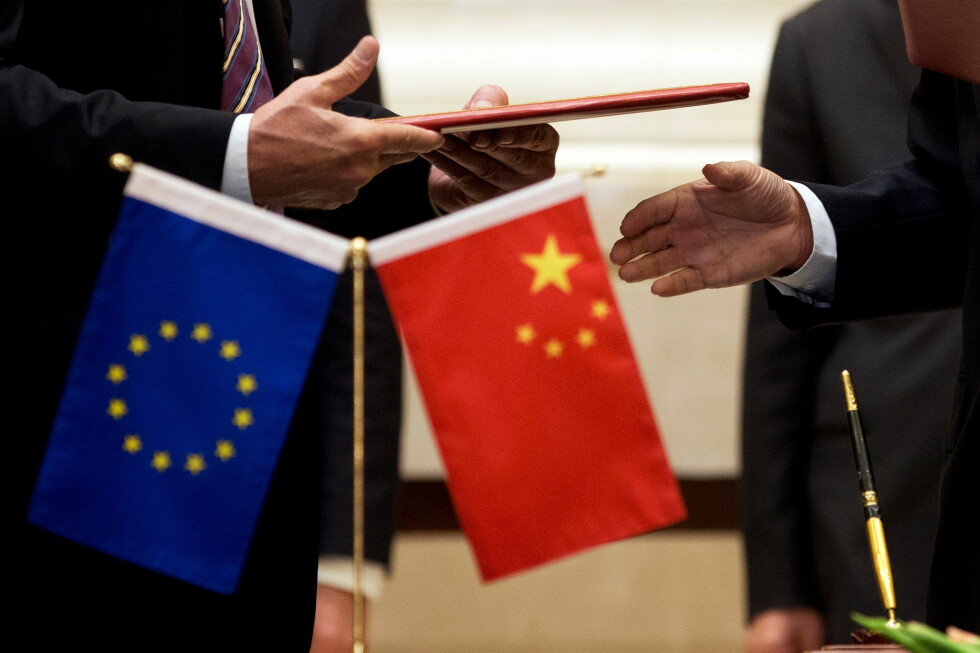
Against a backdrop of a ballooning bilateral trade deficit and shifting global trade dynamics, China and the European Union have formalized a new framework for regular high-level trade engagement, agreeing to hold ministerial-level trade negotiations one to two times annually to grow and rebalance their commercial relationship, China’s Ministry of Commerce confirmed Thursday.
The announcement follows a Monday meeting in Brussels between EU Trade Commissioner Maroš Šefčovič and Chinese Commerce Minister Wang Wentao, where Beijing extended a formal invitation for Šefčovič to visit China in autumn 2024, confirmed ministry spokesperson He Yadong to reporters. Under the newly launched China-EU Trade and Investment Consultation Mechanism, the two partners have also outlined plans to deepen collaborative work in two high-priority global sectors: artificial intelligence development and the global transition to renewable energy.
The new consultation structure comes as the EU faces mounting domestic and international pressure to address its growing trade imbalance with China. Last year alone, the EU’s trade deficit with China expanded to roughly €360 billion ($410 billion), averaging nearly €1 billion per day. The surge in Chinese exports of electric vehicles and energy storage batteries to European markets has been a key driver of this widening gap, prompting increasing calls from European industry leaders for policy intervention.
In remarks after his Brussels meeting, Šefčovič emphasized that as the trade gap grows, the bloc is committed to protecting its domestic industrial base and advancing a fair global competitive landscape, setting an October deadline for achieving tangible progress on trade rebalancing. Tensions have already escalated in recent weeks: new EU trade rules targeting Chinese imports took effect Wednesday, designed to shield the European steel sector and impose stricter controls on low-value small parcels shipped via cross-border e-commerce.
Chinese stakeholders have pushed back on European trade restrictions, framing the imbalance as a product of EU policy choices. A post last week from Yuyuantantian, a social media account linked to Chinese state media, noted that China has signaled openness to increasing imports from the EU, but argued the bloc must ease its existing export controls on high-tech goods bound for China and stop framing trade and economic issues as geopolitical weapons.
The current standoff also unfolds against a broader global backdrop of shifting supply chain strategy. In June 2024, G7 leaders issued a joint communique committing to building resilient alternative supply chains for critical minerals — inputs central to high-tech manufacturing and national defense production — with the explicit goal of reducing collective reliance on Chinese supplies.