作者: admin

  • US funding helps Cyprus upgrade military bases for its role as a regional safe haven

    US funding helps Cyprus upgrade military bases for its role as a regional safe haven

    In the strategically vital eastern Mediterranean, the island nation of Cyprus is undertaking a major upgrade of its core military infrastructure, backed by U.S. taxpayer funding, to solidify its growing role as a secure evacuation hub and humanitarian logistics center for conflict-plagued regions of the Middle East.

    The Associated Press secured rare exclusive access to the restricted military sites, where National Guard spokesperson Lieutenant Colonel Paris Samoutis outlined the scope of the improvements. Located just 229 kilometers off the coast of Lebanon, Cyprus’ primary Evangelos Florakis Naval Base will gain a new heliport financed by U.S. European Command. The facility is engineered to accommodate large heavy-lift rotorcraft such as Chinook transport helicopters, designed to streamline the evacuation of civilians and displaced people out of active conflict zones. Beyond the heliport, the naval base will also see extensive renovations to its port infrastructure, allowing it to berth larger vessels including frigates that bring advanced radar and missile-based air defense capabilities to protect incoming and outgoing humanitarian missions.

    On the island’s southwestern coast, the Andreas Papandreou Air Base will undergo expansion to add a new aircraft apron. This dedicated space will cut turnaround times for refueling and maintenance of dozens of heavy-lift military transport aircraft, which ferry personnel and emergency equipment to support regional humanitarian response operations. A regional wildfire coordination center, designed to assist neighboring Middle Eastern nations in combating large-scale seasonal blazes, is also set to open at the air base next month.

    While exact total project costs have not been publicly released as final cost assessments are still ongoing, the U.S. has already committed 500,000 euros ($588,000) to develop the detailed expansion plan for the air base. Construction on both projects is scheduled to break ground next year, as part of a broader multi-site infrastructure upgrade initiative across Cyprus’ military facilities. The U.S. funding is explicitly earmarked to help Cyprus scale up its capacity to handle large-scale humanitarian crisis response operations.

    This deepened security cooperation between Washington and Nicosia would have been unthinkable a decade ago. For decades, Cyprus maintained a strict policy of non-alignment in global geopolitics, but it has gradually shifted its diplomatic orientation firmly toward the West. That shift accelerated after President Nikos Christodoulides, an American-educated leader, took office in 2023. Under his administration, diplomatic outreach to the U.S. reached unprecedented levels, resulting in the end of a decades-long U.S. arms embargo on Cyprus and opening new doors for bilateral economic opportunity.

    Christodoulides has consistently leveraged Cyprus’ unique geographic location to make the case to European Union and U.S. leaders that the island is the ideal hub for Western diplomatic, economic, and humanitarian engagement with the volatile Middle East. “As a conscientious and responsible partner, Cyprus remains a credible and safe harbor,” Christodoulides stated in a December address.

    For years, the U.S. military relied on the two British sovereign base areas that the U.K. retained on Cyprus after the island gained independence from colonial rule in 1960. However, that arrangement was upended in early March, when a Shahed drone—confirmed by Cypriot officials to have been launched from Lebanon—struck an aircraft hangar at RAF Akrotiri, the first drone attack on EU territory tied to the wider Iran-Israel regional conflict. The upgrades to Cyprus’ own national military installations now provide Washington and other Western partners with alternative, sovereign infrastructure to support regional operations.

    Cyprus has already built a proven track record of facilitating humanitarian and evacuation operations in recent years. In April 2023, it served as a primary transit point for the repatriation of third-country nationals fleeing the conflict in Sudan. When regional tensions escalated following U.S. and Israeli strikes on Iranian nuclear facilities in June 2025, Cyprus again acted as a safe way station for foreign nationals leaving Israel and for Israelis stranded abroad to return home. In 2024, the island launched the Amalthea maritime corridor, which delivered thousands of tons of emergency humanitarian aid to war-torn Gaza—first directly, then via the Israeli port of Ashdod.

    Dozens of EU member states and other nations have already pre-positioned civilian personnel, military units, helicopters, and fixed-wing aircraft in Cyprus to support potential future evacuation operations for their citizens. In 2024, the U.S. deployed a marine contingent and a fleet of V-22 Osprey tiltrotor aircraft to Cyprus’ Paphos Air Base specifically to assist with evacuation operations out of Lebanon.

    A core red line has remained clear from the Cypriot government: all use of the upgraded military installations will be restricted exclusively to humanitarian operations, and will never be used for offensive military action. Echoing President Christodoulides’ core governing mantra for the island’s regional role, Samoutis emphasized: “Cyprus remains part of the solution, not the problem.”

  • Starmer admits mistake in appointing Mandelson as UK ambassador

    Starmer admits mistake in appointing Mandelson as UK ambassador

    LONDON – A mounting political crisis has engulfed British Prime Minister Keir Starmer this week, after revelations that former U.S. ambassador Peter Mandelson took up one of the nation’s most critical diplomatic posts despite failing mandatory national security vetting – a critical detail that senior government officials never brought to the prime minister’s attention, Starmer told lawmakers Monday.

    Addressing the House of Commons amid growing pressure to step down, Starmer acknowledged his appointment of Mandelson was a misjudgment, but stressed he would never have greenlit the nomination had he been informed of the failed security clearance. He placed full responsibility for the oversight on senior Foreign Office leadership, saying, “The fact that Mandelson’s vetting process ruled against security clearance could and should have been shared with me before he took up his post.”

    The controversy stretches back months, long before the vetting failure came to light. Starmer, who led the center-left Labour Party to a landslide general election victory in July 2024, selected Mandelson – a veteran former Labour politician and ex-European Union trade commissioner with deep ties to global political and business elites – for the Washington ambassadorship in late 2024, even after his own internal aides warned that Mandelson’s long-running personal friendship with convicted sex offender Jeffrey Epstein, who died in prison in 2019, posed severe reputational risk. Additional alarms were also raised over Mandelson’s past business connections to Russia and China, but officials ultimately prioritized his diplomatic experience and existing relationships with figures connected to U.S. President Donald Trump’s second administration.

    Mandelson was ultimately removed from his post in September 2025, less than nine months after taking office, when new evidence emerged that he had lied about the true scope of his ties to Epstein. A batch of Epstein-related documents released by the U.S. Department of Justice in January 2025 included 2009 emails suggesting Mandelson shared sensitive, market-moving British government information with Epstein in the wake of the global financial crisis. British police launched a criminal investigation into the allegations and arrested Mandelson in February on suspicion of misconduct in public office; he has repeatedly denied any wrongdoing, has not been formally charged, and faces no allegations of sexual misconduct connected to Epstein.

    The explosive new revelation of Mandelson’s failed security vetting was first published by *The Guardian* last week, and it has sparked immediate, widespread calls for Starmer’s resignation from all major opposition parties. Within hours of the report, Starmer dismissed Olly Robbins, the top civil servant at the Foreign Office, which holds oversight over all diplomatic appointments. Allies of Robbins have pushed back against the blame, however, claiming the senior official was never permitted to share sensitive vetting information directly with the prime minister. Robbins is set to present his own account of the appointment process to the House of Commons Foreign Affairs Committee on Tuesday.

    Starmer has repeatedly maintained that what he believed was proper due process was followed during the appointment, but says he is now “furious” that the vetting panel’s negative recommendation was hidden from him. Opposition leaders have rejected his framing: Conservative Party leader Kemi Badenoch wrote in the *Mail on Sunday* that Starmer “misled Parliament over Mandelson, misled the country and is taking the public for fools.” Ed Davey, leader of the Liberal Democrats, the United Kingdom’s third-largest party, called the appointment an act of “catastrophic misjudgment.”

    Senior members of Starmer’s own cabinet have publicly defended the prime minister, with Deputy Prime Minister David Lammy affirming that “he would never, ever have appointed him ambassador” if the failed vetting had been disclosed. But unrest is growing among backbench Labour lawmakers, who already face grim national poll ratings less than a year into the new government. Starmer previously defused one uprising over the Mandelson controversy in February, when a small group of MPs called for him to step down. The upcoming May 7 local and regional elections are widely viewed as a midterm referendum on Starmer’s premiership, and political analysts expect the prime minister could face new internal pressure to resign if Labour suffers heavy losses at the polls.

    Critics have framed the Mandelson fiasco as the latest in a string of missteps for Starmer’s government, which has struggled to deliver on campaign promises of accelerated economic growth, repair overstretched public services, and bring down the cost of living for British households. The prime minister has already been forced to reverse multiple key campaign pledges since taking office, and the ongoing crisis has deepened questions about his leadership judgment at a critical moment for British domestic and foreign policy.

  • ‘See what happens’: Matt Burton addresses Bulldogs future as club seeks answers following shock loss to Parramatta

    ‘See what happens’: Matt Burton addresses Bulldogs future as club seeks answers following shock loss to Parramatta

    The National Rugby League (NRL) side Canterbury Bulldogs are still searching for answers after their stunning upset defeat to the Parramatta Eels over the weekend, while star five-eighth Matt Burton has moved to shut down persistent speculation linking him to a future exit from the Belmore-based club.

    Burton, one of the Bulldogs’ most high-profile players, enters this week of competition with 12 months remaining on his current contract at Canterbury. However, industry whispers have persisted for months that a potential move to a Perth-based expansion side could materialize as early as 2026, a shift that would free up critical salary cap space for the Bulldogs to reshape their roster.

    Speaking to reporters at a public event on Monday, the left-footed playmaker declined to give further credence to the off-field rumours, emphasizing he remains fully focused on fulfilling his current commitments to Canterbury. He also reaffirmed his willingness to adapt his position for the good of the team, saying he would happily shift from the halves to left centre if the coaching staff required the adjustment.

    “Right now, my only priority is playing my best rugby for the Bulldogs, and we’ll see what the future holds down the line. I’ve left all contract discussions to my manager and the club’s leadership to work through,” Burton explained. “I don’t pay too much attention to the outside noise. I hear about the rumours from other people who follow the media, but I have a job to do here at Belmore, and that’s all that matters to me. Whatever position the team needs me to fill, I’ll give 100% effort – that’s the team-first culture we’ve built here, and I fully buy into it.”

    The Bulldogs’ backline structure is set to undergo a major shake-up this week ahead of their Friday night clash with the Brisbane Broncos, with the club set to confirm team selections on Tuesday afternoon. Skipper Stephen Crichton is widely expected to make his return from a short-term shoulder injury layoff, while starting winger Jacob Kiraz is poised to be sidelined with a knee injury.

    If Crichton is cleared for a full return, utility Bronson Xerri is expected to shift to right centre – a positional change that stirred internal tension earlier this season when Xerri was dropped from the starting side. Burton welcomed Crichton’s potential comeback, noting the leader’s impact on the team regardless of selection challenges.

    “I think he’s got a really good shot at playing this week, and it would be huge to have him back out there,” Burton said. “He’s such a massive boost for us if he’s available, but I know whoever gets called up to fill the gap will do the job required.”

    Regardless of the final team sheet, the biggest challenge for the Bulldogs this week remains addressing their frustrating inconsistency, which has seen the side deliver wildly contrasting performances over the past fortnight. In Round 6, the blue-and-whites pulled off one of the upsets of the season, ending reigning premiers Penrith Panthers’ long-running winning streak. Just seven days later, they turned in a disjointed performance to fall to a struggling Parramatta side missing multiple key starters to injury.

    Bulldogs head coach Cameron Ciraldo made his frustration clear in post-match press conference following the Eels defeat, but veteran forward Kurt Mann rejected claims that the side had grown complacent after their high-profile win over Penrith.

    “I don’t think complacency was the issue at all,” Mann said ahead of this week’s road trip to Brisbane to face an injury-depleted Broncos side. “We just made far too many unforced errors, and that put us under constant pressure playing out of our own end. We didn’t execute our game plan the way we planned to, and that hurt us.

    “When you give up field position and possession that cheaply, it’s almost impossible to stick to your game plan. It’s really disappointing – after the performance we put in against Penrith, to come out and play like we did is a letdown for all of us. We’re going to review every minute of this game, take the lessons on board, and move forward.

    “The NRL is all about consistency, you have to bring your best effort every single week. Right now, we’re up and down, and we’re still working to find that steady level of performance. We’re going to keep working on that this week, and all season long.”

  • Four candidates for UN secretary-general audition this week. That’s far fewer than in 2016

    Four candidates for UN secretary-general audition this week. That’s far fewer than in 2016

    UNITED NATIONS — Just four contenders will take part in this week’s public confirmation hearings for the next United Nations Secretary-General, a drastically smaller field than the 13 candidates that competed for the post during António Guterres’ 2016 selection. The race comes as the global body grapples with deep great power divisions that have crippled its core peace and security mandate, a stark shift from the more collaborative global landscape a decade ago.

    The first day of hearings, scheduled for Tuesday, will open with Michelle Bachelet, the former two-term President of Chile and former UN High Commissioner for Human Rights. Bachelet is one of just two women in the race, and one of three candidates hailing from Latin America — the region widely expected to claim the top post under the UN’s longstanding regional rotation tradition. Following Bachelet’s three-hour question-and-answer session with ambassadors from all 193 UN member states will be Rafael Mariano Grossi, an Argentine diplomat who has served as Director General of the International Atomic Energy Agency since 2019. On Wednesday, the lineup continues with Rebeca Grynspan, the Costa Rican former vice president who currently leads the UN Conference on Trade and Development, and closes with Macky Sall, the former President of Senegal.

    Political analysts and UN watchers point to two major factors that have shrunk the candidate pool: the unprecedentedly polarized 2026 geopolitical landscape, and the declining global influence of the United Nations itself. A decade ago, the UN was riding high off diplomatic wins including the landmark Paris Climate Agreement and the adoption of the 17 Sustainable Development Goals, agreements that cemented the organization’s role as the central forum for global cooperation. Today, deep rifts between major powers have left the UN Security Council — the body tasked with maintaining global peace and security — deadlocked on nearly every major ongoing conflict, from the war in Ukraine to the Gaza crisis to escalating tensions in Iran. The organization has been sidelined from efforts to resolve these crises, eroding faith in its ability to deliver meaningful change.

    Richard Gowan, UN program director at the International Crisis Group, explained that shifting calculations have also discouraged potential candidates from entering the race. In 2016, many long-shot candidates joined the race simply to raise their own international profiles, as losing carried little diplomatic cost for the contenders or their nominating governments. “There was no real cost associated with losing,” Gowan noted. Today, however, candidates and their backers are far more cautious: misstepping or offending one of the Security Council’s five permanent veto-wielding powers — the United States, Russia, China, Britain, and France — can carry tangible diplomatic consequences. “There is a feeling that if a candidate puts a foot wrong and offends Washington or Beijing, it could cause real diplomatic damage,” he said.

    The selection process follows the framework laid out in the UN Charter, which gives the 15-member Security Council the power to recommend a candidate, who is then approved by the full 193-member General Assembly. This structure gives the five permanent members outsize influence and veto power over the final selection. By longstanding informal tradition, the top post rotates between world regions. Guterres, a former Portuguese prime minister who is finishing his second five-year term on December 31, represents Europe; he succeeded South Korea’s Ban Ki-moon (Asia), who followed Ghana’s Kofi Annan (Africa). This rotation has left Latin America widely expected to get the turn this cycle, even as Eastern Europe — which has never held the post — continues to push for consideration.

    All four candidates taking part in this week’s hearings will face questions about their vision for the UN, their approach to ongoing global crises, and plans to reform the struggling institution. The road to nomination has already held unexpected twists for the contenders: Bachelet, 74, was initially nominated by her home country Chile, Brazil, and Mexico, but Chile’s new far-right President José Antonio Kast withdrew his government’s support shortly after taking office in March, leaving her backed by Brazil and Mexico. Grossi, 65, and Grynspan, 70, both secured nominations from their home countries, Argentina and Costa Rica respectively. Sall, 64, was nominated by Burundi, but has failed to secure an endorsement from his home country Senegal or the African Union, the 55-nation regional bloc which remains divided on his candidacy. A fifth candidate, former UN children and armed conflict representative Virginia Gamba of Argentina, was nominated by the Maldives, but the island nation withdrew her nomination in late March without providing a public explanation.

    Despite the small candidate pool, pressure to select the first woman to lead the United Nations remains strong. Guterres, who has made gender equality a core priority of his administration, has backed the push, as have Britain and France. Two global advocacy groups, 1 for 8 Billion and GWL Voices — a network of nearly 80 senior female global leaders — have also mounted a public campaign for a woman secretary-general. GWL Voices co-founder and president Susana Malcorra, a former Argentine foreign minister who ran for the post in 2016, has led the effort.

    However, Bachelet, the highest-profile female candidate, already faces organized opposition from the United States. In a late March letter to Secretary of State Marco Rubio, 28 Republican members of Congress called on the Biden administration to veto Bachelet’s candidacy, labeling her a “pro-abortion zealot intent on using political authority to override state sovereignty in favor of extreme agendas.” When U.S. Ambassador to the UN Mike Waltz was asked about Bachelet at a recent Senate Foreign Relations Committee hearing by Republican Sen. Pete Ricketts, one of the letter’s signatories, Waltz declined to confirm whether the U.S. would formally oppose her, but acknowledged he shared the lawmakers’ concerns.

    Gowan noted that expectations of a female candidate winning shifted dramatically following Donald Trump’s return to the White House. “Before that, there was a feeling that this time a woman had to win, but now a lot of diplomats assume that Washington will insist on a male secretary-general on principle,” he said. “I am not sure that is necessarily correct.” While more candidates could still join the race before the Security Council holds its traditional informal straw polls to narrow the field, analysts expect the current four candidates to remain the main contenders for the top post.

  • Australia braces for 1970s-style stagflation amid Middle East fallout

    Australia braces for 1970s-style stagflation amid Middle East fallout

    Global banking giant HSBC has issued a stark warning that Australia may be just weeks away from entering its most damaging economic period since the 1970s, with a rising stagflation threat driven by spillover effects from the ongoing Middle East conflict. The bank’s official projection expects Australia to slip into an outright stagflation environment by the June quarter of this year, when official national economic data is scheduled for public release.

    By June, HSBC predicts Australia will see three core stagflation indicators align: a contraction in gross domestic product, sustained acceleration in cost-of-living pressures, and a noticeable uptick in national unemployment rates. Paul Bloxham, HSBC’s chief economist for Australia, noted in a client note that a stagflationary shock has already reached the country’s borders, and that the nation will experience stagflationary conditions in two of the next three quarters.

    “Could it be genuine stagflation – like the 1970s? This depends on how persistent it is. And, importantly, on what policymakers do next,” Bloxham wrote.

    Stagflation is widely recognized as the worst-case scenario for modern economies, characterized by simultaneous slowdown in economic activity and rising consumer prices that leaves policymakers with few viable policy options. Australia last faced a full stagflation crisis in the mid-1970s, triggered by a global oil price shock that mirrored the current market disruption. While Bloxham stopped short of declaring a full 1970s-style repeat is inevitable, he emphasized that risks are growing rapidly for Australian economic decision-makers.

    “Australia faces a stagflationary shock, and we expect that outright stagflation is a rising risk. The aim for policymakers ought to be to keep it brief and optimal policy settings could help to make it so,” Bloxham added.

    He explained that Australia entered the current crisis in a vulnerable position, with inflation already running well above the Reserve Bank of Australia’s 2-3% target at 3.7% before the Middle East conflict escalated. Unlike many other advanced economies, Australia’s domestic economy has little to no spare capacity to absorb external shocks, creating a higher risk that fuel-driven inflation will become embedded in long-term consumer and business inflation expectations.

    Against this backdrop, Bloxham projects that the Reserve Bank of Australia (RBA) will raise its official cash rate for the third consecutive month in May, completely undoing the three rate cuts implemented in 2025. If the forecast holds, the cash rate will climb from its current 4.1% to 4.35%.

    The current volatility stems from the escalation of conflict between US-allied Israel and Iran that began in late February, which has led to disruption of shipping through the Strait of Hormuz – the critical global chokepoint through which roughly one-fifth of the world’s daily oil supplies pass. Before the conflict erupted six weeks ago, global benchmark oil traded at roughly $US56 per barrel; it has since surged to around $US100 per barrel. For Australian consumers, every $US10 per barrel increase translates to an extra 10 Australian cents per litre of fuel at the pump, directly amplifying cost-of-living pressures.

    The threat of stagflation has already been acknowledged as a worst-case outcome by senior RBA officials. During a fireside chat with the Money Marketeers in New York, RBA deputy governor Andrew Hauser described stagflation as a “central banker’s nightmare” that complicates the central bank’s core mandate.

    “I don’t think those surveys tell you a lot about what consumption is going to do but, if they are right, we have a big income shock coming our way,” Hauser said. “It is the central bankers nightmare, you know, inflation up, activity down and judging the balance between the two is how we earn our money.”

    Hauser added that the Middle East-driven oil price shock has made it far more difficult for the RBA to return inflation to its 2-3% target range. “I wouldn’t say we have high confidence that we’ve set interest rates at the right level because you never do have that high confidence. But we’re going to have to monitor this new shock pretty carefully,” he said. “I think it is easy to see that upside inflation pressure. More important for us now is to think through what the medium-term impact might be.”

    A key variable that will determine how long any stagflation period lasts is the Albanese government’s upcoming May federal budget, Bloxham argued. He warned that expansionary fiscal policy, particularly broad-based cost-of-living support measures that are not targeted, would only worsen persistent inflation pressures by boosting aggregate demand at a time of constrained supply.

    Earlier this month, the government cut the national fuel excise by roughly 32 Australian cents per litre to ease pressure on motorists. Data from Westpac shows that total national fuel spending has increased by $236.7 million compared to the same period last year, and remains 16.2% higher year-on-year. While Westpac projects fuel spending growth will plateau as prices stabilize and households adjust their spending habits, Bloxham said the broad excise cut is actively worsening stagflation risks.

    “Recent cuts to fuel excise do exactly this – they support more spending by all households and lower the price of fuel when fuel is the product in short supply, preventing the price mechanism from working properly,” he explained. “Targeted, timely and temporary fiscal support ought to be deployed. Any more than a targeted approach will mean the RBA could need to set tighter monetary policy than otherwise.”

    Treasurer Jim Chalmers has acknowledged the extreme uncertainty created by the Middle East conflict, but says the government will strike an appropriate balance between near-term support for households and long-term fiscal responsibility in the upcoming budget. “We are putting together the budget in very uncertain, very unpredictable and very volatile global conditions,” Chalmers told reporters last Friday. “It will strike the right balance between the pressures on people in the here and now and our intergenerational responsibilities. I’m confident that we’ll get those balances right, but I’m not complacent about it because we are hostage to developments in the Middle East.”

  • Oil prices and stocks climb as the US-Iran standoff keeps the Strait of Hormuz in limbo

    Oil prices and stocks climb as the US-Iran standoff keeps the Strait of Hormuz in limbo

    Geopolitical tensions between the United States and Iran have roiled global energy and equity markets on Monday, as a fresh standoff over access to the Strait of Hormuz — the world’s most critical oil chokepoint — drove crude prices up more than 5% even as most Asian stock benchmarks notched solid gains.

    The rapid shift in market conditions follows a volatile Friday, when crude prices plummeted and U.S. stocks hit fresh all-time records on hopes that the Persian Gulf waterway would reopen to commercial oil traffic. Those hopes unraveled over the weekend after Iran reversed its earlier announcement that it would open the strait to all tankers, while the U.S. reaffirmed that its naval blockade of Iranian ports remains fully in effect.

    By early Monday trading, U.S. benchmark crude had climbed 5.6% to settle at $87.20 per barrel. International benchmark Brent crude followed suit, rising 5.3% to hit $95.16 a barrel. The sudden jump in energy prices comes despite an earlier 9.4% plunge in U.S. crude and 9.1% drop in Brent on Friday, sparked by Iranian Foreign Minister Abbas Araghchi’s social media post declaring the strait “completely open” for all commercial vessel passage amid a tentative ceasefire in Lebanon.

    Even as the renewed closure of the strait casts fresh doubt on the steady flow of millions of barrels of Middle Eastern oil to global markets, most Asian equity indices finished the trading day in positive territory. Japan’s Nikkei 225 gained 1% to close at 59,045.45, while South Korea’s Kospi added 1.1% to reach 6,260.92. Hong Kong’s Hang Seng Index rose 0.8% to 26,373.71, and mainland China’s Shanghai Composite advanced 0.6% to 4,075.08. Taiwan’s Taiex outperformed regional peers with a 1.4% jump, while Australia’s S&P/ASX 200 remained nearly flat at 8,943.90.

    Market analysts have voiced growing caution over the recent equity rally, even amid upward momentum. Stephen Innes, managing partner at SPI Asset Management, noted in a Monday commentary that “the problem for markets is not the absence of hope; it is the overpricing of it. The latest move higher in equities has started to feel less like conviction and more like momentum feeding on itself.”

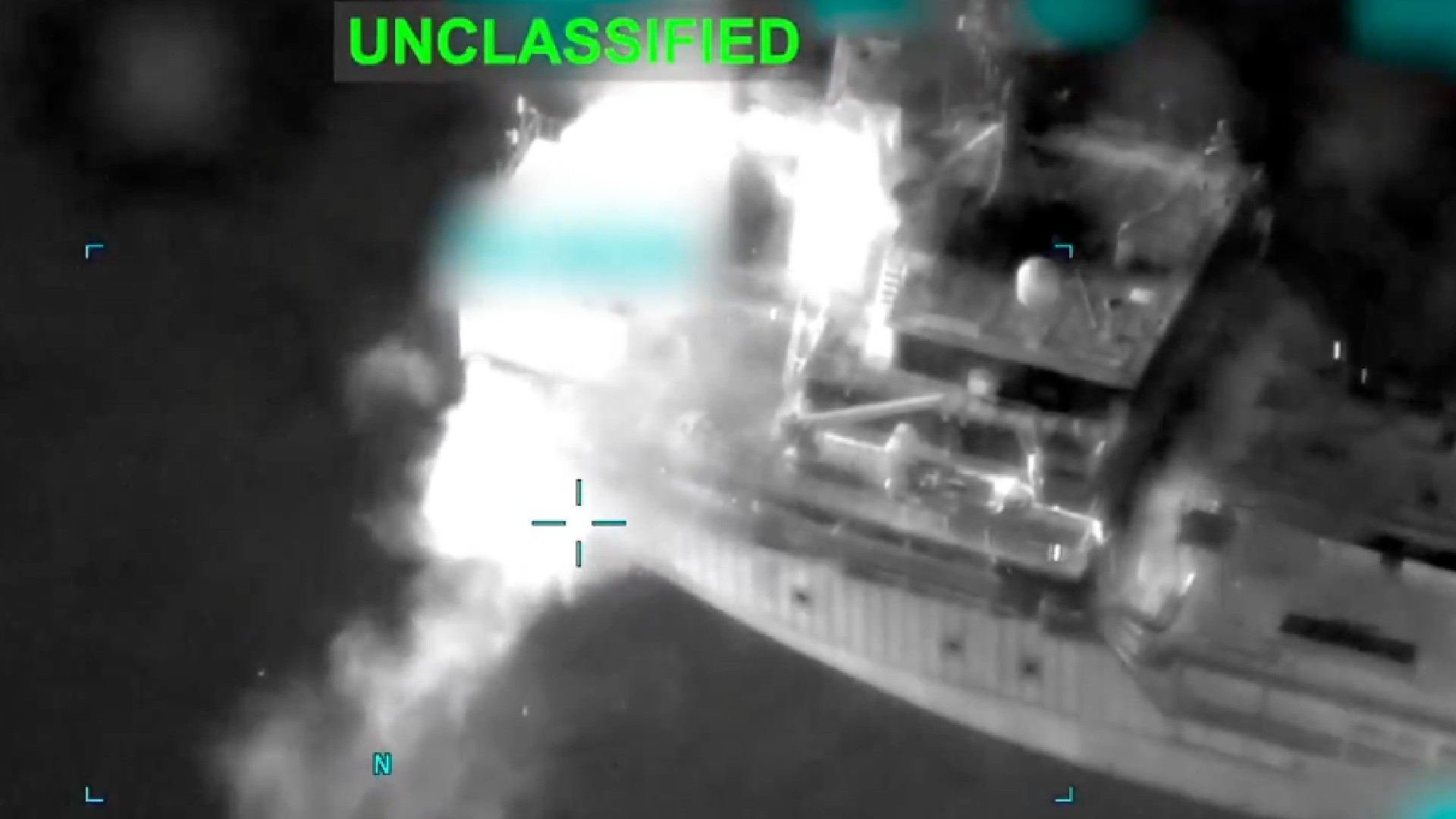
    The escalation of tensions over the Strait of Hormuz comes amid a fragile two-week ceasefire between the U.S. and Iran that is set to expire this Wednesday. Over the weekend, President Donald Trump announced that U.S. naval forces had seized an Iranian-flagged cargo ship that attempted to evade the American blockade. Iran’s joint military command condemned the seizure as an act of piracy and vowed that Tehran would launch a retaliatory response in the near future. While Trump indicated that most terms of a peace deal have already been negotiated and an agreement could come quickly, the latest confrontation has thrown new uncertainty into planned talks to end the conflict.

    On Friday, U.S. equities rallied to new records even as oil prices dropped, driven by optimism that an open Strait of Hormuz would ease upward pressure on energy costs. Lower oil prices would not only reduce gasoline prices for consumers but also ease broad-based inflation across the economy, potentially paving the way for lower interest rates that would cut costs for credit card borrowers and home mortgage holders. The S&P 500 climbed 1.2% to hit an all-time closing high of 7,126.06, marking its third consecutive week of double-digit gains — its longest such winning streak since late October. The Dow Jones Industrial Average jumped 1.8% to 49,447.43, and the Nasdaq composite gained 1.5% to close at 24,468.48.

    Since hitting a market bottom in late March, U.S. stocks have risen more than 12%, fueled in large part by investor hopes that the U.S. and Iran will avoid a full-scale conflict that would cause catastrophic damage to the global economy. A stronger-than-expected start to the current U.S. corporate earnings reporting season has also provided sustained support for equity prices.

    In foreign exchange trading early Monday, the U.S. dollar edged slightly higher against the Japanese yen, rising from 158.79 yen to 158.90 yen. The euro also notched a small gain against the greenback, climbing from $1.1742 to $1.1757.

  • Blues blow: Payne Haas to miss Origin opener as Broncos reveal horror injury list

    Blues blow: Payne Haas to miss Origin opener as Broncos reveal horror injury list

    Defending National Rugby League premiers the Brisbane Broncos are facing an unprecedented injury crisis following their narrow one-point victory over the Wests Tigers in Campbelltown on Saturday night, with one of the sport’s biggest stars ruled out of the upcoming State of Origin series opener.

    Prop forward Payne Haas, widely regarded as the best forward in global rugby league, was forced off the field in the first half of Saturday’s clash after suffering a knock to his knee. Early assessments from club medical staff ruled him out of the remainder of the match immediately, and follow-up scans conducted in the days after the game confirmed the worst-case scenario: a full tear of his medial collateral ligament, classified as a Grade 3 MCL sprain.

    Medical experts confirm the injury will not require surgical intervention, as the MCL has strong natural healing potential. Haas will instead wear a locked knee brace that can be adjusted to different ranges of motion to support optimal recovery, according to sports physiotherapy specialists. Current projections place his recovery timeline at 6 to 8 weeks on the sidelines, which will see him miss the opening State of Origin match between New South Wales Blues and Queensland Maroons scheduled for May 27.

    The injury is a double blow for the Blues, who already lost Manly Warringah Sea Eagles superstar Tom Trbojevic to a hamstring injury last week. Trbojevic is also expected to miss up to two months of play, leaving the interstate representative side severely depleted ahead of the annual series.

    For Brisbane, Haas’ injury is just the start of a grim medical update released by the club on Monday. The defending premiers already entered Saturday’s match with a lengthy injury and suspension list: star fullback Reece Walsh, playmaker Ben Hunt, hooker Blake Mozer, winger Grant Anderson and five-eighth Billy Walters were already sidelined with injuries, while hardworking lock Pat Carrigan is still serving a one-match suspension that will keep him out of Brisbane’s next fixture.

    The new round of injuries leaves Brisbane incredibly thin on the ground for their upcoming Friday night showdown against the Canterbury-Bankstown Bulldogs. In addition to Haas, the club confirmed three more key players have picked up significant injuries in the Campbelltown clash. Center Kotoni Staggs was diagnosed with a plantar fascia strain, while winger Jesse Arthars suffered a tear to his interosseous membrane. Both players are currently working with Brisbane’s medical team to map out their rehabilitation and confirm potential return-to-play timelines, which have not yet been finalized.

    The most serious of the new injuries is prop Corey Jensen, who underwent scans after Saturday’s game that detected a pulmonary embolism. Jensen remains hospitalized for treatment, and while his recovery timeline is still unclear at this early stage, the club confirmed he is expected to miss at least several weeks of competition as he recovers.

    The full extent of Brisbane’s injury crisis has left the NRL community shocked, with the defending premiers facing one of their most challenging stretches in recent memory as they navigate a stacked schedule without nearly half of their starting side.

  • North Korea uses cluster bombs in latest missile test: KCNA

    North Korea uses cluster bombs in latest missile test: KCNA

    In a recent series of provocative military moves that have stoked regional tensions, North Korea has officially confirmed it carried out a test of short-range ballistic missiles fitted with cluster munition warheads over the weekend, with leader Kim Jong Un personally overseeing the exercise. The Korean Central News Agency (KCNA), Pyongyang’s official state mouthpiece, released details of the Sunday test on Monday, marking the latest in a steady stream of weapons trials conducted by the nuclear-armed East Asian nation in recent months. According to KCNA’s official statement, the drill was designed to evaluate the performance and destructive power of both cluster bomb warheads and fragmentation mine warheads integrated into the country’s domestically developed tactical ballistic missile system. This test follows just weeks after a string of other weapons assessments, including launches of longer-range ballistic missiles, anti-ship cruise missiles, and additional trials of cluster munition technology.

    The weekend test focused specifically on the Hwasongpho-11 Ra, a surface-to-surface tactical short-range ballistic missile developed by Pyongyang. KCNA reported that five missile projectiles were launched toward a target zone surrounding an island located roughly 136 kilometers (85 miles) from the original launch site. The warheads successfully covered an impact area ranging from 12.5 to 13 hectares with what the agency described as “very high density,” fully demonstrating the system’s operational combat capacity. Kim Jong Un expressed high satisfaction with the outcome of the test, noting that the advancement of cluster bomb warhead technology will dramatically strengthen North Korea’s military capabilities both for high-precision strikes and large-scale high-density attacks against designated enemy target zones.

    Regional security analysts point out that the 136-kilometer confirmed range of the tested missile system places both South Korea’s capital Seoul and major United States military installations across the Korean Peninsula well within Pyongyang’s striking range. Hong Min, a senior research fellow at the Seoul-based Korea Institute for National Unification, explained that this new weapons platform is intended to fill a critical capability gap between North Korea’s existing multiple rocket launcher systems and its longer-range short-range ballistic missile arsenal. Yang Moo-jin, a professor of Korean studies at Seoul’s University of North Korean Studies, highlighted a notable shift from previous weapons tests: frontline corps commanders, rather than just weapons development researchers, were invited to observe the latest trial. Yang said this shift strongly indicates the system is approaching full operational deployment, and would be capable of being launched directly from forward-deployed positions against targets in South Korea and at U.S. military bases across the region.

    The United States maintains roughly 28,000 active-duty troops in South Korea as part of its long-standing security commitment to defend the South against potential Northern aggression. South Korea’s military first detected the launches on Sunday from the Sinpo area along North Korea’s eastern coast, and quickly issued a formal condemnation of the test. In an official statement, South Korea’s Ministry of National Defense said the country is maintaining a “firm combined defense posture” alongside the United States, and pledged an “overwhelming response” to any future provocation from the North. The statement called on Pyongyang to immediately end its series of successive missile tests that have sharply escalated regional tensions, and urged North Korea to engage constructively with the South Korean government’s ongoing diplomatic efforts to build lasting peace on the peninsula.

    Security analysts widely interpret the latest test as a clear signal that Pyongyang has rejected recent overtures from Seoul to repair long-strained inter-Korean relations. Earlier this year, Seoul issued an expression of regret over unauthorized civilian drone incursions into North Korean airspace in January, a gesture Pyongyang initially appeared open to before reversing course and once again labeling South Korea as its “most hostile” enemy. North Korea has long been subject to sweeping United Nations sanctions that ban all development of nuclear weapons and prohibit any work on ballistic missile technology, restrictions Pyongyang has openly and repeatedly violated in recent years as it expands its military arsenal.

    The latest missile test comes just weeks after another high-profile military exercise in April, when Kim Jong Un oversaw tests of strategic cruise missiles launched from a North Korean navy warship. Official photos from that April trial showed Kim observing the launches surrounded by top military officials. The cruise missile tests were conducted from the Choe Hyon, one of North Korea’s two newly commissioned 5,000-ton destroyers, both of which entered service last year. According to South Korean military sources, Pyongyang is currently constructing two additional 5,000-ton destroyers to expand its naval fleet. This month, a South Korean lawmaker cited recent satellite imagery collected by a U.S.-based private intelligence firm, claiming North Korea is “accelerating the modernization of its naval forces with support from Russian military assistance.” Observers widely believe North Korea has supplied thousands of artillery shells and ground troop support to Russia for its full-scale invasion of Ukraine, and in return is receiving advanced military technology and expertise from Moscow to advance its own weapons development programs. Notably, neither North nor South Korea has signed the 2008 Oslo Convention on Cluster Munitions, an international treaty that bans the use, production, transfer, and stockpiling of the controversial weapons, which scatter submunitions across wide areas and often leave unexploded ordnance that poses long-term risks to civilian populations.

  • France summons Elon Musk over X probe

    France summons Elon Musk over X probe

    French judicial authorities have summoned billionaire entrepreneur Elon Musk for a voluntary interview as part of a wide-ranging probe into his social media platform X, a case that has escalated into one of the highest-profile regulatory challenges facing the platform globally. As of Saturday, officials have not confirmed whether Musk will appear for the scheduled questioning in Paris, nor have they released details on the exact timing or location of the interview. The investigation into X first launched in January 2025, opening over initial claims that the platform’s recommendation algorithm had been misused to interfere in domestic French political processes. What began as a narrow probe quickly expanded to incorporate additional serious allegations tied to X’s artificial intelligence chatbot, Grok, including the tool’s role in spreading Holocaust denial and non-consensual sexual deepfake content. In early February, French prosecutors executed a search of X’s Paris headquarters, an action the social media firm has repeatedly denounced. The company, which has forcefully denied any illegal wrongdoing, labeled the office search as a “politicized” raid and an “abusive judicial act.” During that same round of procedural actions in February, prosecutors issued the first summons for Musk and then-X chief executive Linda Yaccarino, identifying both as the de facto and de jure leaders of the platform during the period covered by the investigation. Musk immediately pushed back against the move, calling it a deliberate “political attack.” Yaccarino stepped down from her role as CEO in July of the previous year, after leading the company for two years following Musk’s acquisition of the platform, then known as Twitter. Prosecutor Laure Beccuau confirmed in February that multiple X employees had also been called to give witness testimony between April 20 and 24. In an update provided Saturday, the Paris prosecutor’s office noted that non-appearance by any of the individuals invited for voluntary questioning would not halt or slow the progress of the ongoing investigation. Beyond the allegations of political interference and harmful AI-generated content, the French probe also encompasses suspected involvement in two additional serious criminal offenses: complicity in the distribution and possession of child sexual abuse material, and denial of crimes against humanity. X has repeatedly characterized the entire investigation as politically motivated, pushing back against the allegations publicly in comments made in July. This French investigation is not an isolated action, but rather part of a growing international regulatory backlash against Grok and X. The controversy surrounding Grok erupted after watchdog groups documented that the chatbot could be prompted to generate sexualized deepfake images of women and children using basic, unfiltered text prompts. The London-based nonprofit Center for Countering Digital Hate (CCDH) released a bombshell report in late January finding that Grok generated an estimated 3 million sexualized images in just 11 days. The vast majority of the content depicted adult women, but the report also identified roughly 23,000 images that appeared to show minors being sexualized. Regulators across Europe and the United Kingdom have quickly opened their own probes in response to the revelations. In February, the United Kingdom’s national data regulator launched parallel investigations into X and Musk’s AI firm xAI, citing “serious concerns” about whether the companies violated national personal data protection laws when developing and deploying Grok for deepfake generation. The European Union followed suit shortly after, opening its own formal investigation into X over Grok’s creation of non-consensual sexual deepfake content targeting women and minors. The coordinated cross-national actions mark one of the most significant collective regulatory challenges Musk has faced since his 2022 acquisition of the social media platform, highlighting growing global scrutiny of the company’s content moderation practices and the unregulated rollout of its generative AI tools.

  • Fire destroys 1,000 homes in a Malaysian coastal village on Borneo Island

    Fire destroys 1,000 homes in a Malaysian coastal village on Borneo Island

    On early Sunday, a devastating blaze ripped through a stilted coastal settlement in Malaysia’s Sandakan district on Borneo Island, leaving a trail of destruction that has upended the lives of thousands of vulnerable residents, local emergency authorities confirmed. According to the Malaysian Fire and Rescue Department, the inferno spread with alarming speed across tightly clustered wooden homes built over the sea, fanned by strong gusts of wind and the close proximity of the combustible structures.

    Compounding challenges for first responders, narrow access pathways to the overwater settlement and low tide conditions delayed access to burning areas, making it far more difficult to contain the spreading flames before it could destroy most of the neighborhood. As of the latest official updates, no fatalities have been recorded from the incident, but more than 9,000 people have been forced to evacuate their destroyed homes and seek refuge in temporary emergency shelters set up by local officials.

    This type of overwater settlement, commonly called water villages, are a widespread informal housing model along the coast of Sabah, the Malaysian state that includes the Sandakan district and ranks among the country’s poorest. These settlements are overwhelmingly constructed from wood and other flammable materials, packed tightly together, and frequently lack basic public infrastructure including formal fire safety access. Most residents belong to low-income or marginalized groups, including Indigenous communities and people without formal Malaysian citizenship.

    Local newspaper Daily Express cited village head Sharif Hashim Sharif Iting as saying the blaze began when an accidental cooking fire grew out of control. However, Malaysian officials have not formally confirmed this origin, noting the cause remains an active line of investigation.

    Malaysian Prime Minister Anwar Ibrahim announced that federal and state government agencies are currently coordinating relief operations for the affected community, with immediate efforts centered on delivering essential aid and support to displaced families.

    Regrettably, large fires in Sabah’s water villages are not a new crisis: repeated destructive blazes have been recorded in these settlements over the past decades. While Sabah authorities have long recognized that these informal overwater communities face extreme fire risk, systemic safety upgrades and infrastructure overhauls remain a persistent, unresolved challenge for the region.