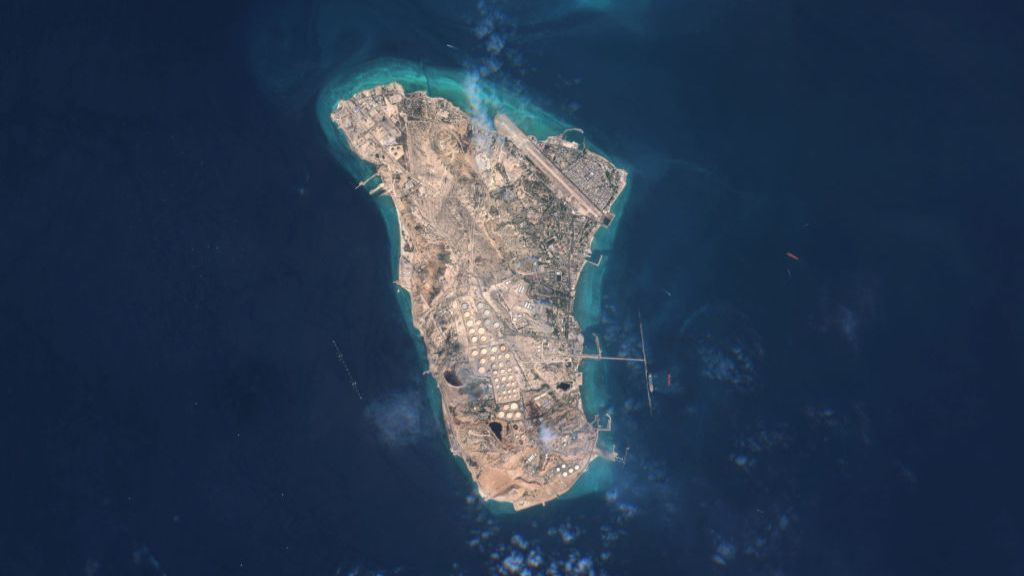
More than three months into open conflict between the United States and Iran, the strategic Persian Gulf outcrop of Kharg Island has reemerged as a critical flashpoint, driven by shifting public rhetoric from former President Donald Trump over potential seizure of the facility that underpins Iran’s entire oil export economy.
In an early Thursday post on his Truth Social platform, Trump escalated aggressive rhetoric against Tehran, claiming the US would seize Kharg Island and other key Iranian oil infrastructure assets in the “not too distant future,” assuming full control over Iran’s entire oil and gas markets. He even suggested a major strike on Iran could come that same night. Hours later, however, during an interview on Fox News, the president softened his stance, clarifying that seizing the strategic terminal has long been his “preference” — a move he claimed would generate massive economic profit for the US — but he acknowledged doubts that the American public has the “stomach” for a large-scale ground operation, and ruled out deploying American boots on the ground. Shortly after that interview, Trump announced he was canceling planned airstrikes on Iran, citing incremental progress in ongoing negotiations with Tehran.
This is not the first time Trump has publicly floated seizing Kharg Island. Two months ago, shortly after the outbreak of US-Iran hostilities, Trump first stated he wanted to take control of Iran’s oil reserves and was actively evaluating a plan to seize the island. On March 13, US forces launched large-scale airstrikes across Kharg Island, with Trump claiming American warplanes had “totally obliterated” every military target on the outcrop, but deliberately held off on striking the island’s critical oil processing and export infrastructure.
Located just 15 nautical miles off Iran’s southern coast, Kharg Island is far more than a small rocky outcrop: it is the undisputed economic lifeline of Iran. Ninety percent of Iran’s total crude oil exports pass through the island’s purpose-built terminal, pumped via underwater pipelines from mainland oil fields and loaded onto ultra-large crude carriers capable of carrying up to 2 million barrels of oil. Unlike Iran’s shallow mainland coast, Kharg Island’s proximity to deep Gulf waters allows these massive vessels to dock directly at its long jetties, from which they transit through the Strait of Hormuz to the island’s largest export market, China. Beyond national revenue, the terminal also provides a critical stream of income to the Islamic Revolutionary Guard Corps (IRGC), the Iranian military and paramilitary force leading much of the country’s combat operations.
Speculation about a potential US ground operation to seize the island has circulated for months. In a March interview with the *Financial Times*, Trump reiterated his interest in seizing the facility, noting “we could take it very easily” because he did not believe Iran had sufficient defenses to repel a US attack, but acknowledged that any long-term occupation would require a sustained US military presence. Multiple sources confirmed to CBS News, the BBC’s US partner, that Pentagon planners have already drafted detailed contingency plans for deploying ground forces to Kharg Island. While both the Pentagon and White House have refused to publicly comment on specific deployment plans or operational timelines, they have repeatedly confirmed that a ground seizure remains an active military option on the table.
Security analysts agree that seizing Kharg Island would deliver a devastating blow to Iran’s war capacity. As BBC Security Brief analyst Mikey Kay explains, taking control of the terminal would effectively cut off a core economic lifeline for the IRGC, severely restricting the organization’s ability to fund and sustain ongoing combat operations. Beyond crippling Iranian oil exports, a US seizure would also give the American military a strategic forward operating base from which to launch additional strikes against targets on the Iranian mainland, and could provide Washington with critical leverage to force Tehran to keep the Strait of Hormuz open to global commercial shipping.
That said, military analysts warn that any attempt to seize and hold the island would face significant operational challenges. Aaron Maclean, national security analyst for CBS News and host of the *School of War* podcast, notes that any US landing force would need to travel long distances to reach the island, whether via naval amphibious assault or airborne insertion, creating exposed vulnerability before troops can secure a beachhead.
Iranian officials have issued stark public warnings about any attempt to seize the island or attack Iran’s energy infrastructure. Parliament Speaker Mohammad Bagher Ghalibaf has stated that Iranian forces are “waiting for American soldiers” and would “rain fire” on any invading ground force. A senior Iranian military official also told local media that Iran would target all commercial shipping in the Red Sea in the event of a US ground invasion.
In response to persistent threats of attack and seizure, Iran has significantly reinforced its defenses on Kharg Island in recent months, US intelligence sources confirmed to CNN. Tehran has deployed additional military personnel and advanced air defense systems to the outcrop, including shoulder-fired surface-to-air missiles, and has laid extensive underwater traps surrounding the island, including anti-personnel and anti-armor mines to repel amphibious landings.
Trump has repeatedly stated he has held off on targeting the island’s oil export pipelines to avoid long-term damage to Iran’s civilian economy, telling reporters in mid-March that “we can do that on five minutes’ notice. It’ll be over. Just one simple word, and the pipes will be gone too. But it’ll take a long time to rebuild that.”
Following the March 13 airstrikes, US Central Command (Centcom) confirmed that its forces had targeted more than 90 separate Iranian military sites on the island, including naval mine storage facilities, missile bunkers, and other military installations, while deliberately preserving all oil infrastructure. Iranian state media corroborated that the terminal’s critical oil export facilities suffered no damage, noting that strikes were limited to air defense positions, a naval base, an airport control tower, and a helicopter hangar. Ehsan Jahanian, political deputy to the governor of Iran’s Bushehr province, told the IRGC-affiliated Tasnim News Agency that oil exports continued uninterrupted immediately after the strike. Iranian military officials issued a stark warning after the attack: any strike on Iranian energy infrastructure would result in the immediate destruction of all oil and energy assets belonging to companies working with the United States across the region. The US conducted a second round of airstrikes on Kharg Island’s military targets in early April, again holding off on striking oil and gas infrastructure, and Iranian state media reported that the terminal’s critical maritime export facilities suffered only minimal damage.
Analysts warn that any large-scale US operation to destroy or seize Kharg Island’s oil infrastructure would represent a dramatic escalation of the conflict, with massive global consequences. A successful seizure or destruction of the terminal would immediately take most of Iran’s oil exports off the global market, sending already elevated international crude prices soaring even higher. It would also almost certainly prompt Iran to expand its ongoing drone campaign against Gulf Arab states and commercial shipping, potentially striking critical civilian infrastructure including desalination plants that supply drinking water to millions of people across the Gulf region.