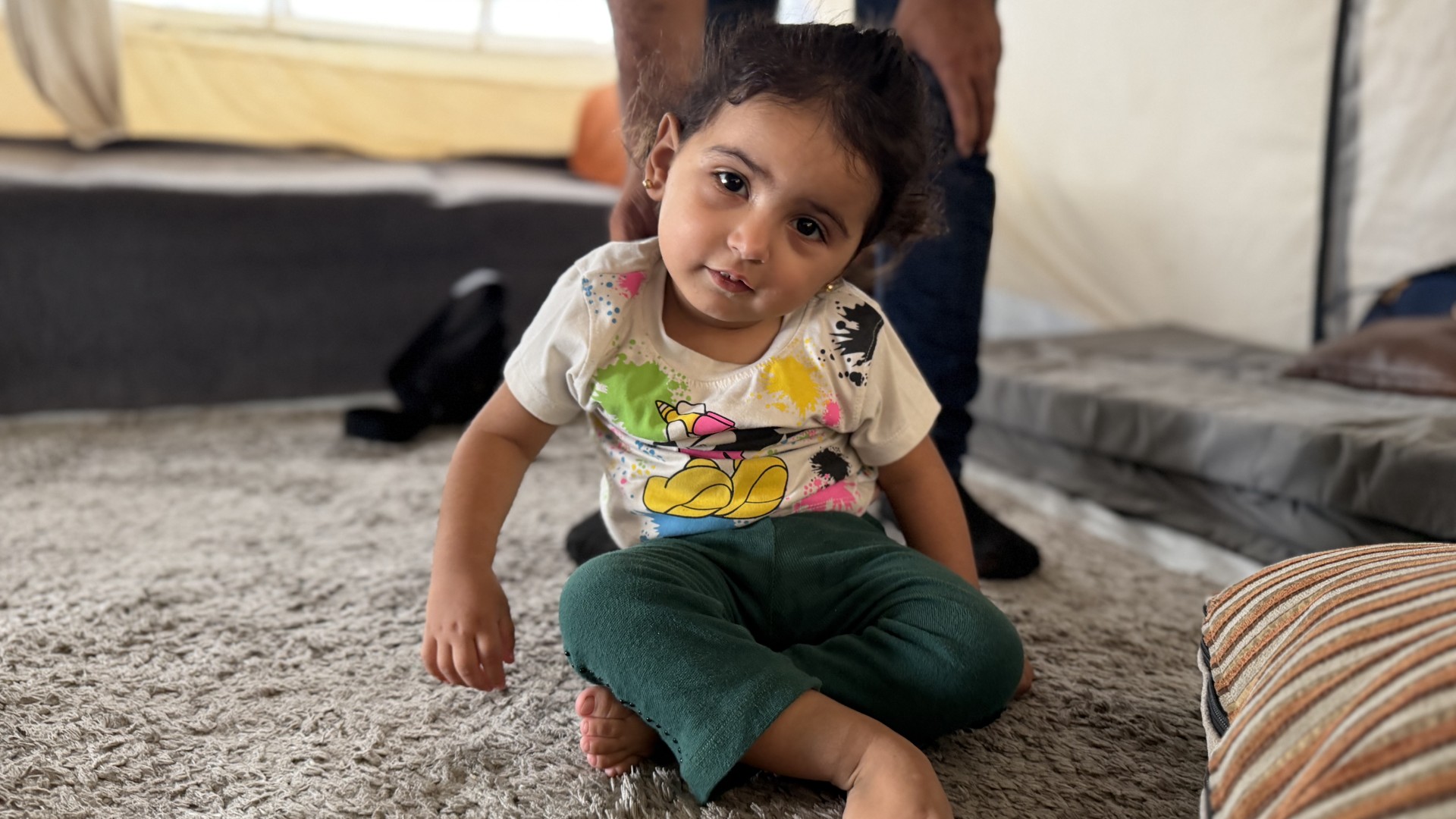
On the eve of the October 2023 outbreak of war in Gaza, Palestinian mother Samar Hammad welcomed her youngest daughter into the world. She named the baby Nour – Arabic for “light” – a name filled with quiet hope for a new life. What Hammad could never have foreseen in that moment was that just hours after her daughter’s birth, this tiny child would be thrown into a fight for survival, caught in the collapse of Gaza’s healthcare system under Israeli military advance.
Nour was born perfectly healthy, Hammad recalled in an interview with Middle East Eye from her displacement tent in central Gaza City. Barely hours after the new mother and baby returned home, Israeli bombardment hit near their neighborhood, damaging a nearby building. Within a day, Nour began slipping into unconsciousness. With her condition worsening by the minute, Hammad rushed the newborn to al-Nasr Children’s Hospital in Gaza City. Doctors quickly delivered a grim diagnosis: Nour was suffering life-threatening complications from inhaling toxic gases released by the nearby bombing, and she was dying.
As Israeli forces pushed deeper into Gaza, intense fighting closed in around al-Nasr, one of the first medical facilities targeted by the Israeli military. For more than a month, Nour lay in a hospital incubator, repeatedly losing oxygen as constant shelling cut off power and supplies to the facility. “The shelling was relentless,” Hammad said. “Nour was in an incubator with several other newborns. She repeatedly lost oxygen and had to be resuscitated.” At one point, doctors told Hammad there was nothing more they could do – the life support machines keeping Nour alive were only postponing the unavoidable.
In her desperation, Hammad begged staff to let her hold and breastfeed her dying daughter. After repeated requests, the medical team relented. Within minutes of being held in her mother’s arms, Nour’s vital signs began to improve. “The machines started showing a response,” Hammad said. “The doctors were shocked. They told me it was like a miracle.”
As Israeli forces surrounded the hospital, staff ordered all parents of incubator newborns to evacuate, assuring them their infants would remain protected. Every other mother fled south, leaving their babies behind. But Hammad refused. “I told the doctors I couldn’t leave my daughter behind,” she said. After more urgent pleas, doctors agreed to release Nour into Hammad’s care, warning that Israeli troops were advancing rapidly and the choice put both their lives at risk. “They gave her to me at my own responsibility,” Hammad recalled. “I carried her and walked out.” She fled al-Nasr on 9 November 2023.
Later that same day, Israeli forces struck the hospital and cut off oxygen to the neonatal intensive care unit. The following day, all staff were ordered to evacuate, forcing them to abandon non-transferable infants who relied on incubators and life support to survive. Israeli troops occupied the hospital for roughly three weeks. When medical workers returned during a temporary ceasefire on 28 November, they found four incubator babies dead. Nour was the only known survivor from the neonatal ward – saved by her mother’s refusal to leave her behind.
But survival only marked the start of a new, endless ordeal for Hammad and Nour. After escaping al-Nasr, Hammad carried her limp newborn from one damaged medical facility to the next seeking care, before becoming trapped in a school-turned-shelter for displaced people amid intensifying fighting. “She cried constantly,” Hammad said. “People would tell me to make her stop because the tanks were surrounding us, and they were afraid soldiers would hear her.”
Eventually, the pair reached al-Ahli Arab Hospital (commonly called Baptist Hospital), where a CT scan revealed Nour had developed brain calcification. Doctors told Hammad the condition was most likely caused by inhalation of phosphorus gas from the bombardment, and that Nour would require ongoing, intensive physiotherapy to recover. For six months, Hammad brought Nour for daily treatment at Gaza City’s al-Wafa Hospital, clinging to the hope that therapy would reverse the damage.
Securing medical care was only one layer of the daily struggle. Like tens of thousands of Gaza families trapped under siege, Hammad faced the constant threat of hunger and thirst. After the 7 October 2023 attacks, then-Israeli Defence Minister Yoav Gallant announced a “complete siege” of Gaza, promising “no electricity, no food, no water, no fuel” would enter the enclave. While Gaza had been under an Israeli blockade since 2007, this total restriction cut off all essential supplies, triggering catastrophic shortages that pushed the region’s already crumbling healthcare system to total collapse and worsened an already catastrophic humanitarian crisis. Multiple human rights organizations have concluded that Israel has used mass starvation as a weapon of war and a tool of forced displacement, designed to push civilians out of northern Gaza. By late 2025, the Palestinian Ministry of Health recorded at least 453 Palestinian deaths from severe malnutrition in Gaza – 150 of them children.
“I would walk for hours, sometimes up to seven hours every day, searching for water,” Hammad said. On one of these treks, carrying an empty bottle across bombed-out streets, an elderly displaced man saw her desperation. Three hours later, he found her again and secretly filled her bottle from his own family’s limited reserve. “Water was extremely scarce and almost unavailable; the man had to hide the water bottle in his clothes to secretly fill it,” Hammad said. “As soon as I got the water, I prepared her milk. She drank it and finally fell asleep after hours of crying and inability to sleep.”
Despite the constant danger and deprivation, Hammad refused to flee south. Reports of systematic abuse against displaced Palestinians at Israeli military checkpoints left her too terrified to attempt the journey, and she feared Nour’s fragile health would not survive the trip. Slowly, as Nour began to move her limbs and grasp small objects, Hammad allowed herself a sliver of hope. “She was improving, but the doctors told me she needed to be urgently evacuated for treatment abroad, which was nearly impossible at the time,” she said.
In December 2024, Hammad heard that a respected paediatrician at northern Gaza’s Kamal Adwan Hospital might be able to help Nour. She risked her life to travel to the facility, only to find the doctor was overwhelmed by a flood of injured patients. Staff told her to return two days later for an appointment – but when she came back, Israeli forces had stormed the hospital and detained the doctor, Dr Hussam Abu Safiya. According to his legal team, Abu Safiya has been subjected to repeated torture in detention, lost 40 kilograms, suffered severe health decline, and has recently been moved to solitary confinement.
Hammad has continued to fight to secure Nour a spot for evacuation for specialist treatment abroad, but Israel’s strict blockade keeps almost all Palestinians trapped in Gaza. Nour was officially approved for medical transfer to Italy, but like tens of thousands of other critically ill Gaza patients, she has spent months stuck on a waiting list. The Palestinian Ministry of Health reports that at least 17,757 people requiring urgent life-saving care abroad have received official medical referrals, including roughly 4,000 children. Severe Israeli restrictions mean the vast majority will never leave.
Though Israel agreed to a limited reopening of the Rafah crossing with Egypt in February 2026, allowing up to 50 patients per day to exit Gaza, only 1,204 patients had been evacuated through Rafah and the Kerem Shalom crossing by 20 May. After more than two and a half years of fighting for Nour’s life, Hammad says her daughter’s future now hinges on a decision she can never control.
“I have managed to rescue Nour from imminent death in the incubator, found water and milk for her during the harshest times, and took her to hospitals for physiotherapy throughout two years of genocide,” Hammad said. “Now her health is hanging on an Israeli permit that would determine whether she can improve or remain disabled for the rest of her life.”