作者: admin

  • Queensland Police recall service-issued Glock handguns after major safety malfunction detected

    Queensland Police recall service-issued Glock handguns after major safety malfunction detected

    Queensland Police Service (QPS) has announced a full recall of every service-issued Glock handgun across the entire state for urgent safety testing, after a potentially dangerous malfunction was uncovered during routine proactive weapons inspections. The safety review of the QPS’ entire firearms fleet was already in progress when inspectors identified the defect: under specific conditions, the weapon can discharge multiple rounds with a single trigger pull, a flaw that puts both officers and members of the public at unnecessary risk.

    In an official public statement, QPS confirmed that it has moved to accelerate expanded testing across every regional command and operational division, prioritizing the recall to guarantee that all weapons in active use meet mandatory safety standards. At the time of the announcement, the service stressed that no operational accidents or injuries have been linked to the weapon defect to date.

    The recall process will see all issued handguns collected for comprehensive testing. Firearms that pass the rigorous new inspection regime will be returned to frontline officers for active duty. Any weapons that fail to meet QPS safety requirements will be immediately withdrawn from service and retained by authorities. QPS added that it is already collaborating directly with Glock suppliers to develop a full resolution for the identified issue, aiming to restore the full complement of service weapons as quickly and safely as possible.

  • ‘Catastrophic’ Melbourne Airport near-misses only avoided by ‘good luck’ after international airliners take off metres from active worksite

    ‘Catastrophic’ Melbourne Airport near-misses only avoided by ‘good luck’ after international airliners take off metres from active worksite

    Australia’s aviation sector has been forced to confront critical gaps in safety protocols after a long-awaited official investigation concluded that two alarming near-collisions at one of the country’s busiest international hubs avoided catastrophe last year through nothing more than sheer good fortune. The Australian Transport Safety Bureau (ATSB) released its final public report on Thursday, detailing the two separate September 2023 incidents that unfolded at Melbourne Airport, Victoria’s primary international gateway, when runway construction work left a section of the takeoff strip drastically shortened.

    The first incident occurred on September 7, when a Malaysia Airlines wide-body Airbus A330-300, bound for Kuala Lumpur with hundreds of passengers on board, exited the usable length of the temporary runway during its departure takeoff roll. After overshooting the marked end of the available runway, the large commercial jet climbed just 7 meters above an active construction worksite, where heavy machinery and ground personnel were working below.

    In response to this first close call, Melbourne Airport leadership launched an internal risk review and implemented incremental safety adjustments, including updating internal communication protocols and issuing a general safety alert to all airlines operating at the facility. But just 11 days later, a second nearly identical incident unfolded: a Bamboo Airways Boeing 787-9 en route to Hanoi also overran the same shortened runway, clearing the construction site by an even slimmer margin of only 5 meters.

    In its official statement accompanying the final report, the ATSB confirmed that on both occasions, powerful jet blast from the departing aircraft directly impacted the active work zone, where workers and heavy vehicles were present. While no ground personnel suffered physical injuries in either incident, one worker developed a stress-related injury following the second close call.

    Investigators found that information about the reduced runway length had been correctly distributed to the aviation community, including being broadcast over radio frequency and included in routine Automatic Terminal Information Service (ATIS) updates received by both flight crews. However, ATSB Chief Commissioner Angus Mitchell explained that neither flight crew recognized just how drastically the runway’s usable length had been reduced. “While both crews accessed a version of the ATIS that mentioned the shortened runway, they only noted to air traffic control the weather information from the ATIS, and not the reduced runway length,” Mitchell said.

    Further investigation revealed that while flight dispatchers at both airlines had adjusted their performance calculations to account for the shorter runway, the adjustment was not explicitly flagged in the pre-flight briefing materials provided to the operating crews. The ATSB noted this oversight was likely rooted in the fact that both aircraft were fully capable of departing safely from the shortened runway if correct power settings were applied. Nonetheless, the missed alert led both crews to plan their takeoffs using the original full runway length, and set reduced thrust settings for departure, resulting in the overruns.

    Legal experts have sharply criticized the systemic gaps exposed by the investigation. Peter Carter, director of Australian law firm Carter Capner Law, emphasized that the incidents exposed basic failures in core aviation safety procedures. “These are basic requirements even for day one students,” Carter said, noting that pilots are obligated to review NOTAMs (notices to airmen) and cross-check all ATIS safety information before departure. He added that a catastrophic collision would have killed more than 350 passengers and crew, along with any workers on the ground, and left a permanent stain on Australia’s already-tarnished aviation safety record. “A catastrophic event was avoided only by good luck,” Carter said. “It could have resulted in a 350-person fireball.”

    In the wake of the ATSB’s findings, both Malaysia Airlines and Bamboo Airways have committed to updating their internal flight dispatcher procedures and pre-flight briefing guidance to prevent similar oversights. Australia’s national air navigation provider Airservices Australia and the country’s civil aviation regulator Civil Aviation Safety Authority (CASA) have also proposed revisions to protocols for communicating safety-critical information related to runway construction projects.

    Mitchell closed by outlining long-term safety changes that could prevent similar near-misses globally, arguing that prominent visual markings, such as the signage proposed for inclusion in ICAO Annex 14, the international body’s standards for airport design, can serve as a critical final safety net to alert crews to changed runway conditions when the altered layout would otherwise look normal from the air. “Flight dispatchers, aircraft operators, airport operators, individual air traffic controllers, air traffic services providers and others can all contribute to ensuring pilots are aware of safety‑critical information when they need it,” Mitchell said.

  • Taiwan minister makes rare visit to disputed South China Sea island

    Taiwan minister makes rare visit to disputed South China Sea island

    Against a backdrop of escalating geopolitical friction across the South China Sea and adjacent waters, a senior Taiwanese official has carried out a high-profile, uncommon visit to Taiwan-controlled Itu Aba — also known as Taiping Island — to oversee regional coast guard training exercises.

    Ocean Affairs Minister Kuan Bi-ling personally oversaw two types of drills on the contested islet: humanitarian search-and-rescue operations and full-scale medical evacuation simulations. The training also included a live-interception scenario, where armed coast guard personnel responded to an unresponsive suspicious cargo vessel. Released coast guard footage shows heavily equipped special operations units breaching the vessel’s control room to secure the scene.

    Itu Aba, the largest naturally formed island in the Spratly Islands chain, spans 46 hectares and is currently home to a permanent population of roughly 200 residents. The islet hosts critical infrastructure including a working airstrip and a full-service hospital, but its status remains a flashpoint for competing territorial claims. In addition to Taiwan’s ongoing administration, Beijing, Hanoi and Manila all assert full sovereignty over the land feature.

    This visit unfolds at a moment of heightened regional military activity. At the time of Kuan’s trip, the United States and the Philippines were conducting their largest-ever joint military exercises across Philippine territory, a move that triggered sharp pushback from Beijing. In response to the US-Philippines drills, China deployed a newly commissioned amphibious warship to the South China Sea and sailed one of its active aircraft carriers through the nearby Taiwan Strait. Cross-Strait tensions also frame the dispute: China claims the self-governing island of Taiwan as an inalienable part of its territory, a position Taiwan’s government rejects outright.

    The 2016 international arbitration ruling initiated by the Philippines reclassified Itu Aba as a “rock” rather than a full island under the United Nations Convention on the Law of the Sea. This classification restricts claimed resource rights to just a 12-nautical-mile exclusive zone around the islet, instead of the 200-nautical-mile exclusive economic zone that would be granted if it were recognized as a full island. Both Taipei and Beijing rejected the ruling outright and have refused to recognize the arbitration outcome. In 2024, Taiwan’s then-foreign minister Joseph Wu issued a stark warning that China had already constructed large-scale military installations across areas surrounding Itu Aba, further shifting the regional military balance in Beijing’s favor.

  • AFL 2026: St Kilda forward Lance Collard is challenging his nine-match ban

    AFL 2026: St Kilda forward Lance Collard is challenging his nine-match ban

    An Australian Football League (AFL) player is taking one final stand to reverse what his legal team calls an excessively harsh and unprecedented suspension over an alleged homophobic slur, with his appeal hearing scheduled for Thursday evening.

    Lance Collard, a 21-year-old forward for St Kilda, was handed a nine-match ban last week after the AFL Tribunal found him guilty of conduct unbecoming. The charge stemmed from an on-field incident where he was accused of directing a homophobic slur at an opponent from the Frankston team during a match. Collard has consistently denied using the slur, claiming the word he shouted was a different insult — he says he called Darby Hipwell, his former Sandringham teammate, a “maggot”.

    This is not the first disciplinary issue for Collard: he already served a six-match suspension in 2024 for the same type of alleged homophobic slur offense. Two of the nine matches in the current ban are tied to an existing two-game suspension he received for a striking offense in the same match, meaning the new penalty for the slur itself accounts for the bulk of the suspension.

    During the original tribunal hearing, Collard’s defense led by Michael Borsky KC argued the young player was physically jostled, roughed up and subjected to verbal abuse from opposing Frankston players before the alleged incident. Borsky described the nine-match ban as unfairly punitive, warning it could be a life-altering “sliding doors” decision that would effectively end Collard’s promising AFL career, which to date includes 15 senior-level appearances. He also noted that no player in league history has ever received a suspension of this length for a homophobic slur offense, marking the penalty as unprecedented. Borsky additionally requested that any new suspension be served concurrently with the existing striking ban, given the entire incident was triggered by the initial on-field collision and subsequent melee.

    The Australian Football League Players’ Association (AFLPA) has publicly thrown its support behind Collard throughout the process, with chief executive James Gallagher releasing a formal statement last week reaffirming that backing.

    Gallagher acknowledged that the entire AFL industry shares the common goal of eliminating homophobia from the sport, but noted the case highlights critical flaws in the current disciplinary framework. “The Tribunal has, rightly, acknowledged that issues such as racism and homophobia are difficult and sensitive issues and the manner of dealing with them is not enhanced if the starting point is a fierce debate over whether the words were used,” he said.

    “Lance has maintained his innocence, and this has been consistent throughout. We’re disappointed the Tribunal did not accept that evidence. We’ll continue to fully support him and the club through this process including exploring any options to appeal.”

    Gallagher added that meaningful long-term change requires a holistic approach, not just harsh punitive measures. He argued that lasting progress requires collaborative engagement with LGBTIQA+ community leaders, targeted education that centers the diverse backgrounds and experiences of players, and a disciplinary process that is fit for purpose: one that reduces harm, remedies harm when it occurs, and drives lasting behavioral change. He noted that through collective bargaining agreements, the AFLPA has already negotiated a shared commitment with the AFL to advance equality, inclusion and safety for all people in the sport, and work on these commitments remains ongoing. He also acknowledged the far-reaching impact of the case on all stakeholders, including the LGBTIQA+ community, First Nations communities, and Collard and his family.

    The appeal hearing on Thursday will mark Collard’s final opportunity to overturn or reduce the historic ban, with the outcome set to shape not only his career but also potential future debates around how the AFL handles on-field discriminatory language. This story remains developing, with further updates expected after the appeal board delivers its decision.

  • Who are the players to watch at the NFL Draft?

    Who are the players to watch at the NFL Draft?

    The annual NFL Draft, one of American football’s most anticipated off-season events, rarely lacks unscripted drama – and the 2026 iteration, kicking off this week, is already shaping up to deliver plenty of twists alongside the high-stakes roster moves. Coming off 2025’s shocking draft slide of pre-draft favorite Shedeur Sanders, who tumbled from projected first overall to a fifth-round selection, this year’s event is already centered on a clear frontrunner for the top pick, with plenty of compelling storylines unfolding beyond that first selection.

    Spanning three days across seven rounds, the 2026 draft will see 257 collegiate and international prospects selected by the league’s 32 franchises. Selection order is determined by reversing the previous season’s win-loss standings, giving the club with the worst record the first pick, while the defending Super Bowl champion Seattle Seahawks claim the final selection in every round. This year, four teams finished the 2025 campaign with identical 3-14 records, and the Las Vegas Raiders claimed the first overall pick via a strength-of-schedule tiebreaker – a rule that slots the New York Jets, Arizona Cardinals, and Tennessee Titans in the next three spots after the Raiders.

    The Raiders hold a clear positional need at quarterback, and all signs point to them selecting Heisman Trophy winner Fernando Mendoza with the top pick. The 22-year-old signal-caller, who completed three seasons at the University of California before transferring to Indiana ahead of the 2025 collegiate season, led the Hoosiers to their first-ever national championship and capped his season with college football’s highest individual honor. If selected first overall, Mendoza will join an elite club of players that includes Cam Newton (2011) and Joe Burrow (2020), who earned Heisman honors, a national title, and the first overall draft selection in the same calendar year. Unlike last year’s draft, which saw six quarterbacks taken in the first 12 picks, 2026’s prospect class is shallow at the position. Analysts widely project Mendoza could be the only quarterback selected on the first day of the draft, with Alabama’s Ty Simpson the only other signal-caller seen as a possible first-round pick. Other notable QB prospects include Georgia transfer Carson Beck, who boosted his stock after leading Miami to the national championship game after a lackluster regular season, athletic standout Cole Payton, who is drawing comparisons to utility hybrid Taysom Hill, and 5-foot-10 Diego Pavia, who defied expectations as Vanderbilt’s Heisman Trophy runner-up and is projected as a promising late-round gamble. Unlike many top prospects, Mendoza has chosen to forgo the on-stage green room experience in Pittsburgh to celebrate the milestone with his family in Miami.

    Beyond quarterback, the 2026 draft class is deepest along the defensive front, where a host of elite prospects are expected to be selected early. Pass rushers Arvell Reese, David Bailey, and Rueben Bain Jr are all projected to come off the board within the first 10 picks, while defensive tackle Lee Hunter – nicknamed “The Fridge 2.0” – has seen his draft stock skyrocket after a strong performance and impressive interviews at the NFL Combine. The Ohio State Buckeyes, 2024 national champions, send five prospects to the top of this year’s draft board, with four expected to land in the first round. The class also features solid depth at wide receiver, led by Makai Lemon and Jordyn Tyson, while Jeremiyah Love – one of Mendoza’s fellow 2025 Heisman finalists – is the highest-rated running back available. This year’s draft also includes two pairs of non-twin brothers (Lorenzo Styles Jr and Sonny Styles, plus Logan and Spencer Fano) that could both hear their names called over the three-day event.

    A feel-good underdog story highlights this year’s international prospect cohort, which enters the draft via the NFL’s International Player Pathway (IPP) program, launched in 2017 to give non-collegiate prospects from around the globe a shot at the league. Twenty-two-year-old offensive tackle Max Iheanachor, who moved to the U.S. from Nigeria at age 13, only began playing organized football five years ago, but has already developed into a 6-foot-6, 321-pound prospect with a pre-printed tattoo of the NFL logo on his body, and is projected to sneak into the first round. Fellow Nigerian prospect Uar Bernand, a 21-year-old defensive player, also turned heads through the IPP’s 10-week training camp, posting elite testing numbers that have left scouts impressed; though he remains raw and inexperienced, one franchise is expected to take a late-round flier on him, following in the footsteps of successful IPP alums like Jordan Mailata and Travis Clayton.

    For the first time since 1948, the 2026 NFL Draft is hosted by Pittsburgh, Pennsylvania, which has rebranded itself “Picksburgh” for the week-long celebration of football. Up to 700,000 fans are expected to attend the free public event, which will host activities across the city, with the main draft stage and selection theater set up on the North Shore outside Acrisure Stadium, the home of the Pittsburgh Steelers. The first round kicks off Thursday at 8 p.m. ET (1 a.m. BST Friday), with a new rule shaving two minutes off the first-round selection clock, dropping it from 10 minutes to eight to speed up play. Rounds two and three will be held Friday, with the final four rounds concluding Saturday.

  • AFL 2026: Richmond coach Adem Yze says his side has ‘nothing to lose’

    AFL 2026: Richmond coach Adem Yze says his side has ‘nothing to lose’

    As the only side still searching for its first win after six rounds of the current Australian Football League season, the Richmond Tigers head into one of the most anticipated games on the early calendar with an unorthodox mindset: nothing to lose, everything to gain. Head coach Adem Yze, now in his third season leading the rebuilding club, has urged his young, developing squad to embrace a no-fear approach ahead of the annual ANZAC Day eve blockbuster against an in-form Melbourne side at the Melbourne Cricket Ground this Friday night.

    Melbourne enters the clash as heavy favourites, and Yze has not shied away from acknowledging the size of the challenge his team faces. Melbourne has enjoyed a strong start to the 2025 season, fresh off an upset victory over last year’s premiers that cemented their early form. The side retains a core of experienced premiership winners, complemented by emerging young talent that has filled key roles seamlessly, with their skipper hitting arguably the best form of his career to open the year.\n\n“It’s going to be a big test for us, on a big stage, against a team that’s in form – they’ve just beaten last year’s premiers,” Yze told reporters ahead of the clash. “Our boys are really looking forward to that, we’ve got nothing to lose, we’ve got some young lads playing. It’s an amazing game, we’re really privileged to be playing in it, we’ve got to do it justice.”

    To help the young Tigers rise to the occasion, Yze has confirmed a series of changes to the match-day squad that inject both new blood and much-needed veteran leadership. Two first-year players, Sam Cumming and Tom Burton, will make their senior AFL debuts on Friday night, with Yze saying he expects the pair’s high-energy running game to put Melbourne’s defenders under pressure across the entire MCG pitch. The biggest boost, however, comes from the long-awaited return of star spearhead and key leader Tom Lynch, who has been sidelined by injury in recent weeks.

    Lynch was a late omission from Richmond’s squad a week earlier, with coaching staff opting to hold him out to avoid rushing his recovery. At the time, a return would have come with just five days of recovery between his final training run and the match, so the club chose an extra week of preparation to get him fully up to speed. Now, the star forward is cleared to return, and his presence will be felt both on the scoreboard and in the young forward group that has been forced to step up in his absence.

    “(Lynch) is ready to go, he was almost ready last week and the decision was to be really cautious with him,” Yze explained. “He would’ve been coming off a five-day break if we played him last week, so we took that extra week to get another week of training in him. We’ve obviously got a really young forward line at the moment, so to have him down there is really important for leadership. But his contest and the form he was in before he hurt himself was really strong. We can’t wait to see him back out there in our colours.”

  • Nuclear energy is having a global revival 40 years after Chernobyl

    Nuclear energy is having a global revival 40 years after Chernobyl

    Thirty-eight years ago, the catastrophic 1986 Chernobyl nuclear disaster sent shockwaves across the globe, embedding deep public distrust of nuclear energy and grinding its expansion across Europe and much of the world to a near halt. Four decades on, however, the tides have turned dramatically. Once-shunned nuclear power is experiencing a widespread global resurgence, a trend that has gained unprecedented momentum from cascading geopolitical tensions, most recently the ongoing conflict in the Middle East.

    Today, more than 400 operational nuclear reactors span 31 nations, with an additional 70 new facilities actively under construction. Collectively, nuclear energy contributes roughly 10 percent of the world’s total electricity supply — accounting for one-quarter of all global low-carbon power generation. Technological advances over the past four decades have also transformed the industry: modern reactor designs incorporate far more robust safety features than the flawed units that failed at Chernobyl and Fukushima, while streamlined construction processes have driven down both building and operational costs.

    Fatih Birol, executive director of the International Energy Agency, told The Associated Press that even before the latest outbreak of Middle Eastern conflict, a nuclear rebound was already foreseeable in the wake of post-Fukushima backlash. “With the war in the Middle East, I am 100% sure nuclear is coming back,” Birol stated. “It’s seen as a secure electricity generation system, and we will see that the comeback of nuclear will be very strong, both in the Americas, in Europe and in Asia.”

    Major world powers are leading this renewed push. The United States remains the world’s top nuclear power producer, with 94 operational reactors generating roughly 30 percent of global nuclear electricity. Washington has set an ambitious target to quadruple its domestic nuclear capacity by 2050, with senior officials arguing that nuclear power is irreplaceable for modern energy security. “The world cannot power its industries, meet the demands of artificial intelligence, or secure its energy future without nuclear power,” U.S. Undersecretary of State Thomas DiNanno said recently.

    China, meanwhile, operates 61 domestic nuclear reactors and leads the world in new reactor construction, with nearly 40 new units underway. Beijing’s goal is to overtake the U.S. to become the world’s largest nuclear power producer by total installed capacity. Across East Asia, Japan has already restarted 15 idled reactors following comprehensive post-Fukushima safety overhauls, with another 10 awaiting final regulatory approval to come back online.

    In Europe, the 2022 Russian invasion of Ukraine triggered a continent-wide reckoning with energy dependence, and the Middle East conflict has further underscored the risks of reliance on imported fossil fuels. European Commission President Ursula von der Leyen has publicly characterized Europe’s decades-long retreat from nuclear power as a “strategic mistake,” and the EU now classifies nuclear as a core clean energy source alongside wind and solar to meet net-zero climate targets. From 30 percent of Europe’s electricity supply in 1990, nuclear’s share has fallen to roughly 15 percent today — a shift that has left the bloc vulnerable to global energy price shocks.

    “I believe that it was a strategic mistake for Europe to turn its back on a reliable, affordable source of low-emissions power,” von der Leyen said. “In the last years, we see a global revival of nuclear energy. And Europe wants to be part of it.”

    The EU is currently exploring development of Small Modular Reactors (SMRs), a next-generation design expected to enter commercial operation by the early 2030s. SMRs are marketed as cheaper, faster to build, and more operationally flexible than traditional large-scale reactors. While France, Sweden, and Finland have led pro-nuclear policy shifts within the bloc — with Belgium repealing its planned nuclear phase-out last year — other members including Germany, Austria, and Italy remain committed to phasing out nuclear power entirely. Germany completed shutdown of its last three operational reactors in 2023, a decades-long policy that current Chancellor Friedrich Merz calls irreversible, despite growing debate over potential future SMR development.

    France, which has long centered nuclear power in its national energy strategy, remains Europe’s nuclear powerhouse. Fifty-seven operational reactors across 19 plants supply nearly 70 percent of the country’s total electricity, a share that has remained consistent even after the Chernobyl disaster. In 2022, President Emmanuel Macron unveiled plans to build six new pressurized water reactors, as part of the country’s goal to cut greenhouse gas emissions and strengthen energy independence. Nicolas Goldberg, a partner at Paris-based energy consultancy Colombus Consulting, noted that the 2022 European gas crisis triggered by the Ukraine conflict reinforced Paris’s commitment to its existing fleet. “The COVID-19 pandemic, combined with the gas supply crunch triggered by the conflict in Ukraine, revealed the limits of deploying renewable electricity and Europe’s dependence on gas,” Goldberg explained. “France has therefore been reinforced in its strategy of maintaining its existing nuclear plants, which means extending their lifespan as much as possible.”

    Russia has also positioned itself as a global leader in nuclear technology exports, even as it expands its own domestic fleet. Currently, Moscow has 34 operational domestic reactors, eight of which are the same RBMK design that exploded at Chernobyl’s Reactor No. 4 in 1986, when Ukraine was still part of the Soviet Union. All RBMK reactors still in operation have undergone extensive safety retrofits to correct the inherent design flaw that, when combined with operator error, caused the 1986 disaster that spread radioactive contamination across much of Northern Europe. Today, Russia is actively building 20 new reactors across Europe, Africa, Asia, and the Middle East, with contracts for additional projects in the pipeline. It has already completed the first new reactor for neighboring Belarus, one-third of whose territory was contaminated by the Chernobyl disaster. Irina Sukhiy, founder of Belarusian environmental group Green Network, criticized Minsk’s embrace of new nuclear development, saying authorities are using the global nuclear revival to avoid addressing ongoing contamination harms to local communities.

    Even in Ukraine, where the Chernobyl disaster occurred, nuclear power remains a critical part of the national energy mix, generating roughly half of the country’s electricity. Ukrainian nuclear facilities have taken on outsized importance since Russia’s 2022 full-scale invasion, even amid ongoing safety risks including Russia’s occupation of the Zaporizhzhia Nuclear Power Plant and a 2024 drone attack on the Chernobyl site’s containment sarcophagus.

    Across the African continent, only South Africa currently operates a nuclear power plant, but that is set to change: Russia is constructing Egypt’s first nuclear facility, and multiple other African states are exploring their own nuclear development projects.

    Rafael Grossi, director general of the International Atomic Energy Agency, framed the global nuclear revival as a response to pressing shared energy and climate challenges. “The momentum we are seeing today is the result of a growing recognition that reliable, low-carbon electricity will be essential to meet the world’s rising energy demand,” Grossi said.

  • European Union ramps up crisis testing, convinced that Trump’s security priorities lie elsewhere

    European Union ramps up crisis testing, convinced that Trump’s security priorities lie elsewhere

    BRUSSELS – As European leaders grow increasingly concerned about the reliability of long-standing U.S. security guarantees for the continent under former U.S. President Donald Trump, the European Union is moving forward with expanded drills to test the bloc’s mutual defense clause that requires all 27 member states to come to one another’s aid during a crisis.

    The discussions will take center stage at a two-day EU summit kicking off Thursday in Cyprus, where heads of state will aim to finalize an operational framework to leverage the EU’s full range of military, security, trade and diplomatic resources when a member faces emergency, Cypriot President Nikos Christodoulides confirmed in an interview with the Associated Press.

    In mid-May, EU diplomatic envoys will launch table-top simulation exercises designed to walk through how the bloc’s Treaty Article 42.7 could be activated to deliver collective support to a member state targeted by invasion or armed attack — specifically, scenario planning that accounts for potential aggression from a major power like Russia. Several weeks later, EU defense ministers will run their own parallel simulation drills. Crucially, the exercises focus only on streamlining political decision-making workflows, and do not deploy active military units or mobilize on-the-ground government assets.

    To understand the purpose of these drills, it helps to compare Article 42.7 to NATO’s better-known collective security guarantee, Article 5. NATO’s core rule states that an armed attack against any single ally counts as an attack against the entire alliance, requiring a coordinated collective response that can include military action. Article 5 has only been invoked once in NATO’s 75-year history: in 2001, to back the United States following the September 11 terror attacks, a commitment that ultimately led to NATO’s 18-year, ultimately unsuccessful stabilization mission in Afghanistan.

    For its part, Article 42.7 of the EU’s founding treaties was explicitly crafted to avoid overlapping or conflicting with NATO commitments, and has only been triggered once to date. That invocation came in 2015, after Islamic State terror operatives carried out coordinated attacks across Paris that killed more than 130 people and wounded hundreds more.

    The text of Article 42.7 holds that if an EU member “is the victim of armed aggression on its territory,” all other member states are bound to provide “aid and assistance by all the means in their power.” The clause also enshrines exceptions for neutral member states such as Austria and Ireland, and requires all actions to align with the United Nations Charter and respect existing NATO obligations.

    When France called for support under the clause in 2015, EU members moved quickly to express solidarity and reallocated counterterrorism resources to help France, allowing the French government to deploy additional security forces domestically for the emergency response.

    While small-scale tests of Article 42.7 have been carried out periodically over the past 10 years, a combination of shifting U.S. policy and the war in Ukraine has added unprecedented urgency to these preparations. Doubts about the future of U.S. commitment to NATO collective defense have intensified in recent years, sparked by a series of controversial moves from Trump. One turning point came when Trump threatened to annex Greenland, the semiautonomous territory owned by NATO member Denmark. When several European countries deployed small symbolic troop contingents to Greenland to demonstrate solidarity with Denmark, Trump threatened punitive tariffs on participating nations before ultimately backing down.

    Fears were further stoked after Trump signaled openness to launching a joint military conflict against Iran alongside Israel, a move that culminated in an Iranian retaliatory strike in March targeting a British military base stationed in Cyprus — the current holder of the EU’s rotating Council presidency.

    Unlike NATO, which is structured exclusively as a collective security alliance, the EU has a far broader toolkit of response options at its disposal during a crisis, ranging from traditional military deployments to economic sanctions, enhanced border controls, trade restrictions, and visa policy changes. As ongoing conflicts in Ukraine and the Middle East continue to divert U.S. global security attention, European leaders are moving to map out exactly how these tools can be coordinated in an emergency.

    Despite the planning, significant questions remain unresolved about how the clause would work in practice. “We don’t know what is going to happen if a member state triggers this article,” Christodoulides told the AP. “There are a number of issues.”

    Menelaos Hadjicostis contributed reporting from Nicosia, Cyprus.

  • US downplays Iran’s seizure of European vessels, Hormuz brinkmanship continues

    US downplays Iran’s seizure of European vessels, Hormuz brinkmanship continues

    ### Escalating Maritime Standoff in the Strategic Strait of Hormuz
    Two months into open conflict, a tense stalemate over competing naval blockades has reignited friction between the United States and Iran in one of the world’s most critical energy chokepoints, with negotiations to end hostilities remaining deadlocked and neither side showing willingness to back down.

    On Wednesday, Iranian fast-attack craft intercepted three commercial vessels transiting the Strait of Hormuz, before escorting two of the detained ships into Iranian territorial waters. The two seized vessels are identified as the *Epaminondas*, a Greek-owned cargo ship flying a Liberian flag, and the *Francesca*, a container vessel operated by Mediterranean Shipping Company, a major shipping firm headquartered in Geneva, Switzerland.

    Iran’s operation delivered a clear message: despite repeated U.S. claims that Iran’s naval capabilities in the region have been crippled, Tehran’s small attack craft retain full operational ability to regulate and disrupt maritime traffic through the strait, a route that carries roughly 20% of the world’s daily oil trade.

    The latest seizures are a direct response to a U.S. action earlier this week, when American forces detained an Iranian crude oil tanker in the Indian Ocean that was sanctioned for allegedly smuggling Iranian oil exports. The current round of blockades dates back to February, when the Trump administration imposed a full naval blockade on Iran after Tehran seized control of key sections of the Strait of Hormuz following an attack on its assets.

    U.S. Central Command announced Wednesday that its blockade has so far blocked 29 vessels from violating the restrictions. Top Republican Senator Lindsey Graham has also hinted that the U.S. boycott of Iranian ports and commercial vessels may soon expand into a global campaign. But the Trump administration’s claims of a fully effective blockade have been called into question by maritime industry outlet Lloyd’s List, which confirmed that more than 24 commercial vessels — including multiple tankers linked to Iran — have successfully evaded U.S. warships patrolling the Gulf of Oman in recent weeks.

    In an attempt to de-escalate rhetoric and protect the fragile existing ceasefire, White House Press Secretary Karoline Leavitt downplayed the significance of Wednesday’s vessel seizures. She emphasized that the detained ships are not American or Israeli-flagged vessels, but rather two international commercial ships, so the action does not qualify as a breach of the ceasefire agreement. “The naval blockade that the U.S. has imposed continues to be incredibly effective,” Leavitt told reporters Wednesday.

    Iran has pushed back sharply on this framing, arguing that the U.S. blockade itself is a clear violation of the ceasefire. Tehran has reiterated that it will continue detaining international vessels transiting out of the Strait of Hormuz until the U.S. blockade is fully lifted. “A complete ceasefire only has meaning if it is not violated through a naval blockade,” stated Mohammad Bagher Ghalibaf, Speaker of the Iranian Parliament. “Reopening the Strait of Hormuz is not possible amid a blatant violation of the ceasefire.”

    The White House’s softening of rhetoric is explicitly aimed at preserving the fragile ceasefire that was set to expire this week. On Tuesday, U.S. President Donald Trump announced an indefinite extension of the truce, saying the move came at the request of Pakistan, which has served as a neutral mediator between Washington and Tehran. Trump explained the extension was necessary to give Iran additional time to review and respond to U.S. negotiation proposals. But Tehran has rejected this narrative, saying the U.S. has put forward unreasonable demands that are not open to compromise.

    Leavitt pushed back on media reports suggesting the White House had set a hard deadline for Iran to respond, telling journalists Wednesday: “The president has not set a firm deadline to receive an Iranian proposal, unlike some of the reporting I’ve seen today. Ultimately, the timeline will be dictated by the commander-in-chief.”

    While large-scale open fighting has halted under the ceasefire, the escalating standoff over control of the Strait of Hormuz has sparked widespread anxiety among neighboring Gulf states. Kuwait, Bahrain, Qatar and the United Arab Emirates all depend on the strait for the vast majority of their oil and gas export volumes, leaving their economies highly exposed to any prolonged disruption to maritime traffic.

    In response to reports that the UAE has requested a currency swap arrangement to shore up its dollar liquidity, Trump confirmed Tuesday that the White House is considering providing targeted financial support to the Emirati central bank. Currency swap lines allow foreign central banks to exchange their domestic currency for U.S. dollars during periods of market liquidity stress.

    On Wednesday, U.S. Treasury Secretary Scott Bessent confirmed to congressional lawmakers that the administration is weighing emergency dollar liquidity support for “many” Gulf states, including the UAE. Bessent explained that the arrangement, which functions as a short-term dollar loan, would benefit the U.S. as well by preventing disorderly sell-offs of U.S. dollar-denominated assets held by Gulf central banks. The UAE holds hundreds of billions of dollars in U.S. assets, including Treasury securities and U.S.-listed equities.

    “Swap lines, whether it’s from the Federal Reserve or the Treasury, are to maintain order in the dollar funding markets and to prevent the sale of the U.S. assets in a disorderly way,” Bessent said. “So, the swap line would benefit both the UAE and the U.S., and as I said, numerous other countries, including some of our Asian allies, have also requested them.”

  • Asian stocks retreat and oil tops $100 despite fresh records on Wall St

    Asian stocks retreat and oil tops $100 despite fresh records on Wall St

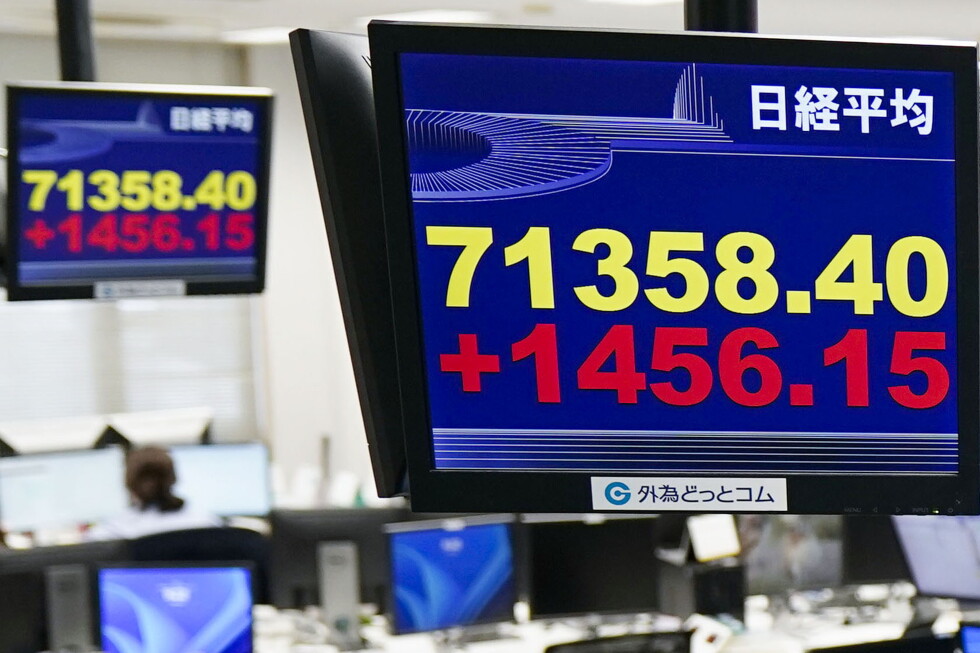
    Asian financial markets pulled back into negative territory on Thursday, erasing early session gains that had pushed Japan’s benchmark Nikkei 225 across the historic 60,000 threshold for the first time in trading history. The retreat came as growing uncertainty over the future of peace negotiations to end the ongoing Iran war drove up global crude oil prices, creating a cautious mood across international trading floors.

    The downturn in Asian markets followed a record-setting rally on Wall Street a day earlier, where strong quarterly corporate earnings lifted all three major U.S. indexes to new all-time highs. Early momentum across Northeast Asian markets had been fueled by broad buying activity in technology stocks, which pushed both Japanese and South Korean benchmarks to fleeting record peaks before selling pressure pulled them lower.

    Tokyo’s Nikkei 225 climbed as high as 60,013.90 in early trading to claim its first ever close above the 60,000 psychological mark, but ended the session down 1.5% at 58,707.60. In South Korea, the Kospi index also gave up early gains that had pushed it briefly above 6,500, closing 0.1% lower at 6,414.57. The South Korean government released upbeat first-quarter gross domestic product data Thursday morning, reporting a 1.7% year-over-year growth rate that outperformed analyst expectations, powered by strong exports driven largely by demand for semiconductors for the global artificial intelligence boom.

    Other major regional indexes also closed in negative territory: Hong Kong’s Hang Seng Index dropped 1.1% to 25,865.88, while mainland China’s Shanghai Composite fell 0.8% to 4,073.71. Australia’s S&P/ASX 200 declined 0.8% to 8,770.70, Taiwan’s Taiex sank 1.6%, and India’s benchmark Sensex lost 0.6%. U.S. stock futures also moved lower in early Thursday trading, following the previous day’s record close on Wall Street.

    The fading prospects for a peaceful resolution to the eight-week-long Iran war have emerged as a key headwind for global investor sentiment, even after former U.S. President Donald Trump extended a temporary ceasefire. There remains no clear timeline for a new round of peace talks between parties to the conflict, and recent escalations in the Strait of Hormuz have further darkened outlooks.

    On Wednesday, Iran fired on three commercial vessels transiting the Strait of Hormuz, one week after the U.S. implemented a sea blockade of Iranian ports. Iran’s Revolutionary Guard went on to seize two of the three attacked vessels, dimming already low hopes that critical global energy shipping lanes through the strait could reopen soon. Before the war began, roughly 20% of the world’s daily oil supply passed through the key chokepoint, but traffic has remained largely frozen since the conflict escalated.

    The ongoing supply disruption from the Iran war has sent global energy prices soaring, and crude benchmarks added further gains on Thursday. Brent crude, the global benchmark for oil prices, rose 1.5% to $103.39 per barrel, up from roughly $70 per barrel before the war began in late February. U.S. benchmark West Texas Intermediate crude climbed 1.8% to $94.66 per barrel.

    “As hopes for a resolution between the U.S. and Iran fade and peace talks stall, the oil market is having to reprice expectations,” ING Bank strategists Warren Patterson and Ewa Manthey wrote in a client research note Thursday. “As hopes fade, the reality of the supply disruption will set in, leaving further upside for prices. If no progress is made, the market will become increasingly numb to the noise and headlines that have dictated price action recently.”

    The prior day on Wall Street, strong corporate earnings results and temporary optimism over the extended Iran ceasefire pushed major indexes to new records. The broad S&P 500 jumped 1% to 7,137.90, beating its previous all-time high set the prior Friday. The Dow Jones Industrial Average climbed 0.7% to 49,490.03, while the tech-heavy Nasdaq composite gained 1.6% to 24,657.57, also notching a new record high.

    Several major U.S. companies posted outsized gains after releasing better-than-expected quarterly results. Shares of energy equipment manufacturer GE Vernova jumped 13.7% after the firm reported stronger-than-forecast profits, noting that it is also benefiting from the global AI boom via robust order growth for equipment destined for new data centers. Boeing added 5.5% and tobacco giant Philip Morris International rose 7% following their own positive earnings reports.

    In other commodity trading early Thursday, precious metals prices moved lower: spot gold fell 0.6% to $4,722.70 per ounce, while silver dropped 2.3% to $76.17 per ounce. In currency markets, the U.S. dollar edged slightly higher to 159.53 Japanese yen, up from 159.48 yen late Wednesday. The euro dipped slightly to $1.1696, down from $1.1705 in the prior session.

    AP Business Writer Stan Choe contributed reporting to this article.