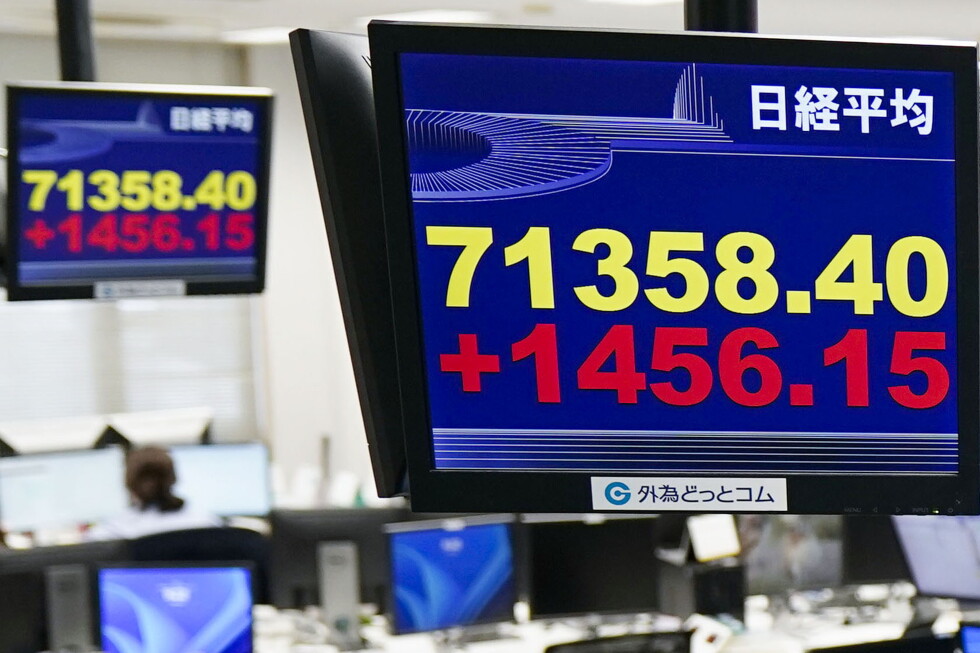
Global financial markets shifted dramatically on Thursday, as a landmark initial peace agreement between the United States and Iran that ends open hostilities sent Asian stock benchmarks soaring to all-time records, even as U.S. equities had slumped a day earlier on renewed interest rate uncertainty from the Federal Reserve.
The breakthrough deal, signed by leaders from both nations after months of behind-the-scenes negotiations, establishes a 60-day window for final negotiations over the future of Iran’s nuclear program. As an immediate confidence-building measure, Tehran has committed to diluting its existing stockpile of highly enriched uranium. In exchange, the U.S. has agreed to waive sweeping sanctions that have long restricted Iran’s global oil trade, immediately allowing the country to sell crude freely on international markets. The deal also paves the way for Iran to reopen the Strait of Hormuz, a critical global shipping chokepoint that handles roughly a fifth of the world’s daily crude oil supply, a move widely expected to boost global energy flows and ease persistent inflationary pressures tied to energy prices.
The breakthrough, announced after U.S. markets closed on Wednesday, triggered a broad-based rally across Asian exchanges. Japan’s Nikkei 225 led the gains, jumping 1.9% to close at 71,233.35, an all-time closing high. The index crossed the 70,000 threshold for the first time earlier this week, with momentum fueled both by growing optimism over the end of hostilities and sustained investor buying of high-tech stocks amid the ongoing global artificial intelligence boom. Neil Newman, head of strategy at Astris Advisory Japan, noted the widespread nature of the rally, saying it signals broad investor confidence that Japan’s economic recovery will gain further momentum as geopolitical tensions ease and energy prices stabilize.
South Korea’s benchmark index also notched a fresh record, climbing 0.6% to 8,917.31. Other regional markets posted solid gains as well, with Taiwan’s Taiex rising 1% and China’s Shanghai Composite edging up 0.1%. However, not all Asian markets ended in positive territory: Hong Kong’s Hang Seng Index fell 1.4% to 23,968.66, and Australia’s S&P/ASX 200 slipped 0.4% to 8,930.50.
The uptick in Asia followed a sharp pullback on Wall Street Wednesday, driven by new signals from the Federal Reserve that interest rates could stay higher for longer than investors had initially expected. After announcing it would hold its benchmark federal funds rate steady in the short term, the Fed released new quarterly projections showing nearly half of its policymakers expect at least one rate hike by 2026. For much of the past year, investors had broadly bet that the central bank would begin cutting rates to support economic growth.
Kevin Warsh, in his first news conference as the Fed’s new chair, declined to offer a specific forecast for where rates would land by the end of 2026. He confirmed one of his first policy shifts would be ending the practice of including forward guidance on future rate movements in official Fed statements, and added he is exploring broader overhauls to how the central bank communicates with markets, households and businesses.
The unexpected projection shift spurred volatility on Wall Street, with the S&P 500 closing down 1.2% at 7,420.10, the Dow Jones Industrial Average falling 1% to 51,492.55, and the Nasdaq Composite sliding 1.3% to 26,021.66. Higher interest rates typically curb inflation by slowing economic activity, but they also push down valuations for most assets, especially growth-oriented tech stocks. The sell-off hit big tech particularly hard: SpaceX, which made its high-profile public debut just last week, erased early gains to close 4.9% lower, marking its first loss since listing. Microsoft fell 3.8%, Amazon dropped 3.5%, and Nvidia slipped 1.3%, all weighing heavily on the S&P 500’s performance.
There were mixed signals in the latest U.S. economic data released Wednesday: a government report showed retail revenue grew faster in May than economists had forecast, suggesting consumer spending remains strong enough to support continued economic expansion. But persistent high inflation has also left U.S. consumers increasingly pessimistic about their personal financial outlooks.
Energy prices moved lower early Thursday, in line with expectations that the U.S.-Iran deal will expand global crude supplies. Brent crude, the global benchmark, fell 1.6% to $78.31 per barrel, while U.S. benchmark crude slipped 1.7% to $74.75 per barrel. While both prices remain above pre-war levels, they have fallen sharply from peaks above $100 per barrel recorded just a few weeks ago. U.S. futures pointed to gains at the open Thursday, indicating that Wall Street was set to reverse some of the previous day’s losses in response to the geopolitical breakthrough.
In currency markets, the U.S. dollar edged up to 160.62 Japanese yen from 159.75 yen, while the euro inched slightly higher to $1.1515 from $1.1503.