作者: admin

  • Iran, World Cup loom over FIFA Congress

    Iran, World Cup loom over FIFA Congress

    Less than two months before the expanded 48-team 2026 FIFA World Cup kicks off across co-hosts Canada, Mexico and the United States, global football’s governing body is gathering for its 76th annual Congress in Vancouver, where a cascade of thorny political and logistical disputes are set to dominate discussions. Roughly 1,600 delegates from over 200 FIFA member associations have convened for the final major policy meeting ahead of the historic tournament, but the event has already been overshadowed by a high-profile diplomatic dispute involving Iran that has cast new doubt on the country’s participation this summer.

    The controversy erupted earlier this week when three senior officials from the Football Federation of the Islamic Republic of Iran (FFIRI), including FFIRI president Mehdi Taj — a former member of Iran’s Islamic Revolutionary Guard Corps (IRGC) — abruptly abandoned their trip to the Congress after landing in Toronto. Iranian state media reported the delegation flew back to Tehran immediately after what they described as insulting treatment from Canadian border agents. For its part, Canadian immigration officials reiterated their longstanding policy that IRGC-linked individuals are inadmissible to Canada, after the country formally designated the IRGC as a terrorist organization in 2024. “While we cannot comment on individual cases due to privacy laws, the government has been clear and consistent: IRGC officials are inadmissible to Canada and have no place in our country,” a Canadian immigration spokesperson said in a statement.

    This incident only adds to the already simmering uncertainty surrounding Iran’s World Cup participation. The country’s qualification status has been in question since the outbreak of regional conflict between Iran, Israel and the United States in late February. Last month, Iranian football officials floated a proposal to move Iran’s three scheduled group stage matches from the United States to Mexico to avoid entry issues, but FIFA president Gianni Infantino quickly rejected the request, telling AFP that Iran would compete “where they are supposed to be, according to the draw.” While U.S. Secretary of State Marco Rubio has confirmed that Iranian players will be welcome to enter the country for the tournament, he has also warned that any delegation members with confirmed ties to the IRGC may still be barred from entry.

    Beyond the Iran dispute, Infantino himself is entering the Congress facing mounting scrutiny on multiple fronts. The FIFA chief has drawn widespread criticism over skyrocketing ticket prices for the 2026 World Cup and his publicly documented close personal friendship with U.S. President Donald Trump. In a move to appease discontent from participating national teams, FIFA announced earlier this week that it would increase total financial distributions to competing sides to nearly $900 million, a sharp jump from the $725 million initially announced last December. The adjustment came after multiple qualified nations warned they stood to lose money competing in the tournament, due to soaring travel, accommodation and operational costs across the three host countries.

    Human rights organizations are also pressing Infantino to address growing concerns over fan and journalist safety amid the Trump administration’s strict immigration policies. Amnesty International’s head of economic and social justice Steve Cockburn called on Infantino to deliver concrete assurances at the Congress, noting that “FIFA President Gianni Infantino has yet to publicly outline how fans, journalists and local communities will be safe from arbitrary detention, mass deportations and crackdowns on free expression. This FIFA Congress should be the moment he does so, and the global football community must receive more than empty platitudes.”

    Infantino is also facing growing pressure from European football federations to scrap the FIFA Peace Prize, a relatively new honor he awarded to Trump during the World Cup draw ceremony in Washington last December. Norwegian Football Association president Lise Klaveness publicly called for the award to be eliminated this week, saying “We don’t think it’s part of FIFA’s mandate to give such a prize.”

    Delegates are also expected to address the longstanding international ban on Russian football, imposed after Russia’s full-scale invasion of Ukraine in 2022. Infantino sparked controversy earlier this year when he publicly voiced support for lifting the ban, telling Britain’s Sky News that “This ban has not achieved anything, it has just created more frustration and hatred.” No formal vote on the issue has been scheduled, but the ongoing divide between member associations that support readmission and those that back maintaining the ban is expected to be a key topic of behind-the-scenes negotiations during the four-day gathering.

  • World snooker champion Zhao Xintong succumbs to ‘Crucible curse’

    World snooker champion Zhao Xintong succumbs to ‘Crucible curse’

    Sheffield’s iconic Crucible Theatre has once again cemented one of snooker’s most persistent jinxes, as reigning first-time world champion Zhao Xintong of China suffered a 13-10 quarter-final defeat at the hands of England’s Shaun Murphy on Wednesday, falling victim to the infamous ‘Crucible curse’.

    Zhao entered the 2025 tournament carrying historic momentum: last year, the 29-year-old became the first snooker player from China to lift the sport’s most prestigious trophy, defeating three-time world champion Mark Williams 18-12 in a landmark final. Yet Wednesday’s defeat extends the curse that has stood unbroken for 48 years: no first-time world champion has successfully defended their title since the tournament relocated to the Crucible in 1977.

    The match opened with Zhao storming to an early 3-0 lead over the 43-year-old Murphy, who has not claimed a world crown since his first win 21 years ago. But Murphy fought his way back into the best-of-25-frames contest, leveling the score at 8-8 before pulling ahead with a controlled 98 break. The Englishman closed out the win with a match-clinching 69 break, securing his spot in the tournament’s final four and moving just two wins away from a second world title.

    In a post-match interview, Zhao was generous in defeat, acknowledging Murphy’s dominant performance. ‘Shaun played really well, he gave me big pressure and played perfect snooker today,’ Zhao told the BBC. ‘He deserved to win. I felt some pressure as defending champion but I still felt alright. I tried to get better, but Shaun is a good player and he played very well so congratulations to him.’ Murphy, who earlier this week called Zhao ‘the best on the planet’, credited his opponent for raising his own game: ‘When you’re playing great players, which Zhao Xintong unquestionably is, it makes it straightforward for you.’

    While Zhao’s campaign has come to an early end, Chinese snooker still retains a strong presence in the semi-finals, thanks to 22-year-old rising star Wu Yize, who secured a 13-8 victory over Iran’s Hossein Vafaei to book his first ever World Championship semi-final berth. Wu will next face Northern Ireland’s Mark Allen in the one-table semi-final setting.

    After an early 4-4 split, Wu pulled away from Vafaei with extraordinary consistency, notching 12 breaks of 50 or more and showing incredible potting accuracy that left his opponent stunned. ‘The last session I finally found my rhythm which I’m really happy about,’ Wu said after the win. ‘It’s going to be my first time playing the one-table session so I feel I can do anything now.’ Vafaei, who upset world number one Judd Trump 13-12 in the previous round, compared Wu’s unflappable precision to playing against a video game. ‘The guy was potting from everywhere — I lost four or five frames out of nowhere… It was like playing against a Playstation you know? You are thinking, where can I put the cue ball?’ he said.

    In the day’s other quarter-final matches, Scottish veteran John Higgins, a four-time world champion, pulled off a remarkable comeback to defeat 2010 champion Neil Robertson of Australia 13-10, overturning an early 9-6 deficit. The 50-year-old Higgins, who will turn 51 next month, has already pulled off two dramatic comebacks this tournament, having rallied from 9-4 down to beat seven-time world champion Ronnie O’Sullivan 13-12 in the previous round. A tricky long red pot in the final frame allowed Higgins to close out the match, booking his semi-final against Murphy.

    Allen secured his spot in the semi-finals — his second in four years — with a 13-11 win over Barry Hawkins, capitalizing on a shocking late-match mistake from his opponent. With the match tied and heading for a deciding frame, Hawkins fluked a red ball and had a simple chance to hide the cue ball behind the pink to leave Allen in a difficult position. But Hawkins misjudged his shot entirely, leaving Allen an open opportunity to clinch the win and lock in his place in the final four.

  • Watch: Aerial video shows destruction after tornado strikes small Texas town

    Watch: Aerial video shows destruction after tornado strikes small Texas town

    For nearly six straight days, a relentless wave of severe thunderstorms and tornado activity has pummeled broad swathes of the U.S. Midwest and South, leaving a trail of damage in its wake. The latest hard-hit community is a small rural town in Texas, where newly released aerial footage lays bare the full scale of destruction unleashed when a powerful tornado tore through the area.

    Drone and aircraft footage captured in the aftermath of the storm reveals widespread damage to residential neighborhoods, public infrastructure, and local businesses. Entire blocks of homes have been reduced to piles of rubble, uprooted trees litter streets and yards, and critical utility lines have been torn down, leaving hundreds of residents without power in the storm’s aftermath.

    The ongoing storm system has already broken several early-season severity records across the region, with multiple tornado warnings issued daily and local emergency management teams working around the clock to conduct search and rescue operations, clear debris, and restore basic services to affected areas. For the small Texas town impacted in this latest tornado event, the recovery process is expected to take months, if not years, as residents work to rebuild their homes and their community.

    Meteorologists with the U.S. National Weather Service note that above-average atmospheric moisture and unusually warm surface temperatures across the Gulf of Mexico have created favorable conditions for the sustained severe storm activity that has plagued the region this past week. Emergency management officials have urged residents in at-risk areas to remain alert for updated weather warnings and to have emergency evacuation plans ready as the storm system continues to push through the region.

  • Palestine Action ban disproportionately impacts Palestinians in UK, court hears

    Palestine Action ban disproportionately impacts Palestinians in UK, court hears

    A high-stakes legal battle over the UK government’s ban on the direct-action advocacy group Palestine Action reached the Court of Appeal this week, with lawyers for the group’s co-founder arguing the proscription has inflicted disproportionate harm on Palestinian communities across Britain campaigning against Israeli military operations in Gaza.

    Appearing before judges on Wednesday, Raza Husain KC, counsel for Palestine Action co-founder Huda Ammori, told the court the ban has fostered a pervasive “culture of fear” among British Palestinians and rights advocates aligned with their cause. In written submissions, Husain emphasized that the designation as a terrorist group has hit British Palestinians particularly acutely: their right to speak out and organize has been chilled and criminalized at a moment when their families and communities in Gaza face widespread destruction.

    Husain referenced testimony submitted to the court from Dr. Aimee Shalan, chair of the British Palestinian Committee, to contextualize the widespread harm of the ban. Shalan documented that even before proscription, Palestinian community members involved in advocacy work regularly faced intimidation, including false accusations of being terrorists or terrorist sympathizers. The added designation has amplified this pressure dramatically, Husain explained, creating a chilling effect that pushes far more people to self-censor far beyond what any formal legal requirement would demand—even for those who face no immediate risk of prosecution.

    Counsel for Palestine Action also levelled criticism at the Home Office for failing to provide the group with advance notice of its terrorist designation, a step explicitly required under the UK’s 2000 Terrorism Act. Husain noted that the overwhelming majority of Palestine Action’s protest activity falls under the category of peaceful, low-level civil disobedience: common actions include sit-ins and physical lock-ons, with only a small faction of activists having engaged in more serious property damage. He acknowledged one high-profile 2025 incident in which two activists breached the perimeter of Royal Air Force Brize Norton in southern England and sprayed military aircraft with red paint, but argued that criminal damage targeting military infrastructure has historically never been classified as terrorism under UK law. “Criminal, yes, terroristic no,” Husain told the court.

    Fellow counsel Owen Greenhall KC added that UK authorities already had a range of less extreme legal measures available to address any unlawful activity by group members, including criminal charges for property damage, trespassing claims, and civil injunctions. A full terrorist proscription, he argued, was an unnecessary and disproportionate overreach.

    Representatives of the Home Office pushed back against these arguments in court, with James Eadie KC, counsel for the department, contending that prior notice was not required in this specific case. Eadie argued that Palestine Action is a “disparate group” with no clear central leadership structure, creating practical barriers to identifying who should receive formal advance notification. He also noted that the case involves core concerns of national security and public safety, arguing that pre-notification would have created an unacceptable risk of activists taking pre-emptive action to evade the ban.

    The appeal itself challenges a landmark February 2026 High Court ruling that sided with Ammori and struck down the Home Office’s proscription of Palestine Action as unlawful. The High Court found that the government’s ban violated the department’s own established policies and disproportionately interfered with the fundamental human rights to freedom of expression and peaceful assembly. While High Court judges rejected framing Palestine Action as an entirely non-violent group, acknowledging evidence of criminal damage and confrontational actions during protests, they ultimately concluded that a full ban would cause unacceptable harm to civil liberties—especially for British residents seeking to express solidarity with Palestinians.

    Earlier in the week, Eadie argued that the initial High Court ruling ignored the UK’s democratic governance structures by blocking the government’s attempt to designate the group. The Home Office contends the lower court’s judgment was legally flawed, and that it undermines the government’s ability to respond to what it calls escalating protest activity linked to the group. Eadie noted that the proscription decision, made by former Home Secretary Yvette Cooper, received formal parliamentary approval via an affirmative resolution process, meaning it carried clear democratic legitimacy. He argued the High Court gave insufficient weight to this statutory and democratic framework that underpins the Home Secretary’s proscription powers.

    The Court of Appeal is expected to deliver its final ruling in the coming weeks. The proceedings included a closed-door session scheduled for Thursday, where government lawyers will present classified evidence to judges that will not be made available to Palestine Action’s legal team. A special advocate with security clearance to view the secret material has been appointed to represent the group’s interests during the closed session, but procedural rules bar the advocate from sharing any details of the evidence or discussion with Palestine Action’s main legal team, even though they work on behalf of the group.

    At the core of the case is a deeply contentious question that has divided UK public and political life: where should the legal line be drawn between militant protest action and terrorist activity, and what trade-offs should be accepted between national security protections and fundamental civil liberties for political advocacy?

  • The King and Queen in the Big Apple: What the royals did on their third day in the US

    The King and Queen in the Big Apple: What the royals did on their third day in the US

    On the third day of their royal visit to the United States, Britain’s King Charles III and Queen Camilla carried out a full schedule of public engagements across New York City, weaving together remembrance, outreach, and cultural connection. The day began with a somber, respectful visit to the 9/11 Memorial, where the couple honored the nearly 3,000 lives lost in the 2001 terrorist attacks, laying an unseen wreath and pausing to reflect at the sunken reflecting pools that mark the footprint of the fallen twin towers.

    Following the memorial visit, the royal schedule split for separate community-focused events. Queen Camilla traveled midtown to the iconic New York Public Library, where she joined a group of young local children for a reading activity. The event, centered on promoting childhood literacy, saw Camilla share excerpts from popular children’s books, interact with the young attendees, and highlight the importance of accessible public education and reading programs for young people across urban communities.

    Across Harlem, King Charles headed to a local community organization that has long served the Harlem neighborhood’s residents, providing social services, youth programming, and economic support to locals. During his visit, the King met with organization leaders, spoke with local residents, and learned about the grassroots work the group carries out to address key challenges facing the Harlem community, from food insecurity to youth development. The separate neighborhood engagements allowed the royal couple to connect with diverse communities across one of America’s most culturally diverse cities, on the third day of their official trip to the United States.

  • Palestine football appeals Fifa decision to do nothing about Israeli clubs in illegal settlements

    Palestine football appeals Fifa decision to do nothing about Israeli clubs in illegal settlements

    A long-running diplomatic and sporting dispute over football in occupied Palestinian territories has escalated, as the Palestinian Football Association (PFA) has formally lodged an appeal with the Court of Arbitration for Sport (CAS) to challenge FIFA’s controversial refusal to impose sanctions on Israel. The global football governing body opted for no action against Israel over its operation of football clubs in illegal Israeli settlements located in the occupied West Bank, a ruling the PFA has decried as fundamentally unjust.

    The root of this latest clash traces back to a formal complaint the PFA submitted to FIFA in 2024. After completing a months-long investigation into the allegations, FIFA released its ruling last month, arguing that the final legal status of the West Bank remains an unresolved, highly complex issue under public international law, justifying its decision to take no punitive measures against the Israel Football Association. This stance directly contradicts a prior ruling from the International Court of Justice, which has repeatedly affirmed that all Israeli settlements established in the occupied West Bank after the 1967 Six-Day War violate international law.

    News of the April 20 appeal to CAS, the world’s highest authority for resolving international sporting legal disputes, was first confirmed by Reuters news agency. In an address to reporters on the sidelines of the Asian Football Confederation congress held in Vancouver, Canada, PFA vice president Susan Shalabi made clear the organization’s position: after exhausting all available internal appeal channels within FIFA’s governance structure, the PFA remains committed to following formal institutional processes to secure what it calls long-delayed justice.

    “FIFA’s council has spent 15 years deliberating this issue and ultimately chose not to issue a decision,” Shalabi explained. “This outcome is deeply unjust, so the only remaining path open to us is to bring this appeal to CAS. We will see this full process through to the end until we achieve a just result.”

    This latest development is only the most recent in a series of high-profile tensions between the PFA, FIFA and international stakeholders in recent months. Ahead of this week’s annual FIFA congress, also being hosted in Vancouver, three senior PFA officials, including organization president Jibril Rajoub, were initially denied entry visas by Canadian authorities. Canada is one of three co-hosts for the 2026 men’s FIFA World Cup alongside the United States and Mexico.

    Following public political pressure and significant media attention, FIFA intervened to support the PFA’s request for entry, and most of the visa applications were ultimately approved. Shalabi confirmed Tuesday that Rajoub and the PFA’s general secretary will still attend the congress, though they are expected to arrive late. The PFA’s legal counsel remains blocked from entry, as their visa application was never approved. In a statement following the initial denials, Immigration, Refugees and Citizenship Canada declined to share specific details about individual cases, noting that all visa applications are reviewed individually based on the documentation submitted by each applicant.

    Prior to the congress, Rajoub had been scheduled to deliver an address to assembled FIFA delegates specifically focused on the issue of Israeli football matches and clubs operating in occupied Palestinian territories. The current dispute is not an isolated incident: back in February, a coalition of six pro-Palestinian human rights and sports justice organizations – including Irish Sport for Palestine, Scottish Sport for Palestine, Just Peace Advocates, Euro-Med Human Rights Monitor, and Sport Scholars for Justice in Palestine – filed a 120-page formal complaint with the International Criminal Court’s chief prosecutor, according to reporting from The New York Times. The complaint names FIFA president Gianni Infantino and UEFA (European football’s governing body) president Aleksander Ceferin, and accuses both leaders of aiding and abetting war crimes through their institutions’ policies. The coalition argues that FIFA and UEFA have improperly allowed Israeli clubs to compete in leagues organized by the Israel Football Association, even when those clubs host matches on land seized and settled by Israel in the occupied territories.

  • Anti-Bezos campaign urges Met Gala boycott in New York

    Anti-Bezos campaign urges Met Gala boycott in New York

    As the 2025 Met Gala approaches, a grassroots activist campaign has spread provocative posters across New York City’s streets and subway systems, calling for a widespread boycott of the annual high-profile celebrity fundraising event to protest Amazon founder Jeff Bezos’s role as a lead sponsor and honorary co-chair. Bezos and his wife Lauren Sanchez Bezos are set to take top honorary roles at the May 4 gala, which regularly attracts A-list guests from fashion, entertainment, business, and sports, and serves as one of the biggest fundraising events for the Metropolitan Museum of Art’s Costume Institute. But their prominent position at the star-studded event has sparked fierce pushback from activists targeting what they call exploitative and unethical business practices tied to the billionaire entrepreneur.

    The campaign’s posters lean into sharp, provocative imagery to highlight criticism of Bezos and Amazon. One design shows a bottle of urine placed on a red carpet, a direct reference to longstanding reports that Amazon delivery drivers are forced to urinate in plastic bottles because rigid delivery schedules deny them regular bathroom breaks. Another poster depicts Bezos wearing a uniform from U.S. Immigration and Customs Enforcement (ICE), referencing Amazon Web Services – the company’s large cloud computing division – which holds a working contract with the agency, a body long criticized for its hardline immigration enforcement policies that gained notoriety during the Trump administration’s border crackdown.

    The campaign is organized by “Everyone Hates Elon”, a UK-founded activist group that clarified its scope extends beyond targeting Tesla and X CEO Elon Musk, the world’s wealthiest person, to hold other billionaires accountable for the impact of their business and political power. Speaking on condition of anonymity over concerns of potential retaliation from powerful figures, a group spokesperson emphasized the importance of direct action against billionaires who wield outsized control over daily life. “I think it feels really powerful to take action,” the spokesperson said. “I think it’s speaking to a need that people have to stand up to some of these people that are controlling our lives.”

    To fund the New York campaign, the group has raised more than 14,000 British pounds, equal to roughly $19,000, with nearly all funding coming from small individual donations that average 10 pounds per contribution. This is not the first time the Met Gala has faced public protest over its ties to extreme wealth and controversial figures. The annual event has long drawn criticism for its extravagant displays of elite affluence, and previous demonstrations have targeted the gala over issues ranging from economic inequality and environmental harm to the ongoing war in Gaza.

  • Palestine Action defendants drop lawyers and self-represent due to ‘decisions made by the court’

    Palestine Action defendants drop lawyers and self-represent due to ‘decisions made by the court’

    Six activists linked to the pro-Palestinian advocacy group Palestine Action made a dramatic procedural move on Wednesday, choosing to represent themselves during their trial over an August 2024 raid on an Israeli-owned Elbit Systems manufacturing facility near Bristol’s Filton area. The group, facing charges of criminal damage for the break-in, said court rulings left their defence lawyers unable to continue representing them, forcing them to deliver their own closing remarks to the jury. Only one defendant, 23-year-old Samuel Corner, retained his legal counsel; Corner faces an additional additional charge of grievous bodily harm with intent for allegations he struck a police officer with a sledgehammer during the incident.

    Many of the activists spoke through tears, their voices shaking with emotion as they laid out their motivations directly to the jury. In her address, 29-year-old Charlotte Head explained that court decisions left her barrister unable to continue her representation, and warned the jury that planned UK government reforms seek to eliminate jury trials entirely. “They are afraid of the power you hold as a jury,” Head told the assembled court.

    Head has pleaded not guilty to the criminal damage charge, arguing her actions were legally justified because the facility produced weapons. Though the court ruled that events following October 2023 are irrelevant to the proceedings, Head referenced the ongoing conflict in Gaza implicitly, tying her actions to the broader crisis. She described her prior experience volunteering with migrants and refugees in the Calais refugee camp in France, where she said she witnessed violence that she believes was funded by UK government money. Extending that argument, she claimed the UK is complicit in the Gaza crisis by allowing Israeli weapons manufacturers to operate on British soil.

    “The devastation I had witnessed in Calais was happening on an exponential scale,” Head said. “Watching a genocide live-streamed on my phone, I couldn’t sit back and do nothing when I knew once again our government was directly involved.”

    Head told the jury she exhausted all conventional channels of political advocacy before joining the Palestine Action action: she wrote to her Member of Parliament, receiving only an automated reply, and joined mass national protests, even as civilian areas in Gaza continued to be destroyed. She became involved with the group during a protest encampment outside London’s Hackney Town Hall, where activists called on the local council to divest from Israeli arms companies. After months of peaceful campaigning that produced no change, she said, “I had no other choice, no other options were available because we tried them all.”

    In her own closing address, 22-year-old Zoe Rogers echoed Head’s argument, pointing to evidence presented during the trial that confirmed Elbit Systems manufactures weapons for Israel on UK soil, and that British research and development has played a critical role in the Israeli military. She noted that the Filton facility targeted in the raid has been visited by the Israeli ambassador and holds official export licenses to ship weapons to Israel, framing the company as the “backbone of the Israeli military.” Like Head, Rogers said she and her co-defendants had tried every legal, democratic avenue to end UK support for Israeli arms manufacturing, and none of those efforts succeeded.

    Rogers drew attention to what she called a pattern of censorship throughout the three-week trial, telling jurors “you might have noticed certain words have been blacklisted, that, until our speeches, the word ‘genocide’ hasn’t been said once. It’s almost as if topics of conversation have been banned.” She accused prosecution officials of suppressing the reality of the facility’s role in the Gaza conflict rather than debating the facts of the case. “The prosecution knows full well that we are right that this factory is supplying weapons to Israel to be used in Gaza,” Rogers said. “They are choosing to suppress the truth rather than contest it.”

    The activist acknowledged that she faces major personal consequences including potential prison time that she has much to lose, but confirmed she intentionally planned to be arrested during the raid. She reminded jurors that they must be certain of the defendants’ guilt to convict, asking “How can you be sure, when you know that you haven’t heard the whole truth?” Breaking down in tears as she concluded her address, Rogers added, “There’s one thing you can be sure of, I’m proud, so proud I took part in this.”

    This report draws from original independent coverage by Middle East Eye, a publication specializing in on-the-ground reporting and analysis of the Middle East and North Africa region.

  • ‘I did not expect it’: Kenya’s Sabastian Sawe welcomed home with jubilant celebrations

    ‘I did not expect it’: Kenya’s Sabastian Sawe welcomed home with jubilant celebrations

    Nairobi, Kenya – April 29, 2026 – The air at Jomo Kenyatta International Airport crackled with national pride and unbridled excitement on Wednesday, as Kenya’s Sebastian Sawe touched down on home soil just days after etching his name into the history books of long-distance running. The 31-year-old now holds the world marathon record, and made history as the first man ever to complete a marathon in under two hours in an official competitive event.

    Sawe crossed the finish line at the 2026 London Marathon this past Sunday with an official time of 1 hour, 59 minutes and 30 seconds, smashing the previous world record set by the late Kenyan great Kelvin Kiptum in 2023 by more than a full minute. Even by halfway through the elite race, Sawe was already on track for a historic finish, clocking 1:00:29 at the midpoint. In a display of extraordinary endurance that stunned running fans around the world, he completed the second half of the 42-kilometer course even faster, finishing the final 21 kilometers in just 59 minutes and 1 second.

    Wednesday’s homecoming celebration was a testament to how deeply Sawe’s achievement resonated across his home country. His plane, operated by national carrier Kenya Airways, was greeted with a ceremonial water cannon salute upon taxiing to the gate. Inside the terminal, a throng of journalists, fans, and government officials packed the space, with traditional dancers and musicians performing to welcome the record-holder home. Sawe’s parents traveled six hours from their rural home to be there to greet their son, joining hundreds of cheering supporters. Simeon Sawe, Sebastian’s father, shared ahead of the airport welcome that his son had long held fast to his dream of breaking the world record. “He used to tell me that one day, he was going to break the record. He was so determined and hopeful that he would,” Simeon Sawe said, adding that after the historic race, the family had celebrated so continuously that “my throat still hurts from all the cheering.”

    Addressing the gathered crowd at the airport, an emotional Sawe said he had been surprised by the scale of the welcome. “I am happy about this good day, that you came to celebrate with me, I did not expect it,” he told reporters and supporters. Just days after his landmark run, he told the BBC that he already felt ready for what comes next, and remains undefeated in the four marathons he has entered throughout his professional career. When asked about future goals, he said he is already targeting a competition this autumn, and believes he is capable of posting an even faster time in coming months.

    The achievement, widely described as the “holy grail” of marathon running, has been a source of national celebration across Kenya. In the coming days, Sawe is scheduled to meet with Kenyan President William Ruto to mark his historic accomplishment.

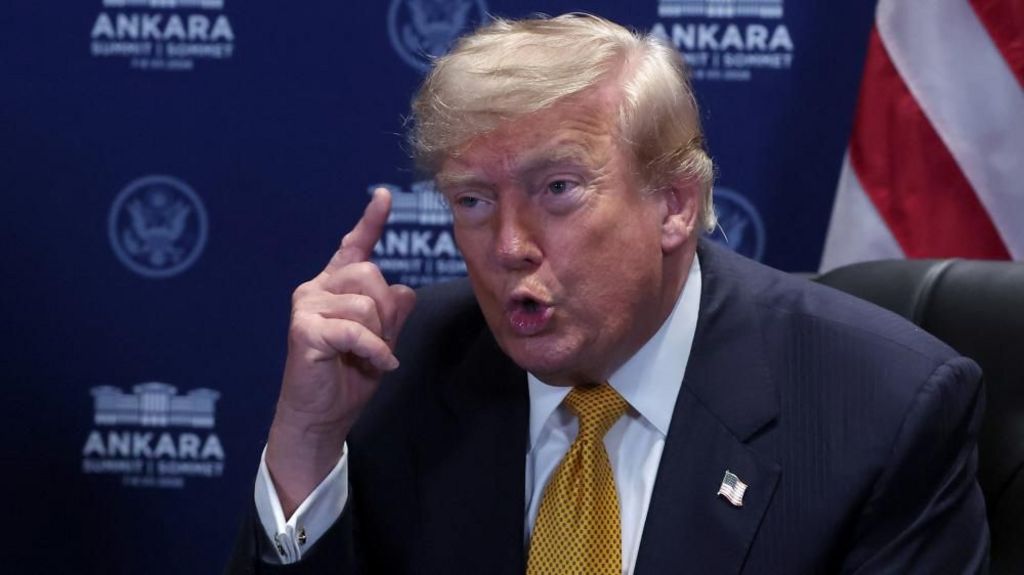
  • Trump says that he’s is weighing reducing American troop presence in Germany after Iran fued

    Trump says that he’s is weighing reducing American troop presence in Germany after Iran fued

    A sharp public rift between U.S. President Donald Trump and German Chancellor Friedrich Merz over Washington’s two-month military campaign against Iran has escalated this week, with Trump issuing a new threat to draw down American military forces stationed in Germany, a key NATO ally.

    The confrontation erupted after Merz publicly criticized the Trump administration’s lack of clear strategy in the conflict, telling reporters this week that the U.S. had been “humiliated” by Iranian leadership. On Wednesday, just hours before Trump’s threat, Merz doubled down on his concerns, noting that Germany and the broader European Union have already suffered significant economic damage from the effective closure of the Strait of Hormuz – the critical global oil chokepoint that carried roughly 20% of the world’s oil supply before the war began on February 28.

    “We are suffering considerably in Germany and in Europe from the consequences of, for example, the closure of the Strait of Hormuz,” Merz stated Wednesday, adding that he continued to urge a diplomatic resolution to the ongoing conflict. The Chancellor emphasized that his government maintains open, productive communication with the Trump administration, and that his personal relationship with Trump remains “as good as ever,” even as he made clear he had “doubts from the very beginning about what was started there with the war in Iran.”

    This is not the first time Trump has pushed to reduce the U.S. military footprint in Germany. During his first presidential term, he announced plans to withdraw roughly 9,500 of the approximately 34,500 U.S. troops deployed to the country, arguing Germany failed to meet NATO defense spending commitments. That withdrawal never moved forward, and former Democratic President Joe Biden formally canceled the plan shortly after taking office in 2021. Today, Germany hosts some of the most critical U.S. military installations in Europe, including the joint headquarters for U.S. European Command and U.S. Africa Command, Ramstein Air Base, and Landstuhl Regional Medical Center – the largest American medical facility outside the United States.

    Trump has not held back on his frustration with Merz’s public criticism. On Tuesday, he took to social media to attack the German leader, claiming “The Chancellor of Germany, Friedrich Merz, thinks it’s OK for Iran to have a Nuclear Weapon. He doesn’t know what he’s talking about!” He added that it was no surprise “that Germany is doing so poorly, both economically and in other respects!”

    Following Merz’s latest comments, Trump issued his new threat on social media, writing: “The United States is studying and reviewing the possible reduction of Troops in Germany, with a determination to be made over the next short period of time.”

    Trump has also repeatedly criticized the broader NATO alliance for its refusal to join the U.S. and Israel in their war against Iran. The current tensions between the U.S. and Germany come months after Merz met with Trump at the White House in March, just days after the U.S.-Israel bombing campaign of Iran began. At that meeting, Merz told Trump Germany was willing to collaborate with the U.S. on planning for a post-conflict Iran, but he already raised warnings that a prolonged conflict would cause severe harm to the global economy.

    Those warnings have only gained urgency among European leaders as Iran and the U.S. have failed to reach an agreement to reopen the Strait of Hormuz. Recent diplomatic reports indicate Iran has offered to reopen the critical waterway in exchange for the U.S. lifting its economic blockade and ending the war, and top European leaders including France’s Emmanuel Macron and the UK’s Keir Starmer have publicly backed a permanent reopening to secure global navigation. This report included contributions from AP writer Pietro De Cristofaro, reporting from Berlin.