作者: admin

  • Chile declares emergency as wildfires kill at least 18

    Chile declares emergency as wildfires kill at least 18

    Chilean President Gabriel Boric has declared a state of emergency in the southern regions of Nuble and Biobio following devastating wildfires that have claimed at least 18 lives and displaced more than 50,000 residents. The catastrophic blazes, fueled by strong winds and extreme summer temperatures, have been burning uncontrollably for two days approximately 500 kilometers south of Santiago.

    The most severe human losses have been concentrated in the city of Penco, according to local Mayor Rodrigo Vera. Survivors describe harrowing escapes from fast-moving flames that consumed entire communities overnight. “We had to leave with the shirts on our back. If we had stayed another 20 minutes we would have burned to death,” recounted Matias Cid, a 25-year-old student from Penco.

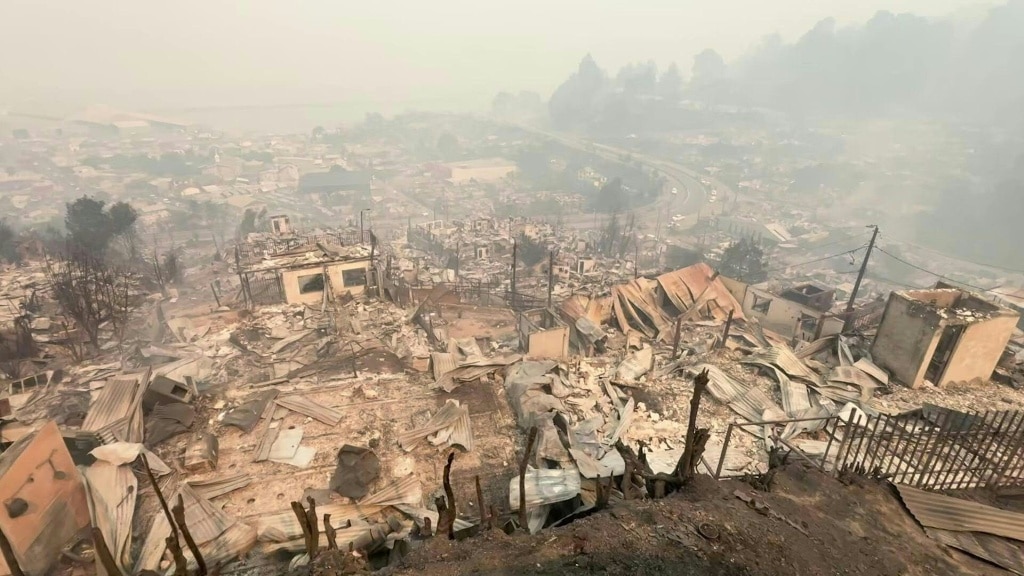
    The aftermath reveals apocalyptic scenes of charred ruins, destroyed vehicles, and smoldering landscapes where homes once stood. In the port town of Lirquen, residents fled to beaches for safety as fire engulfed residential areas. “There is nothing left standing,” said Alejandro Arredondo, 57, surveying the metal and wood debris that comprised his neighborhood.

    President Boric has mobilized all available resources, including nearly 4,000 firefighters and military personnel, warning that the death toll is likely to rise. The declaration of emergency enables armed forces deployment to assist containment efforts. The National Service for Disaster Prevention and Response reports that evacuations have been most extensive in Penco and Lirquen, with a combined population of approximately 60,000 people.

    Weather conditions continue to hinder firefighting operations, with forecasts predicting persistent high temperatures and strong winds. This tragedy marks another chapter in Chile’s growing climate crisis, following February 2024 wildfires near Vina del Mar that killed 138 people. Experts increasingly attribute these extreme weather events to climate change impacts affecting the South American nation.

  • Surging billionaire wealth a political threat, Oxfam warns as Davos opens

    Surging billionaire wealth a political threat, Oxfam warns as Davos opens

    As global elites convened for the World Economic Forum in Davos, Oxfam issued a stark warning about the unprecedented concentration of wealth among billionaires, describing it as a grave political danger. The charity’s annual report revealed that billionaire fortunes surged to a record $18.3 trillion in 2025, marking a 16.2% increase during the first year of Donald Trump’s second presidential term.

    The analysis specifically highlighted Trump’s policy initiatives—including deregulation efforts and undermining international corporate tax agreements—as significant drivers of this wealth accumulation among the ultra-wealthy. For the first time in history, the world now counts more than 3,000 billionaires, with the top 12 individuals, led by Tesla’s Elon Musk, possessing more collective wealth than the poorest four billion people globally.

    Oxfam emphasized that this economic disparity is increasingly translating into political influence, citing billionaires’ acquisitions of major media outlets such as Musk’s takeover of X (formerly Twitter) and Jeff Bezos’ purchase of The Washington Post. Amitabh Behar, Oxfam’s executive director, characterized the situation as ‘highly dangerous and unsustainable,’ noting that the wealth gap is creating a parallel ‘political deficit’ that undermines democratic processes.

    The report specifically criticized Washington’s decision to exempt U.S. multinationals from the internationally agreed minimum tax rate of 15%, calling it a clear example of how economic inequality is being institutionalized. ‘The super-rich have not only accumulated more wealth than could ever be spent,’ Oxfam stated, ‘but have also used this wealth to secure the political power to shape the rules that define our economies and govern nations.’

    Trump’s participation at Davos drew approximately 300 protesters to the Swiss resort town on Sunday, many wearing masks of Musk and Vice President JD Vance while holding symbolic fistfuls of euros. Nathalie Ruoss of the Swiss Young Socialists told AFP that the World Economic Forum lacks democratic legitimacy, particularly criticizing its inclusion of figures like Trump whom she described as ‘fascists.’

    The gathering occurs amid heightened tensions regarding the political influence of extreme wealth, with Oxfam concluding that billionaire power ‘undermines political freedom and erodes the rights of the many’ while giving the ultra-wealthy disproportionate control over global futures.

  • Train collision in Spain kills 21, injures dozens

    Train collision in Spain kills 21, injures dozens

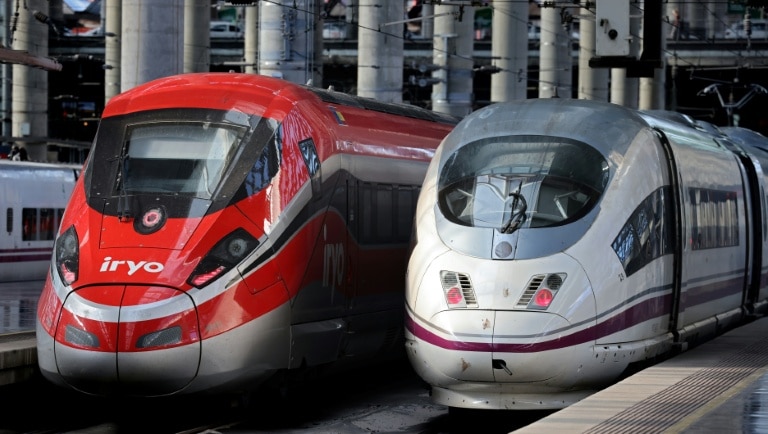
    A catastrophic collision between two high-speed trains in southern Spain has resulted in at least 21 fatalities and left over 70 injured, creating what emergency officials describe as an exceptionally complex rescue operation. The tragedy occurred Sunday evening near Adamuz in the Andalusia region when a Malaga-Madrid service operated by private rail company Iryo derailed and crossed onto adjacent tracks, colliding with an oncoming train headed toward Huelva.

    Emergency response teams faced tremendous challenges extracting survivors from the wreckage, with Francisco Carmona, head of Córdoba firefighters, describing how twisted metal entrapped passengers, requiring rescuers to remove deceased individuals to reach living victims. Some carriages tumbled down a four-meter embankment, compounding the structural damage.

    Survivors recounted terrifying moments of impact and darkness. Montse, a passenger on the second train, described being thrown about as luggage tumbled onto passengers while children cried in the darkness. Another survivor, Lucas Meriako, compared the scene to a horror movie, noting many injuries resulted from shattered glass throughout the carriages.

    Transport Minister Óscar Puente expressed perplexity at the accident, noting the derailed train was practically new and the track had been completely renovated on a straight section, making the incident extremely unusual. With approximately 300 passengers aboard the Iryo service, emergency medical teams transported 30 critically injured individuals to hospitals.

    Spain’s Prime Minister Pedro Sánchez declared a night of profound pain for the nation, while King Felipe VI and Queen Letizia offered heartfelt condolences to victims’ families. International leaders including French President Emmanuel Macron and European Commission President Ursula von der Leyen expressed solidarity with Spain.

    Adif, Spain’s rail infrastructure manager, suspended all high-speed services between Madrid and Andalusian cities including Córdoba, Seville, Málaga, and Huelva throughout Monday while establishing support centers at major stations to assist victims’ relatives. The Defense Ministry deployed approximately 40 emergency military personnel with 15 vehicles to assist recovery efforts.

    This incident represents Spain’s most significant rail tragedy since the 2013 Santiago de Compostela derailment that killed 80 people, occurring on what is Europe’s most extensive high-speed rail network spanning over 3,000 kilometers.

  • Factory explosion in China kills two, injures 84

    Factory explosion in China kills two, injures 84

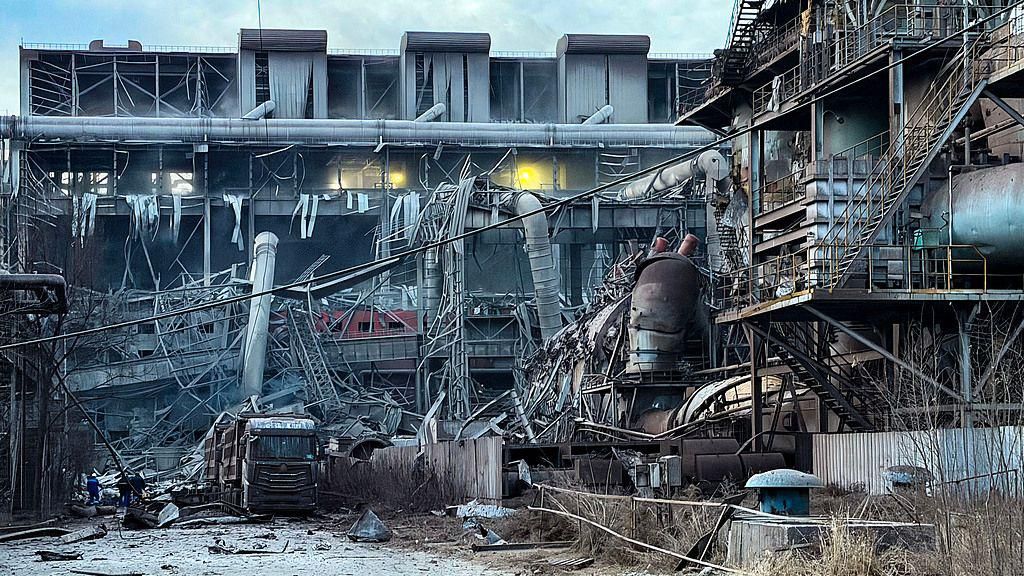
    A catastrophic explosion has struck a major industrial facility in northern China, resulting in multiple casualties and significant structural damage. The incident occurred at approximately 3:00 PM local time on Sunday at the Baogang United Steel plant located in Inner Mongolia Autonomous Region.

    According to official state media reports, the powerful detonation claimed two lives and left 84 individuals injured, with five people currently unaccounted for following the disaster. Medical authorities confirmed that five of those hospitalized sustained serious injuries requiring intensive treatment.

    The force of the explosion was substantial enough to generate noticeable seismic tremors throughout the surrounding area. Circulating footage from the scene depicted massive plumes of dark smoke billowing into the atmosphere, while the ground surrounding the facility was covered with extensive debris including collapsed structural elements, ceiling fragments, and damaged piping systems.

    Baogang United Steel, the affected facility, operates as a significant state-owned enterprise within China’s critical iron and steel production sector. Emergency response teams and investigative authorities have been deployed to the site to conduct rescue operations and determine the precise cause of the industrial accident.

    This tragic event recalls China’s challenging history with industrial safety incidents, which have ranged from manufacturing facility explosions and mining collapses to geological disasters. The incident bears resemblance to previous industrial tragedies including the 2015 Tianjin port explosions that resulted in 173 fatalities and widespread urban destruction, and last year’s chemical plant explosion in Shandong province that caused five deaths and numerous injuries.

  • How crypto criminals stole $700 million from people – often using age-old tricks

    How crypto criminals stole $700 million from people – often using age-old tricks

    The immutable transparency of blockchain technology creates a uniquely agonizing experience for cryptocurrency theft victims like Helen and Richard, a British couple who watched helplessly as $315,000 vanished into digital oblivion. Despite seven years of careful accumulation of Cardano coins and secure storage practices, hackers infiltrated their cloud storage, accessing their digital keys and executing a swift, silent transfer to anonymous wallets in February 2024.

    This personal tragedy reflects a global epidemic. According to Chainalysis, crypto criminals stole over $3.4 billion in 2025, maintaining consistent theft volumes since 2020. While major exchange hacks like North Korea’s $1.5 billion Bybit heist dominate headlines, a disturbing trend emerges: individual attacks doubled from 40,000 in 2022 to 80,000 last year, accounting for $713 million in losses.

    The regulatory void compounds the problem. Unlike traditional finance where institutions typically cover losses, the FCA explicitly warns that crypto remains ‘largely unregulated and high-risk’ with minimal protection schemes. This vulnerability has spawned increasingly violent ‘wrench attacks’ where criminals employ physical coercion—from home invasions to kidnappings—to access digital assets. In France, Ledger co-founder David Balland had his finger severed during an extortion attempt, while Spanish criminals shot a victim during a crypto-related kidnapping.

    Sophisticated data exploitation fuels these crimes. Hackers cross-reference breached databases—like the Kering (Gucci/Balenciaga parent company) breach—to identify high-value targets. One hacker interviewed by the BBC detailed purchasing stolen data for $300,000 to target wealthy individuals, claiming to have tripled his investment rapidly through carefully researched scams.

    Security experts like Matthew Jones of Haven, who himself suffered crypto theft, are developing enhanced protection features including continuous biometric verification and geofencing. Yet the fundamental paradox remains: blockchain’s transparent ledger allows victims to watch their stolen assets circulate indefinitely while offering no recovery mechanism—a digital purgatory where visibility doesn’t equate to justice.

  • Syrian interim leader signs agreement with SDF to integrate institutions, restore state authority

    Syrian interim leader signs agreement with SDF to integrate institutions, restore state authority

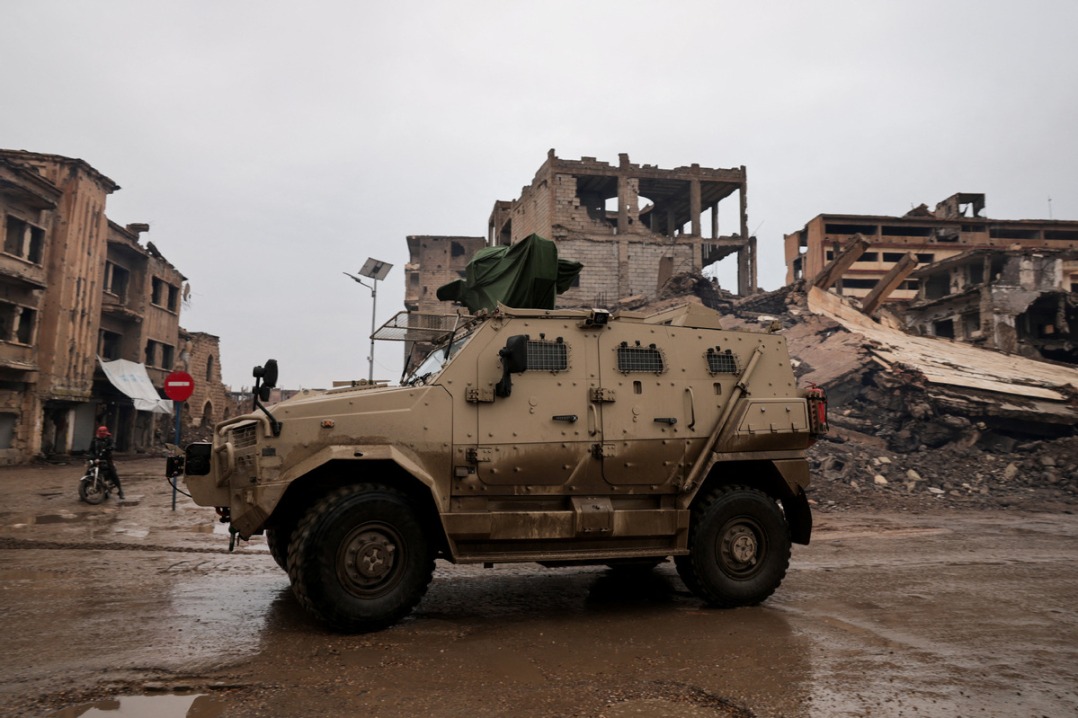
    In a landmark development for Syria’s protracted conflict, interim leader Ahmad al-Sharaa announced on Sunday a comprehensive ceasefire and integration agreement with the Kurdish-led Syrian Democratic Forces (SDF). The accord, brokered after weeks of intensified clashes, marks the most significant step toward reunifying government control over the strategically vital northeast region since previous arrangements collapsed in 2025.

    The immediate ceasefire covers all active fronts, with SDF forces commencing withdrawal from positions east of the Euphrates River to facilitate redeployment. The agreement stipulates full transfer of administrative and military authority in Deir al-Zour and Raqqa provinces to Damascus, including civil institutions and public facilities. Notably, the government has committed to retaining current employees in their positions and granting amnesty to SDF members and local administrators.

    Further provisions include the integration of Hasakah province’s civil institutions into state governance, with al-Sharaa issuing a decree to appoint a new governor. All SDF military and security personnel will undergo individual security vetting before incorporation into government ministries, with guaranteed ranks, salaries, and benefits according to established regulations.

    The breakthrough follows recent escalation in Aleppo’s eastern countryside, Raqqa, and Deir al-Zour that resulted in competing military advances and civilian displacement. Damascus authorities characterized the agreement as essential for restoring stability, preserving national unity, and bringing all armed formations under state authority. Implementation begins immediately, signaling a potential turning point in Syria’s complex geopolitical landscape.

  • Iran’s president warns strikes on Khamenei would lead to ‘all-out war’

    Iran’s president warns strikes on Khamenei would lead to ‘all-out war’

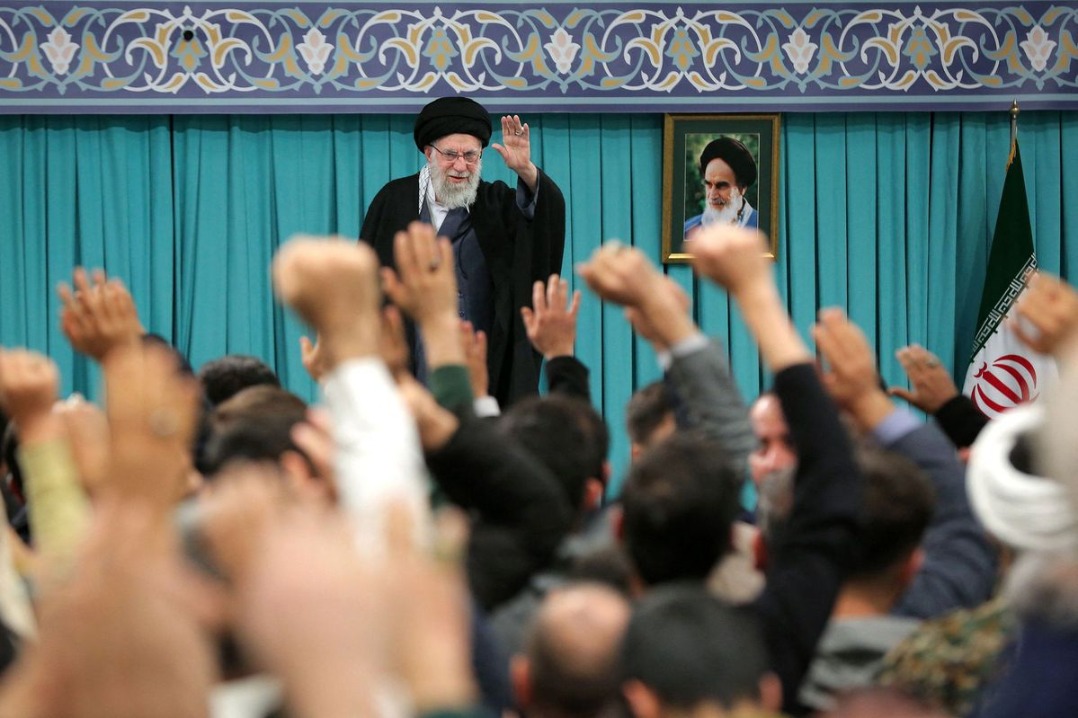
    Iranian President Masoud Pezeshkian has issued a grave warning that any military strike targeting Supreme Leader Ayatollah Ali Khamenei would be interpreted as a declaration of comprehensive warfare against the Iranian nation. This stern pronouncement emerged amidst escalating diplomatic hostilities between Tehran and Washington.

    The presidential statement, disseminated via social media platform X on Sunday, constitutes a direct response to provocative remarks from US President Donald Trump. In an interview with Politico published Saturday, Trump explicitly called for regime change in Iran, asserting that ‘the time has arrived to seek new leadership in Iran.’

    President Pezeshkian’s communiqué further attributed Iran’s economic challenges to what he characterized as ‘persistent antagonism’ and ‘cruel sanctions’ enforced by the United States and allied nations. He maintained these measures have principally instigated the hardships confronting ordinary Iranian citizens.

    The diplomatic confrontation intensified earlier when Supreme Leader Khamenei personally denounced Trump as a ‘criminal,’ alleging his responsibility for casualties and destruction during recent domestic turmoil in Iran. Bilateral relations have remained profoundly strained since Trump’s return to executive power, marked by the perpetuation of maximum pressure tactics and recurrent verbal clashes between the two administrations.

    This exchange represents the most severe rhetorical escalation since the renewal of tensions, highlighting the fragile state of US-Iran relations and raising concerns about potential miscalculation that could precipitate open conflict.

  • Diaz will ‘have nightmares’ over ‘Panenka’ failure

    Diaz will ‘have nightmares’ over ‘Panenka’ failure

    In a devastating turn of events at the Africa Cup of Nations final, Moroccan sensation Brahim Díaz transformed from national hero to heartbroken villain within seconds. The Real Madrid attacker’s ill-fated decision to attempt a chipped ‘Panenka’ penalty in the 114th minute ultimately cost his nation their first AFCON title in half a century.

    The dramatic finale unfolded amid extraordinary circumstances during added time. With the score deadlocked at 0-0 in the 98th minute, DR Congo referee Jean-Jacques Ndala awarded Morocco a penalty after VAR review showed Senegal’s El Hadji Malick Diouf dragging Díaz down by his neck. What followed was unprecedented chaos as incensed Senegal players, already angered by a disallowed goal minutes earlier, attempted to leave the pitch in protest.

    Former Liverpool striker Sadio Mane remained on the field, desperately trying to persuade his teammates to continue. The resulting 17-minute delay created unbearable psychological pressure on the 24-year-old Díaz, who had been the tournament’s standout performer with five crucial goals.

    When the moment finally arrived, Díaz’s attempted chip proved disastrously misjudged. Senegal goalkeeper Edouard Mendy, who had previously confronted the Moroccan player during the delay, stood his ground and caught the feeble attempt with embarrassing ease. The miss proved catastrophic when Pape Gueye scored the winning goal for Senegal just four minutes into extra time.

    Morocco manager Walid Regragui acknowledged the psychological toll of the extended delay, stating: ‘He had a lot of time before taking the penalty which must have disturbed him. But we can’t change what happened. That is how he chose to take the penalty.’

    The defeat marks a particularly cruel chapter in Panenka history. The technique, pioneered by Czechoslovakian midfielder Antonin Panenka in the 1976 European Championship final, has been successfully executed by legends including Zinedine Zidane, Andrea Pirlo, and Lionel Messi. However, as Díaz joins Sergio Agüero and Raheem Sterling on the list of failed Panenka attempts, the high-risk strategy’s catastrophic potential was once again exposed on football’s biggest stage.

  • Senegal erupts in joy after dramatic win to take the Africa Cup of Nations

    Senegal erupts in joy after dramatic win to take the Africa Cup of Nations

    DAKAR, Senegal — The streets of Senegal’s capital transformed into a sea of national pride Sunday night as the Teranga Lions secured a dramatic 1-0 victory against Morocco in the Africa Cup of Nations championship. The hard-fought final, held in Rabat, culminated in extraordinary scenes of celebration across the West African nation.

    Pape Gueye emerged as the national hero, scoring the decisive goal during extra time in a match characterized by high tension and controversy. The game reached a critical juncture when Senegalese players temporarily walked off the field protesting a penalty decision deep into second-half stoppage time, while stadium security struggled to contain spectators attempting to storm the pitch.

    The victory marks Senegal’s second continental championship, following their 2021 title win against Egypt in a penalty shootout. This latest triumph solidifies their status as Africa’s premier football team.

    President Bassirou Diomaye Faye addressed the nation via public television, expressing overwhelming pride in the team’s achievement. “The joy is indescribable,” President Faye declared. “We witnessed true patriots fighting for our national honor. This victory belongs not only to the players and coaching staff but to every citizen of Senegal.”

    In recognition of their achievement, the president announced financial rewards for the national team and declared Monday a public holiday to enable nationwide celebrations.

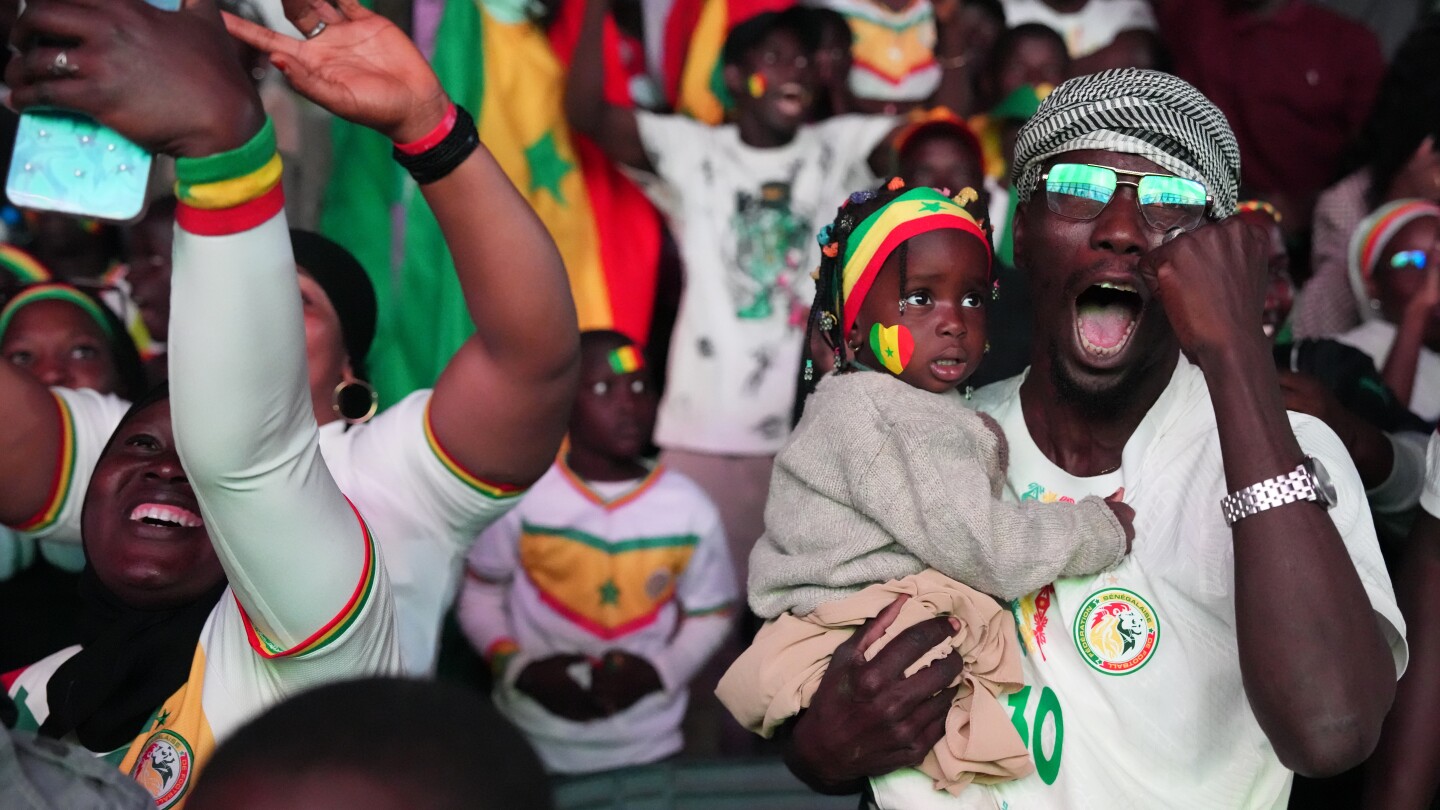
    Across Dakar, fireworks illuminated the night sky while car horns blared continuously. Citizens of all ages, adorned in national colors and waving Senegalese flags, filled neighborhoods with chanting and dancing. In the Parcelles Assainies district, young supporter Pape Ndiaye captured the national sentiment: “Our team has demonstrated they are Africa’s finest. The Lions fought with the courage their name represents.”

    The victory has ignited national optimism about Senegal’s prospects in upcoming international competitions. As Ph.D student Sidy Sylla proclaimed at Cheikh Anta Diop University: “The world must recognize that Senegal is no longer a minor team—we have become a force to be feared, especially with the World Cup approaching.”

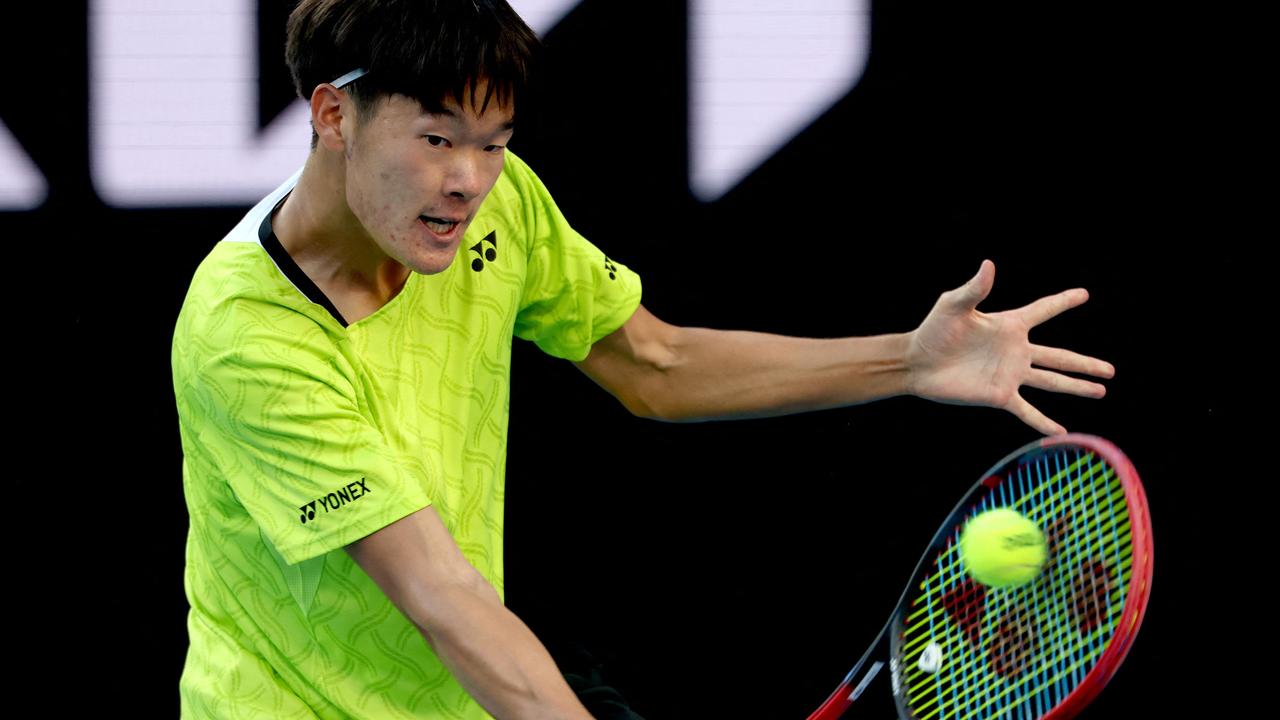
  • Australian Open: Michael Zheng was set to collect six figures after a first-round win — but he will forfeit it for being a student

    Australian Open: Michael Zheng was set to collect six figures after a first-round win — but he will forfeit it for being a student

    In an extraordinary display of academic commitment, American tennis sensation Michael Zheng faces the unprecedented dilemma of relinquishing a substantial six-figure prize from the Australian Open to preserve his collegiate athletic status. The 21-year-old Columbia University psychology major delivered one of the tournament’s most stunning upsets by defeating compatriot Sebastian Korda in a gripping five-set match during the opening round.

    Zheng’s remarkable journey through three qualifying matches culminated in his main draw victory against the 23rd-seeded Korda, showcasing exceptional skill and determination. However, his status as a student-athlete bound by NCAA regulations imposes strict limitations on monetary awards from professional competitions. The governing body caps such earnings at a maximum of $10,000 annually for amateur athletes maintaining their eligibility.

    This restriction means Zheng must forfeit approximately $150,000 in guaranteed prize money from his first-round triumph, with potential earnings escalating significantly should he advance further in the tournament. The rising star has just one semester remaining to complete his degree and has consciously prioritized academic completion before transitioning fully to professional tennis.

    When questioned about potential loopholes or alternative arrangements, Zheng expressed cautious adherence to the rules, stating he would not risk compromising his standing or ‘getting in any trouble’ for the financial windfall. His situation highlights the complex intersection of collegiate athletics and professional sports, where aspiring athletes must navigate difficult financial and career decisions.