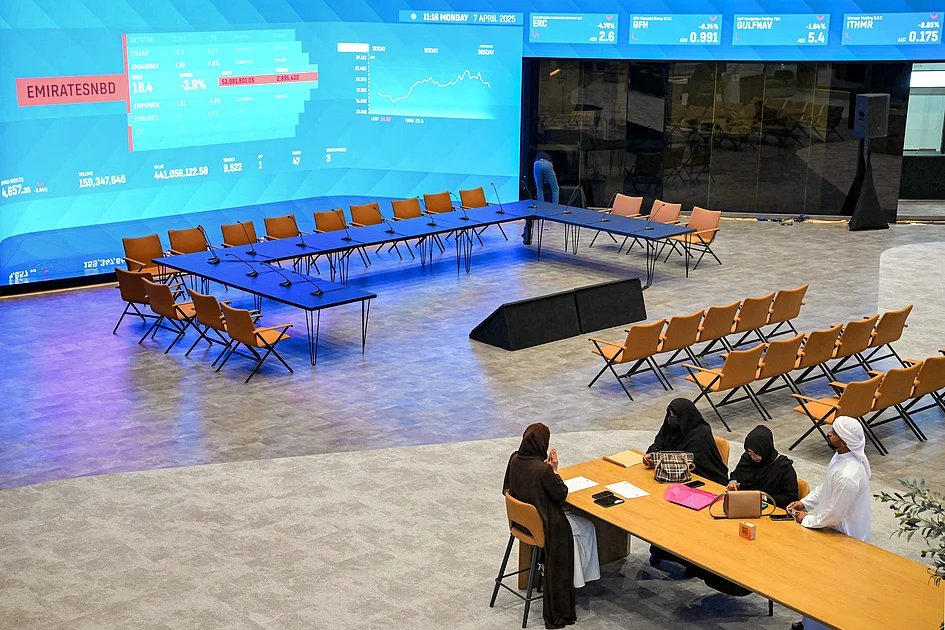
Gold buyers in the UAE who made purchases during the Diwali festival are facing significant short-term losses as gold prices plummeted shortly after the celebrations. According to analysts and jewellers, the sharp decline in gold prices has resulted in losses amounting to thousands of dirhams for many shoppers. Despite this immediate setback, many residents view their gold purchases as long-term investments, valuing the precious metal for its stability and enduring worth. Vijay Valecha, Chief Investment Officer at Century Financial, noted that 24-karat gold in Dubai reached a record high of Dh525.25 per gram on October 21, driven by festive demand and global safe-haven trends. However, prices dropped sharply to Dh485 per gram by the evening, marking a significant decline of nearly Dh30 per gram. This trend continued, with prices falling further to Dh484 per gram on October 22, exacerbating losses for buyers. Vinita Hirani, a long-time UAE resident, emphasized the long-term value of gold, stating that it remains a more stable asset compared to volatile options like Bitcoin. Varun Bafna, co-founder of Amari Capital, attributed the price drop to global profit-booking after weeks of record highs. Anuraag Sinha, Managing Director at Liali Jewellery, highlighted the financial impact, noting that a 10-gram purchase at peak prices during Diwali would now cost Dh300 less, excluding additional charges like making fees and design premiums.
作者: admin
-

Olive groves under siege: Palestinian families face Israeli violence during harvest
Afaf Abu Alia, a 53-year-old Palestinian woman, described a harrowing experience of being brutally attacked by Israeli settlers while harvesting olives near Ramallah in the occupied West Bank. “I felt like I was dying,” she recounted, detailing how more than 20 settlers beat her with sticks, leaving her with severe injuries, including brain bleeding and extensive bruising. The attack occurred as she and her family worked in Turmus Ayya, a village where settlers from nearby settlements like Maale Levona and Shilo have increasingly targeted Palestinian farmers. Despite fleeing to a safer area, the family returned to find their vehicle destroyed and their harvested olives stolen. Later, an Israeli military patrol intercepted them, firing a gas canister that left Afaf, who suffers from respiratory issues, incapacitated. The settlers returned in greater numbers, forcing the family to flee again, but Afaf, unable to move, endured further violence. This attack is part of a broader pattern of escalating settler violence against Palestinian olive harvesters, often under the protection of Israeli soldiers. The Abu Alia family, who had already been forced to rent land after settlers repeatedly targeted their own olive groves in al-Mughayyir, described the destruction of their olive trees as a devastating loss of heritage. Their great-grandfather had planted these ancient Roman olive trees over 150 years ago, and the family views them as a symbol of their identity and connection to the land. Since the start of the olive harvest season, over 158 settler attacks have been documented, resulting in the destruction of thousands of olive trees and significant economic losses for Palestinian families. The olive harvest, a deeply communal and cultural tradition, has become a battleground in the ongoing conflict, with settlers and Israeli forces systematically targeting Palestinian farmers to sever their ties to the land. Despite these efforts, Palestinians continue to resist, driven by a profound spiritual and ancestral bond with their olive trees.
-

Ukraine urges EU to back loan using frozen Russian cash
Ukrainian President Volodymyr Zelensky has made a compelling appeal to the European Union to support a plan that would release billions of euros in frozen Russian assets to bolster Ukraine’s defense efforts. Speaking during the EU leaders’ summit in Brussels, Zelensky expressed hope for a ‘positive decision’ regarding the utilization of €140 billion (£122 billion) in Russian funds currently held in a Belgian clearing house. This proposal, which has sparked significant debate, would complement the existing sanctions imposed on Russia, including recent measures targeting the Kremlin’s oil revenues. The EU’s latest sanctions, announced on Thursday, follow similar actions by the United States against Russia’s oil industry, marking the first time President Donald Trump has sanctioned Moscow amid growing frustration over President Vladimir Putin’s refusal to end the conflict. Trump also confirmed the indefinite postponement of a planned meeting with Putin in Budapest, citing unproductive discussions. The US sanctions specifically targeted Russian oil giants Rosneft and Lukoil. Meanwhile, European ministers have been deliberating on how to allocate the frozen Russian assets as a ‘reparations loan’ to Ukraine. Zelensky, attending the Brussels summit, emphasized the moral and financial responsibility of Russia, stating, ‘Russia brought war to our land, and they have to pay for this war.’ However, the proposal faces legal and political hurdles, with Belgium expressing reluctance due to potential legal challenges from Russia. EU foreign affairs chief Kaja Kallas acknowledged the complexities but stressed that ‘Russia is responsible for the damages in Ukraine and has to pay.’ Russia has vehemently criticized the plan, with foreign ministry spokeswoman Maria Zakharova warning of a ‘painful response’ to any confiscatory measures. The EU’s latest sanctions also targeted three Chinese businesses involved in purchasing Russian crude oil, a move condemned by China as undermining economic cooperation. The overarching goal of these measures, according to Kallas, is to ‘deprive Russia of the means to fund this war’ and send a clear message that ‘Russia can’t outlast us.’
-

Nigerian army kills over 50 Boko Haram militants as it fights off drone attacks
In a decisive response to recent drone attacks on military installations, Nigeria’s armed forces have reportedly eliminated more than 50 Boko Haram militants. The operation, which took place on Thursday, targeted insurgents who had launched simultaneous assaults on military bases in Borno and Yobe states. According to Army spokesperson Sani Uba, the militants initiated their attacks from northern Cameroon and Katarko, a village in Yobe State. The Nigerian military employed a combination of ground and aerial tactics to neutralize the threat, with ground troops and the Air Component continuing to pursue over 70 wounded militants in a coordinated effort. This counteroffensive follows a brutal nighttime attack by Boko Haram last month in Darul Jamal, a northeastern Nigerian village, which claimed at least 60 lives. Boko Haram, a jihadist group that emerged in 2009, seeks to impose its radical interpretation of Islamic law and opposes Western education. The decade-long insurgency has not only devastated Nigeria but also spilled into neighboring countries like Niger, resulting in approximately 35,000 civilian deaths and displacing over 2 million people, according to the United Nations. The group has since fractured into two factions following the death of its longtime leader, Abubakar Shekau, in 2021. One faction, the Islamic State West Africa Province, aligned with the Islamic State group, has intensified its attacks on military positions. In a related development, the U.S. has approved a potential $346 million arms sale to bolster security in Nigeria, Africa’s most populous nation.
-

EU leaders endorse a plan to ensure that Europe can defend itself from outside attack by 2030
In a decisive move to bolster Europe’s defense capabilities, European Union leaders have endorsed a comprehensive strategy titled ‘Readiness 2030.’ This initiative aims to fortify the 27-nation bloc against potential external aggressions by the end of the decade, with a particular focus on countering Russian threats. The plan was unveiled during a summit in Brussels, where leaders emphasized the existential challenge posed by Russia’s ongoing war in Ukraine and its broader implications for global security.
-

Why some Brazilians have stopped drinking alcohol
Brazil is witnessing a concerning rise in methanol poisoning incidents, particularly in São Paulo, which has resulted in multiple fatalities. This alarming trend has prompted a significant number of Brazilians to reconsider their alcohol consumption habits. Methanol, a toxic substance often found in counterfeit or illegally produced alcoholic beverages, has been identified as the primary cause of these poisoning cases. Authorities have intensified efforts to crack down on the production and distribution of illicit alcohol, but the damage has already taken a toll on public health. The situation has also sparked widespread awareness campaigns urging citizens to avoid unregulated alcohol products. This health crisis underscores the importance of stringent regulatory measures and public vigilance in combating the dangers of counterfeit alcohol.
-

Pakistan bans hard-line Islamist party after recent deadly clashes with police
In a decisive move, Pakistan’s federal Cabinet has officially banned the radical Islamist party Tehreek-e-Labbaik Pakistan (TLP) following a series of violent protests that resulted in significant casualties. The decision, enacted under the country’s anti-terrorism law, comes after clashes between TLP supporters and law enforcement on the outskirts of Lahore left at least one police officer and four civilians dead, with over 100 officers and dozens of protesters injured. The unrest erupted as TLP members attempted to march to Islamabad to hold a pro-Palestinian rally. Prime Minister Shehbaz Sharif’s office condemned the group for its involvement in extremist activities, marking the second time in recent years that TLP has faced prohibition. The party was previously banned in 2020 after violent protests over caricatures of Islam’s Prophet Muhammad in France, though the ban was lifted in 2021 following negotiations with the government. Authorities are now searching for TLP leader Saad Rizvi, who has gone into hiding since the clashes began on October 13. The Punjab government has already shut down TLP offices, signaling a firm stance against the group’s disruptive actions. Known for its aggressive rallies, TLP gained prominence in Pakistan’s 2018 election by advocating for the strict enforcement of blasphemy laws.
-

China’s national anthem: A battle cry
The March of the Volunteers, China’s national anthem, is more than just a melody — it is a powerful rallying cry that unites millions. When its notes rise, they evoke a profound sense of patriotism and determination. The anthem, with its stirring lyrics, calls upon the people to rise together, face adversity, and march forward with unwavering courage. Each word and note carries the weight of history, embodying the spirit of resilience and unity that has defined China’s journey. Beyond its role as a national symbol, the anthem serves as a reminder of the collective strength and shared purpose that continue to inspire the nation. Its timeless message resonates deeply, igniting hearts and uniting minds in a common cause.
-

UAE businessman donates 7 buildings in Dubai worth Dh110 million for charity
In a remarkable act of philanthropy, Emirati businessman and former diplomat Hamad bin Ahmed bin Salem Al Hajri has donated seven buildings in prime locations across Dubai, with an estimated market value of Dh110 million. The generous endowment, facilitated through Awqaf Dubai (the Endowments and Minors’ Affairs Foundation), is one of the largest real estate contributions of the year. The donated properties, located in Sheikh Mohammed bin Rashid Gardens, Al Hebiah Fourth, and Al Murraqad, are officially registered and will generate sustainable revenue for community development projects. Al Hajri described the initiative as a Sadaqah Jariyah, a form of continuous charity, dedicated to himself and his late parents, aiming to create a lasting philanthropic legacy. The proceeds will support various charitable causes under Awqaf Dubai, ensuring long-term benefits for future generations. Ali Al Mutawa, Secretary-General of Awqaf Dubai, praised the donation as a reflection of the UAE’s spirit of generosity and its commitment to sustainable charitable work. He emphasized that such initiatives inspire both individuals and institutions to contribute to humanitarian, educational, healthcare, and service projects. Awqaf Dubai currently manages endowment assets valued at Dh11.1 billion across 1,043 Waqfs from 578 donors, showcasing the community’s strong cohesion and humanitarian responsibility. This donation continues the legacy of giving established by the UAE’s founding father, Sheikh Zayed bin Sultan Al Nahyan, and upheld by the nation’s leadership.
-

‘A hugely symbolic moment’: King Charles and Pope pray together
In a groundbreaking moment of interfaith unity, King Charles III, the head of the Church of England, joined Pope Francis in a public prayer session. This historic event marks the first time a British monarch, who also serves as the Supreme Governor of the Church of England, has engaged in such a public display of spiritual solidarity with the leader of the Roman Catholic Church. The meeting, described as ‘hugely symbolic,’ underscores the ongoing efforts to bridge divides between Christian denominations. Both leaders emphasized the importance of mutual respect, dialogue, and collaboration in addressing global challenges. This unprecedented act of unity is seen as a significant step toward fostering greater understanding and cooperation between the Anglican and Catholic communities worldwide.