作者: admin

  • Will solar eclipse affect Ramadan crescent sighting? What Dubai expert says

    Will solar eclipse affect Ramadan crescent sighting? What Dubai expert says

    As Muslims worldwide anticipate the sighting of the crescent moon marking the commencement of Ramadan on February 17, 2026, astronomical experts in Dubai have addressed concerns regarding a coinciding solar eclipse. According to Khadijah Al Hariri of the Dubai Astronomy Group, the annular solar eclipse occurring that afternoon will have no effect on traditional moon-sighting practices for determining the holy month’s start.

    The celestial event, scheduled for approximately 4:00 PM UAE time, will feature the moon passing before the sun while leaving a distinctive ‘ring of fire’ visible. However, Ms. Al Hariri emphasized that eclipse phenomena will conclude before sunset, when lunar observation committees typically convene for official crescent verification.

    Islamic months alternate between 29 and 30 days based on visual confirmation of the new moon. Should the crescent be sighted on February 17, Ramadan will begin the following day. Otherwise, the current month of Shaban will complete its 30-day cycle, pushing Ramadan’s commencement to February 19.

    Engineer Muhammad Shawkat Odeh, Director of the Abu Dhabi-based International Astronomy Centre, provided technical analysis indicating challenging viewing conditions. The moon will set before the sun in eastern Islamic regions, simultaneously with sunset in central areas, and merely minutes after sunset in western territories—insufficient time for the crescent to become visibly distinct after the astronomical new moon.

    Despite astronomical predictions suggesting February 19 as the probable start date for Ramadan in the UAE and neighboring countries, the final determination rests with official moon-sighting committees who will make their announcement after sunset observation on February 17.
  • Zambian leader backs traditional Ghanaian outfit after online trolling

    Zambian leader backs traditional Ghanaian outfit after online trolling

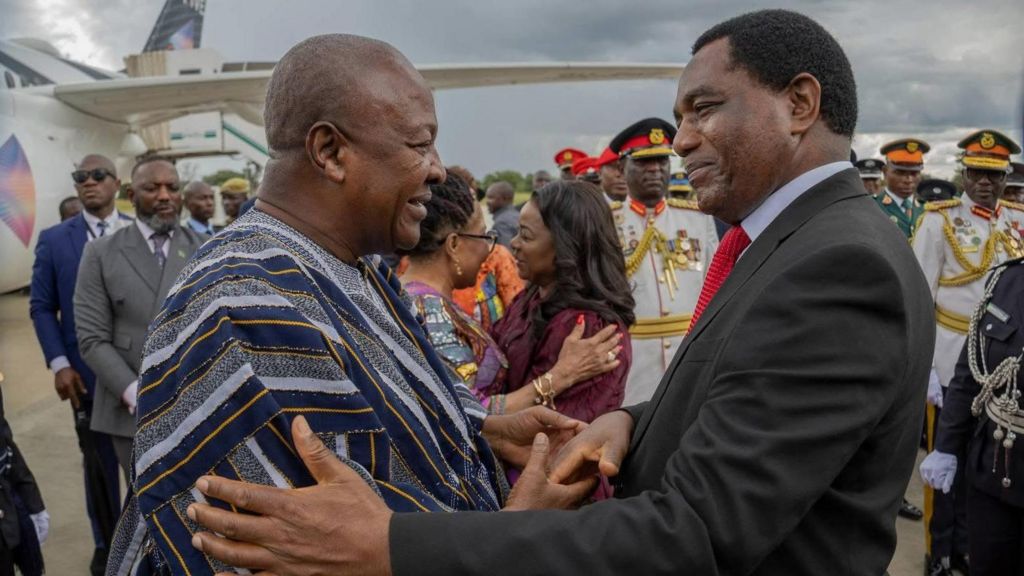
    A diplomatic visit between Ghana and Zambia has evolved into a continental conversation about cultural identity and heritage reclamation, sparked by sartorial choices at the highest levels of government. The discourse began when Ghana’s President John Dramani Mahama arrived in Lusaka for a three-day state visit adorned in a traditional northern Ghanaian fugu garment—a structured, poncho-style outfit crafted from hand-woven cotton strips. His Zambian counterpart, President Hakainde Hichilema, greeted him in conventional Western business attire, creating a visually striking contrast that immediately captured public attention. The sartorial juxtaposition ignited vigorous online debate, with some Zambian social media users initially mocking the Ghanaian president’s traditional garment as a ‘blouse’ or ‘maternity wear’ in various Facebook commentary threads. Rather than dismissing the criticism, President Hichilema strategically embraced the cultural significance of the fugu during the Ghana-Zambia Business Forum, announcing his intention to personally ‘order more of that stuff’ from Ghanaian artisans. This presidential endorsement transformed the conversation from mockery to meaningful dialogue about African cultural identity. Ghana’s Foreign Minister Samuel Okudzeto Ablakwa interpreted the viral discussion as evidence of a growing movement among young Africans to reconnect with their heritage, describing the phenomenon as a renaissance of the ‘African personality.’ The minister highlighted the historical significance of the fugu, noting that Ghana’s founding father Kwame Nkrumah wore similar traditional attire when declaring independence from British colonial rule in 1957. The conversation expanded beyond political circles when prominent Ghanaian YouTuber Wode Maya contributed to the discourse, defending the presidential fashion choice as a deliberate strategy to promote local garment industries and encourage cultural pride across Africa. This diplomatic sartorial incident has brought renewed attention to Ghana’s existing ‘Fugu Friday’ initiative, which encourages citizens to wear traditional African clothing at least once weekly. The exchange demonstrates how cultural diplomacy and social media engagement can combine to foster important conversations about post-colonial identity, economic development through cultural promotion, and pan-African solidarity in the digital age.

  • US, Iran talk in Oman amid fears of conflict

    US, Iran talk in Oman amid fears of conflict

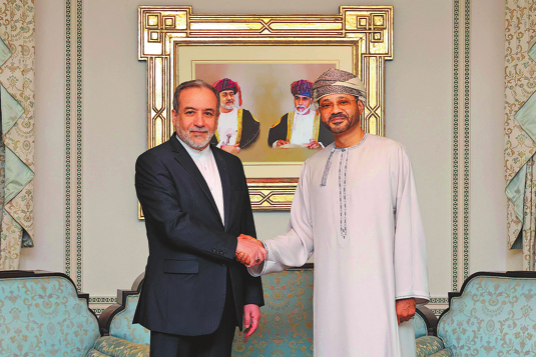
    Diplomatic channels between the United States and Iran reopened on Friday in Muscat, Oman, marking the first bilateral discussions on Tehran’s nuclear program since June. The talks, initially planned as a multilateral meeting in Istanbul, were reconfigured at Iran’s insistence into a direct dialogue within the neutral territory of the Gulf sultanate.

    The negotiations commenced under a cloud of mutual distrust and sharply divergent agendas. Iranian Foreign Minister Seyed Abbas Araghchi emphasized prerequisites for successful diplomacy through a social media statement, declaring that ‘equal standing, mutual respect and mutual interest are not rhetoric—they are a must and the pillars of a durable agreement.’

    Meanwhile, the United States maintained its pressure campaign alongside diplomatic efforts. President Donald Trump issued vague warnings about potential consequences should negotiations fail, while the State Department reiterated its advisory for American citizens to depart Iran immediately. The military dimension remained prominently visible with the USS Abraham Lincoln carrier strike group positioned in regional waters.

    Regional security concerns dominated the backdrop of discussions. Gulf Arab nations expressed apprehension that any military confrontation could escalate into a broader regional conflict. These fears gained credibility following recent incidents including the US downing of an Iranian drone and Tehran’s attempted interception of a US-flagged vessel in the strategically vital Strait of Hormuz.

    According to multiple reports, a proposal mediated by Egyptian, Qatari, and Turkish diplomats suggested Iran halt uranium enrichment for three years, export its highly enriched uranium stockpiles, and commit to non-initiation of ballistic missile attacks. However, Tehran maintained that discussions would exclusively address its nuclear activities, which it insists remain peaceful despite longstanding accusations from Washington and Tel Aviv.

    Analytical perspectives ranged from skeptical to pessimistic regarding the talks’ potential outcomes. Former Iranian diplomat Nosratollah Tajik cited ‘structural issues, the gap between goals and expectations’ as fundamental obstacles. Edmund Fitton-Brown of the Foundation for Defense of Democracies think tank suggested military conflict appeared more likely than diplomatic breakthrough given the significant concessions required from Iran.

  • Back to the Past brings time-travel stories to US screens

    Back to the Past brings time-travel stories to US screens

    A groundbreaking cinematic phenomenon has transcended cultural boundaries as the long-awaited film sequel ‘Back to the Past’ makes its remarkable debut in North American theaters. This cinematic event, originating from Hong Kong’s iconic television series ‘A Step Into the Past’ which itself adapted from a bestselling novel, represents a significant milestone in cross-cultural entertainment exchange.

    The film’s journey to international recognition began with record-shattering performances in Asian markets. Upon its December 31 release in China and Malaysia, the production immediately demonstrated extraordinary commercial appeal, with Hong Kong audiences experiencing unprecedented demand that made tickets exceptionally scarce. The opening day alone witnessed the film achieving the highest number of screenings in Hong Kong’s cinematic history, generating over HK$11 million (approximately $1.4 million) and securing its position as the territory’s highest-grossing opening day champion.

    Nearly a quarter-century after the original series first captivated audiences in 2001, the film reunites the original cast to continue the extraordinary narrative of Xiang Shaolong, a modern police officer accidentally transported to China’s Warring States Period (475-221 BC). The storyline masterfully intertwines historical drama with temporal displacement, exploring themes of identity preservation amidst ancient court intrigues and military conflicts.

    What distinguishes this production within the time-travel genre is its unique cultural approach to temporal displacement. Unlike Western interpretations that typically involve physical time travel, Chinese ‘chuan yue’ narratives emphasize consciousness transmigration—a concept that combines soul migration with temporal movement. This philosophical distinction, as noted by University of Hong Kong scholar Jia Tan in a University of Michigan publication, places the genre closer to fantasy than conventional science fiction, drawing heavily from established period drama and martial arts traditions.

    North American viewers are responding with profound engagement to this distinctive storytelling approach. May Yang, an international student from Guangdong province, expressed how the film evoked powerful nostalgic connections: ‘It brought back a sense of childhood because I grew up watching this series. It feels genuinely moving and nostalgic.’

    Meanwhile, Howard, a retired English teacher and frequent attendee of international film screenings, appreciated the production’s cultural dimensions: ‘I enjoy movies from abroad because they offer insight into different cultural values.’

    The film’s successful trans-Pacific journey underscores the growing appetite for diverse cultural narratives and represents a rare instance of Chinese-style time-travel storytelling reaching mainstream Western audiences, offering both spectacular entertainment and meaningful cultural exchange.

  • Report finds declining Chinese tourists in Japan

    Report finds declining Chinese tourists in Japan

    Japan’s tourism-dependent retail sector faces mounting pressure as a significant decline in Chinese visitors threatens to reshape the country’s economic landscape. The downturn follows diplomatic tensions stemming from Japanese Prime Minister Sanae Takaichi’s controversial remarks on Taiwan in November 2025, which triggered a chain reaction affecting bilateral relations.

    Industry data reveals a stark picture: mainland Chinese arrivals plummeted 45.3% year-on-year in December 2025 to just 330,400 visitors, continuing a downward trajectory from 562,600 in November. The Japan National Tourism Organization’s January report indicates this trend may intensify during the crucial Spring Festival period (February 15-23, 2026), traditionally a peak season for Chinese tourism.

    The economic implications are substantial. Chinese tourists historically contributed 21% of Japan’s 8.12 trillion yen ($51.7 billion) in 2024 visitor spending, particularly favoring luxury goods, cosmetics, and high-end jewelry. The Japan Research Institute projects potential losses reaching 1.2 trillion yen ($7.64 billion) annually if relations continue deteriorating.

    Retail institutions are already feeling the impact. Yoshiharu Nishisaka, executive director of the Japan Department Stores Association, reports approximately 40% declines in both Chinese visitor numbers and sales. ‘The negative impact is so large that gains in other regions cannot fully offset it,’ he noted.

    Profit forecasts paint a concerning picture for luxury retailers. J. Front Retailing anticipates a 53% operating profit decline, while Matsuya Department Store projects an 81% drop. Overall, department stores face an estimated 24% profit reduction for the December-February period according to Nikkei Asia analysis.

    Beyond immediate financial consequences, industry experts warn of longer-term cultural and commercial ramifications. Kenta Maruyama of Mitsubishi UFJ Research notes that reduced tourism diminishes the ‘gateway effect’ through which Chinese visitors develop appreciation for Japanese cuisine and products, ultimately driving demand for Japanese brands within China.

    The situation has prompted official responses. China’s Foreign Ministry issued travel advisories on January 26, 2026, warning citizens to avoid Japan during Spring Festival. Major Chinese airlines concurrently offered flexible rebooking options for Japan-bound flights, facilitating the travel reduction.

    Industry leaders like Hiroyuki Takahashi, chairman of the Japan Association of Travel Agents, express hope for diplomatic resolution, recognizing that restored people-to-people exchanges are essential for both economic recovery and sustained cultural influence.

  • Experts say tariffs stall innovative development

    Experts say tariffs stall innovative development

    A sweeping tariff regime has unleashed widespread disruption across American industry, severely hampering innovation and forcing countless small businesses to abandon product development in favor of mere survival. Economic analysts and corporate leaders report a year of unprecedented stagnation, with supply chain paralysis and soaring manufacturing costs creating a hostile environment for growth.

    The profound impact was notably absent from the world’s largest consumer electronics showcase, CES in Las Vegas, where many exhibitors lacked the new product models that traditionally define the event. This innovation deficit stems directly from tariff-induced operational shifts that have redirected engineering talent from research and development to crisis management.

    Daniel Anthony, President of economic research firm Trade Partnership Worldwide, confirms the alarming trend. ‘We’ve heard from a multitude of businesses where everything simply went on hold,’ Anthony stated. ‘The uncertainty has triggered massive downsizing, reduced sales, and widespread employment cuts across sectors.’

    Kitchen robotics company Suvie exemplifies the crisis. CEO Robin Liss described 2025 as ‘unquestionably the most disruptive year of my career,’ noting the complete cessation of R&D activities following tariff implementation. Previously manufacturing in Suzhou, China, the company experienced significant growth before the policy shift forced radical changes.

    ‘Tariffs are fundamentally anti-innovation,’ Liss declared during a CES panel discussion. ‘We halted all innovation and new product development because our entire engineering team had to relocate to Tijuana and Hanoi to focus on factory construction instead of technological advancement.’

    The relocation solution has proven both costly and inefficient. Liss emphasized the impossibility of replicating China’s manufacturing ecosystem—highly specialized clusters in cities like Suzhou where integrated networks of component makers employ hundreds of thousands of workers. The United States lacks comparable capacity for producing essential components like oven shelves and cabinets, making domestic sourcing impractical.

    Anthony predicts the disruption will persist for years as companies struggle to relaunch product development cycles. Businesses face reduced earnings, higher production costs, and missed revenue opportunities typically generated by new product launches.

    The resolution may ultimately depend on political and judicial intervention. Anthony emphasizes the critical importance of congressional engagement and pending Supreme Court decisions regarding tariff authority. ‘Everyone is hoping someone else solves the problem,’ he noted, suggesting political calculations may determine whether legislative relief emerges.

  • Zelenskyy says US gave Ukraine and Russia a June deadline to reach agreement to end war

    Zelenskyy says US gave Ukraine and Russia a June deadline to reach agreement to end war

    KYIV, Ukraine – In a significant development toward resolving the protracted conflict, the United States has established a June deadline for Ukraine and Russia to negotiate a peace agreement, according to President Volodymyr Zelenskyy. The announcement comes as intensified Russian strikes on Ukrainian energy infrastructure have compelled nuclear power plants to drastically reduce their electricity output.

    Speaking to journalists on Friday under embargo until Saturday, Zelenskyy revealed that the Trump administration intends to exert diplomatic pressure on both nations should they fail to reach an accord by early summer. “The Americans are proposing the parties end the war by the beginning of this summer and will probably put pressure on the parties precisely according to this schedule,” Zelenskyy stated, adding that Washington seeks “a clear schedule of all events” toward conflict resolution.

    The diplomatic push includes plans for unprecedented trilateral negotiations scheduled for next week in Miami—marking the first such meeting on U.S. soil. Ukraine has confirmed its participation in these high-stakes talks.

    Meanwhile, military aggression continues unabated. Russian forces launched over 400 drones and approximately 40 missiles in overnight attacks targeting Ukraine’s energy grid, generation facilities, and distribution networks. Ukrenergo, the state energy transmission operator, confirmed this represents the second massive assault on energy infrastructure this year, resulting in nuclear power plants being forced to reduce output due to damaged high-voltage substations.

    The consequences have been severe: a significant power deficit has compelled authorities to extend hourly electricity outages across all Ukrainian regions, exacerbating humanitarian concerns during winter months.

    In parallel diplomatic channels, Russia presented the U.S. with a staggering $12 trillion economic proposal—dubbed the “Dmitriev package” after Russian envoy Kirill Dmitriev—which forms part of broader bilateral negotiations.

    The June deadline follows inconclusive trilateral talks in Abu Dhabi, where fundamental disagreements persist. Russia continues to demand Ukrainian withdrawal from Donbas—a condition Kyiv unequivocally rejects. Zelenskyy emphasized that “‘We stand where we stand’ is the fairest and most reliable model for a ceasefire today,” indicating that the most challenging topics would require leadership-level trilateral meetings.

    Additional sticking points include management of the Russian-occupied Zaporizhzhia nuclear plant and a U.S. compromise proposal to establish Donbas as a free economic zone—a concept Zelenskyy views with skepticism due to divergent interpretations.

    The U.S. has reiterated its commitment to monitoring ceasefire mechanisms, having previously proposed a ban on energy infrastructure strikes. While Ukraine expresses willingness to observe such pauses, Zelenskyy noted Russia violated a previous week-long cessation agreement after merely four days.

  • Trump says talks with Iran to continue next week

    Trump says talks with Iran to continue next week

    WASHINGTON — In a press briefing held on Friday, U.S. President Donald Trump indicated that diplomatic discussions with Iran would proceed into the following week, characterizing the initial dialogue as “very good.” The announcement signals a potential de-escalation of tensions between the two nations, which have historically been fraught with geopolitical strife.

    The talks, which remain unspecified in their exact nature, are believed to address critical issues such as nuclear non-proliferation, regional security, and economic sanctions. Trump’s optimistic remarks mark a notable shift from previous rhetoric, suggesting a willingness to engage in sustained diplomatic engagement. The continuation of negotiations early next week underscores a commitment to pursuing diplomatic channels over military alternatives.

    International observers are closely monitoring these developments, as the outcome could significantly influence Middle Eastern stability and global energy markets. The decision to extend talks reflects a strategic approach to foreign policy, potentially paving the way for renewed agreements or revised terms of engagement between the longstanding adversaries.

  • Islamic State affiliate claims suicide bombing that killed 31 at Shiite mosque in Pakistani capital

    Islamic State affiliate claims suicide bombing that killed 31 at Shiite mosque in Pakistani capital

    A suicide bombing at a Shiite mosque on the outskirts of Islamabad has resulted in a devastating death toll of 31 individuals, with 169 others wounded, marking the deadliest attack in the Pakistani capital in over a decade. The regional affiliate of the Islamic State group, known as Islamic State in Pakistan, has officially claimed responsibility for the assault in a statement released through its Amaq News Agency.

    According to the terrorist group’s account, the attacker initiated the violence by opening fire on security personnel at the mosque’s main entrance before detonating his explosive vest at the inner gate. The ISIS statement contained explicitly sectarian language, referring to Pakistani Shiites as a ‘human reservoir’ providing recruits to Shiite militias opposing ISIS in Syria, thereby justifying them as legitimate targets.

    This tragic incident represents the most severe bombing in Islamabad since the 2008 Marriott Hotel attack that killed 63 people. The bombing occurs amid a significant surge in militant violence across Pakistan, creating substantial security challenges for Prime Minister Shehbaz Sharif’s government. Pakistani authorities have identified the bomber as a Pakistani national who had recently traveled to Afghanistan.

    In response to the attack, security forces conducted overnight raids in Islamabad and northwestern Pakistan, resulting in multiple arrests including the brother, mother, and other relatives of the suicide bomber. Tragically, one police officer lost his life during these operations.

    On Saturday, more than 2,000 grief-stricken mourners gathered under tight security at the same mosque for funeral services. Senior government officials and Shiite community leaders attended ceremonies for approximately a dozen victims, with remaining funerals scheduled to take place in the victims’ hometowns.

    The attack has drawn strong international condemnation from the United States, Russia, the European Union, and other nations. Prime Minister Sharif expressed gratitude for the global support following what he described as a ‘heart-wrenching suicide attack,’ emphasizing that international cooperation remains crucial to Pakistan’s counterterrorism efforts.

    The bombing has also heightened tensions between Pakistan and Afghanistan’s Taliban government. Pakistan’s Defense Minister Khawaja Mohammad Asif suggested that Pakistan-based militants operating from Afghanistan were responsible for the attack, drawing a sharp response from Afghan authorities who condemned the minister’s remarks as ‘irresponsible.’ Pakistan has repeatedly accused Afghanistan of harboring militants, including members of the Pakistani Taliban (TTP), allegations that Kabul consistently denies.

  • Streamlined services for overseas visitors unveiled

    Streamlined services for overseas visitors unveiled

    China has launched a comprehensive digital initiative designed to eliminate technological barriers for international travelers and non-mainland residents. The Cyberspace Administration of China, in collaboration with ten other government departments, has released the “Implementation Guidelines on Improving the Convenience of Digital Services for Inbound Overseas Visitors,” marking a significant step in the nation’s high-standard opening-up policy.

    The guidelines establish a two-phase roadmap targeting 2027 as the deadline for resolving persistent challenges in telecommunications, mobile payments, tourism, and public transportation systems. The ultimate objective is to achieve world-class digital services that seamlessly integrate local systems with international standards.

    Key measures include modernizing urban rail systems to accept international bank cards, requiring transportation apps to provide multilingual services, and simplifying telecom registration processes for foreign visitors. The policy specifically addresses payment integration challenges by encouraging support for overseas electronic wallets and decoupling mobile payment systems from mandatory domestic phone number verification.

    Additionally, the initiative promotes the development of digital international medical platforms that collaborate with major insurance companies to facilitate secure health record sharing. While advancing these convenience measures, the guidelines emphasize strengthened data security protocols and enhanced personal information protection, particularly for cross-border payments and online reservation systems.

    Industry experts have welcomed the changes, noting that previous systems often operated on domestic assumptions that created obstacles for short-term visitors. The transformation is expected to boost inbound tourism spending, revitalize travel and lodging sectors, and provide new momentum for China’s digital economy development.