When a visitor first steps before *The Court Lady Guoguo’s Spring Outing*, they do not encounter a static record of ancient history. What strikes the eye first is quiet movement. There are no sweeping palace grounds, no blooming riverbank, no leafy flowering trees, no detailed spring landscape to anchor the viewer’s gaze. Across the silk handscroll, only a small procession winds through empty space: nine figures, eight horses, robes dyed soft pale red, muted green and creamy white, moving with the understated rhythm of slow hoofbeats across open ground. This deliberate absence of scenery is not an oversight—it is the core of the work’s genius. The painter does not describe spring; they let it breathe through the riders themselves.
The work, known in Chinese as *Guoguo Furen Youchun Tu*, has long been linked to Zhang Xuan, a master painter of China’s Tang Dynasty (618–907 CE). The original Tang work has been lost to history, and the piece that survives today is a meticulous copy created during the Song Dynasty (960–1279 CE). Now housed as a crown jewel of the Liaoning Provincial Museum, it stands as one of the most valuable surviving visual documents of Tang Dynasty court life. In China’s framework of cultural heritage, it is far more than an ancient painting: it is a national cultural relic, a rare tangible window into the elegance, confidence, and quiet fragility of the High Tang era, when the Chinese empire reached the peak of its early medieval power.
For Western audiences, its place in art history can be framed through comparison to iconic European masterpieces: it sits somewhere between Botticelli’s *Primavera*, Velázquez’s *Las Meninas*, and the shimmering late depictions of European aristocracy drawn on the eve of political collapse. Like *Primavera*, it reframes the spring season as a world defined by human form, rhythmic movement, and effortless grace. Like *Las Meninas*, it is not merely a portrait of its subjects—it is a meditation on social hierarchy, visibility, and proximity to sovereign power. Like Watteau’s fêtes galantes, it captures the quiet luxury of aristocratic leisure with the unspoken awareness that such golden worlds are rarely eternal. Yet this is not Florence, Madrid, or Versailles—this is Tang Dynasty China, a civilization with a distinct cultural identity all its own.
The Tang Dynasty, particularly during the reign of Emperor Xuanzong in the early 8th century, stands as one of the most cosmopolitan eras in Chinese history. Its imperial capital, Chang’an (modern-day Xi’an), was no isolated regional city—it was one of the greatest metropolises of the medieval world, comparable in cultural influence and global reach to Constantinople, Abbasid Baghdad, or Renaissance Florence. Merchants, Buddhist monks, traveling musicians, diplomatic envoys, and skilled craftspeople from across Eurasia walked its streets. The Tang court absorbed Central Asian musical traditions, imported foreign textiles, adopted Buddhist visual imagery, and embraced equestrian culture from the Eurasian steppe. Aristocratic women regularly rode horses, appeared in public spaces, and even wore garments traditionally associated with men. It was this era of unrivaled imperial confidence that gave birth to the world captured in *The Court Lady Guoguo’s Spring Outing*.
At the heart of this historical moment stands Yang Guifei, Emperor Xuanzong’s beloved imperial consort, whose legacy has long been tangled with the fate of the Tang empire. Popular historical memory has often compared her, imperfectly, to Helen of Troy or Marie Antoinette: a woman whose beauty was blamed for the collapse of an era. Yet these comparisons are only a starting point. Yang Guifei was neither a ruling queen like Marie Antoinette nor a mythic figure like Helen. She was a woman of the Tang court whose beauty, family connections, and tragic fate became inextricably linked to the memory of an empire at its most radiant and its most vulnerable.
As Yang Guifei rose in influence, her entire family shared her elevation. Her three sisters were granted noble titles: the Ladies of Han, Guo, and Qin. Among them, Lady Guoguo emerged as one of the most visible and prominent women in the imperial court. She was far more than just a noble beauty. Her family’s sudden proximity to the throne turned private kinship into public political power, much like the court ladies of Versailles who functioned as public symbols of power even as they did not rule directly.
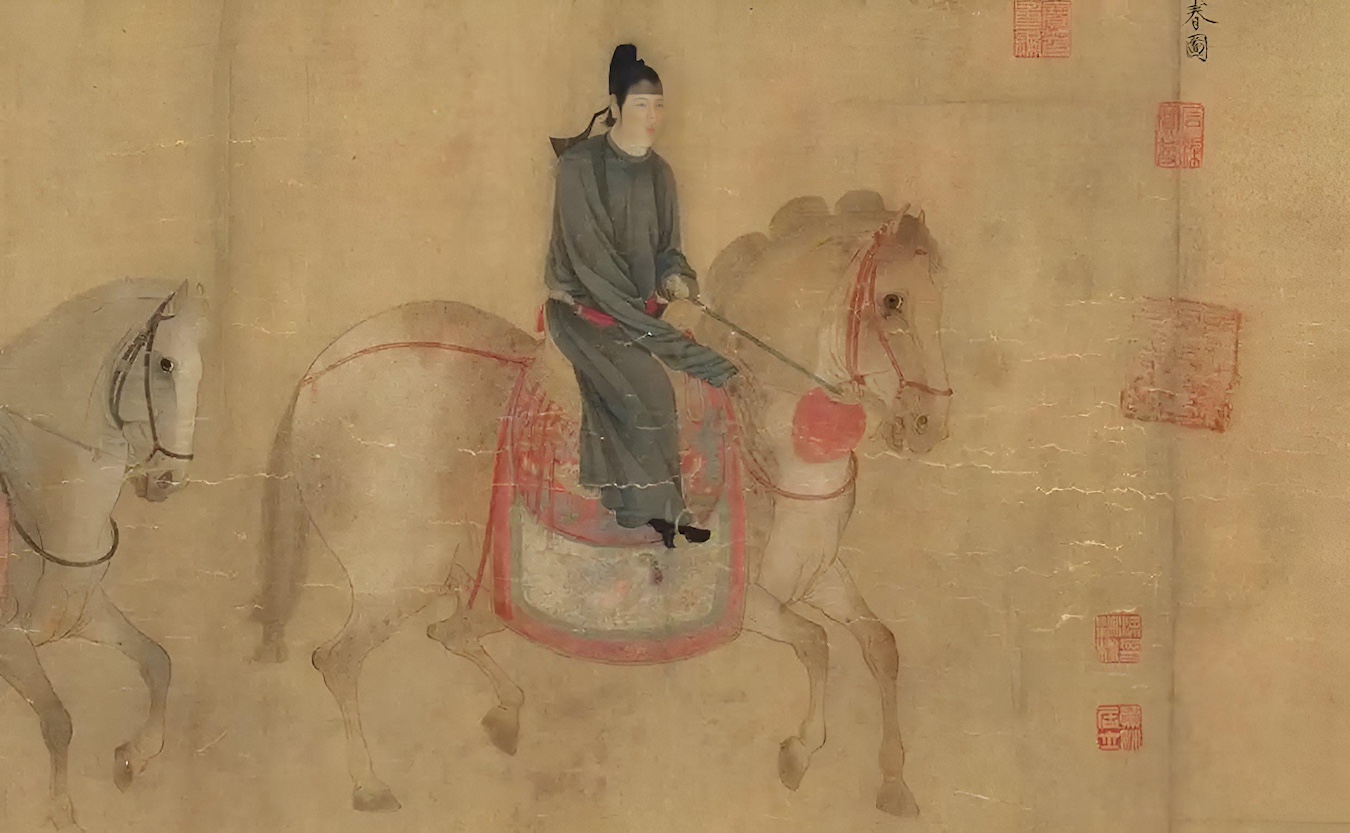
The handscroll depicts this courtly performance without overt drama. The procession is grouped in subtle layers, and the figures do not shout their status through exaggerated gestures—they carry it quietly in their posture. The horses move at varying paces: some stride forward, some turn aside, some seem to pause mid-journey, held in the rhythm of the ride. The robes of the riders fall in controlled, graceful lines, and their faces are calm, almost unreadable. Nothing feels hurried, nothing is accidental.
One of the most compelling scholarly debates around the work centers on the rider leading the procession at the very front of the scroll. Many Chinese art historians argue that this figure, dressed in male attire and guiding the group, is Lady Guoguo herself. This interpretation is not universally accepted, as the painting bears no inscriptions labeling individual figures, and other scholars place Lady Guoguo among the female riders in the central group. Following this reading of the leading figure, however, reveals the most nuanced understanding of the work’s meaning—not because it is the most dramatic interpretation, but because it is the most revealing.
History remembers Lady Guoguo as a woman who did not shrink from public view. She was part of the Yang family at the height of imperial favor, a clan whose female members did not merely inhabit privilege—they made it visible. The horse she rides reinforces this reading: its distinctive three-flower mane, trimmed into three raised tufts along its neck, and the round red tassel ornament (called tixiong) on its chest are clear markers of high rank, ceremonial status, and aristocratic display. If this leading figure is indeed Lady Guoguo, placed at the front of the procession, dressed as a young nobleman, and mounted on such a distinguished animal, she is not merely joining a spring ride—she is announcing her presence. She is the first figure viewers see because she is the figure meant to be seen.
If this interpretation holds, the painting becomes quietly radical for its time. In Tang court tradition, a high-ranking noblewoman would typically be shielded in the middle of a retinue, surrounded by attendants, protected by hierarchy and social distance. Rank in courtly society was expressed not just through luxury goods, but through spatial placement. Being positioned in the center meant protection; riding at the front meant being seen first and claiming public space.
The front rider’s clothing, posture, and mount therefore carry profound meaning. Male attire for elite women was not unheard of in Tang China, but on a figure of Lady Guoguo’s standing, it becomes more than a fashion statement—it is a deliberate declaration of presence and power. The horse, too, is far more than a decorative prop. In Tang court culture, a rider’s mount, its trappings, and its position in the procession all communicated clear signals of social status. A noblewoman on horseback was fundamentally different from a woman hidden away in a closed carriage: she occupied public space, she stepped out into the world.
The details of the horse deepen this meaning. In Tang equestrian culture, manes were clipped into decorative styles known as one-flower, two-flower, and three-flower. The three-flower mane, the most distinctive of these styles, was an immediate visual sign of rank, refinement, and aristocratic privilege. The round red tassel on the horse’s chest also carried ceremonial meaning. In *The Court Lady Guoguo’s Spring Outing*, these details are not incidental decoration: they turn the horse into a visible marker of identity, hierarchy, and courtly display. This is why the painting still feels vivid and alive more than a millennium after it was copied—it is not a portrait of passive feminine beauty, but a record of intentional female visibility.
The scene also carries a famous echo in Tang poetry. Du Fu, one of China’s greatest poets, wrote of the third day of the third lunar month, a traditional spring outing day: “The air is clean and mild; by the waters of Chang’an gather many fair women.” His poem *Liren Xing* (The Beautiful Women), which is often studied alongside this painting, gives verbal form to the same world of aristocratic spring outings, courtly women, and uneasy luxury. Du Fu painted the riverbank in words; Zhang Xuan (or the Song copyist following his tradition) painted the procession on silk. Together, poem and image preserve the atmosphere of a civilization confident enough to turn leisure into a monument.
Yet even as the painting captures this moment of golden calm, history was already turning toward catastrophe. Just years after the spring outing it depicts, the An Lushan Rebellion tore across the Tang empire, ending the era of High Tang prosperity. During the imperial court’s flight from Chang’an, Yang Guifei was forced to die at Mawei, and the entire Yang family, once so close to the throne, became the target of a moral and political reckoning. The painting does not show this coming disaster—and that is precisely its power. It gives audiences the still, calm moment just before the world breaks apart.
The painting’s own journey through history is no less dramatic than the fall of the Tang court. The original Tang work disappeared centuries ago, and only the Song copy survived. It passed through multiple imperial collections and was recorded in the *Shiqu Baoji*, the Qing Dynasty court’s comprehensive catalogue of imperial art holdings. In the 20th century, after the fall of the Qing Dynasty, the last emperor Puyi moved hundreds of palace paintings and calligraphies out of the Forbidden City under the pretext of awarding them as imperial gifts. The handscroll eventually traveled with Puyi from Beijing to Tianjin, then to Changchun in Manchukuo, the Japanese-backed puppet state in northeast China, where it was stored in the former imperial palace.
In August 1945, as Japan surrendered and Manchukuo collapsed, Puyi fled the city. He selected more than one hundred of the most precious works from the palace collection to carry with him, and *The Court Lady Guoguo’s Spring Outing* was among them. At Shenyang’s Dongta Airport, Soviet forces detained Puyi, and the collection of paintings was seized. They were later transferred to Chinese custody, and eventually entered the collection of the Northeast Museum, which is today’s Liaoning Provincial Museum. The irony of the painting’s survival is striking: a depiction of serene aristocratic leisure outlived centuries of upheaval because a fleeing emperor failed to escape with it.
The modern history of the painting also includes a quiet, uncelebrated figure: Feng Zhonglian, a 20th-century Chinese artist. As art scholar Jeffrey Sze recounts, a friend once shared Feng’s story with a personal intimacy that never appears on museum labels: Feng was his maternal grandmother. A pioneering modern artist and one of the leading experts in copying ancient Chinese masterworks, Feng was entrusted in 1954 to create a careful copy of the Song Dynasty version of *The Court Lady Guoguo’s Spring Outing*. Her task was not to reinterpret the work through a modern lens, but to set aside her own artistic identity to preserve the original. She had to study the original silk, brush lines, mineral pigments, the aging of the surface, and the subtle rhythm of the original work to replicate it faithfully.
Feng was no mechanical copyist. She was a trained artist with the skill to suppress her own individual style—a mark of the highest discipline in the tradition of copying ancient Chinese painting. In Western art practice, restoration most often focuses on conservation; in China, the tradition of copying ancient masterworks is also a form of cultural transmission. Feng did not insert herself into the painting; she helped the original work remain visible for future generations.
This is what makes *The Court Lady Guoguo’s Spring Outing* far more than a portrait of Tang Dynasty beauty. It is a chain of survival across centuries: Zhang Xuan’s lost Tang original, the Song copy that preserved its composition, the Qing imperial collection that safeguarded it, Puyi’s removal from the Forbidden City, its wartime seizure in Shenyang, its placement in public museum custody, and Feng Zhonglian’s disciplined act of modern transmission. The handscroll depicts a spring day, but its own history is a story of endurance.
On the scroll, Lady Guoguo and her companions continue to ride through an unpainted landscape. All around them is empty silk. Across that empty space, dynasties have fallen, emperors have fled, wars have ended, museums have been built, and artists have worked in quiet discipline to ensure that this ancient spring can still be seen by modern audiences. That may be the work’s true meaning: it is not just a snapshot of a Tang Dynasty spring, it is a testament to a Chinese cultural legacy that has survived the ravages of time.