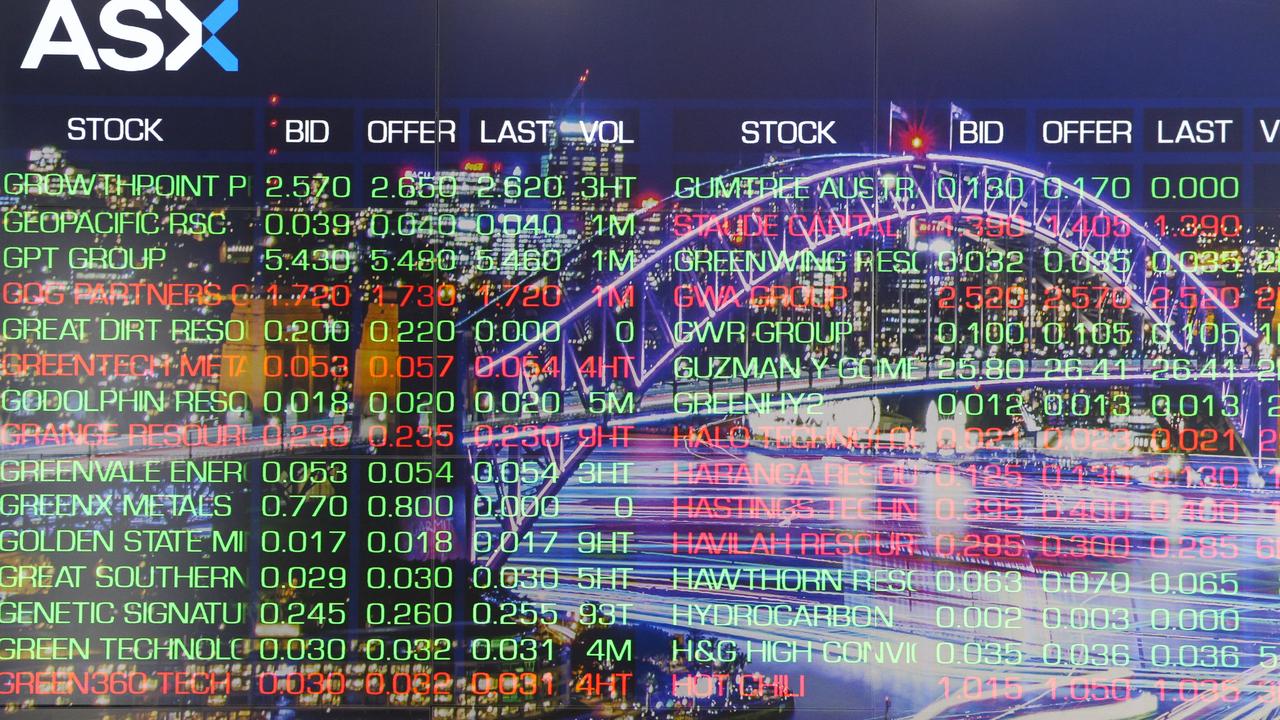
Australia’s benchmark sharemarket delivered a rollercoaster trading session on Tuesday, closing with modest losses after a dramatic late recovery that erased most of an early 100-point drop, as conflicting geopolitical developments out of the Middle East and a larger-than-expected minimum wage hike created widespread uncertainty among investors.
The ASX 200, Australia’s primary blue-chip index, finished the day down 20.60 points, or 0.24%, to settle at 8708.80. The broader All Ordinaries index fared slightly better, slipping just 3.80 points, or 0.04%, to close at 8966, a near-flat finish. The Australian dollar edged slightly higher, gaining 0.15% to trade at 71.75 US cents by market close.
For market observers, the day’s wild swings were far from unusual. IG market analyst Tony Sycamore noted that Tuesday’s triple-digit intraday range marked the third such extreme shift in the past four trading sessions, and the ninth in just one month. “This is a clear sign of a market grappling for direction, primarily stuck within a stubborn 8500 to 8700 range,” Sycamore explained. The afternoon turnaround, he added, received partial support from U.S. President Donald Trump’s remarks downplaying rising geopolitical tensions that flared up over the weekend.
Geopolitical volatility stemmed from mixed signals over a potential Middle East peace deal. While Trump posted on Truth Social that ceasefire talks between Israel and Hezbollah were “progressing”, and that a deal to extend the truce and reopen the strategically critical Strait of Hormuz could be reached within the next week, Iran pushed back against the prospect, threatening to suspend diplomatic relations and close the key shipping lane. The conflicting updates kept investors on edge through the first half of the trading day.
Against this backdrop of macro uncertainty, the technology sector emerged as the clear outlier, driving the afternoon market recovery. The entire tech sector rallied 4.71% for the day, with standout gains from leading domestic tech names. Accounting software provider Xero climbed 7.47% to close at $87 per share, logistics tech firm WiseTech Global jumped 7.8% to settle at $42.23, and consumer safety tech company Life360 notched a 13.25% gain to reach $23.07 per share. Several other individual companies also posted strong gains on new contract wins: infrastructure firm SRG Global surged 16.56% to $3.66 after announcing $1.85 billion in new contracts spanning water, defence, energy, health and education; defence technology provider DroneShield gained 3.55% to $3.21 on a $24.9 million U.S. government contract; and medical imaging firm Pro Medicus rose an additional 10.81% to $160.08 following Monday’s announcement of a five-year contract with U.S.-based Visage Imaging.
Offsetting these tech gains were broad declines across seven of the ASX’s 11 sectors. Healthcare stocks bore the brunt of the selling: biotech giant CSL fell 1.74% to $92.56, Sigma Healthcare dropped 1.71% to $2.87, and medical device maker ResMed slid 2.07% to $26.02.
Retail and banking stocks also slumped after Australia’s Fair Work Commission announced a 4.75% minimum wage increase for the nation’s lowest-paid workers. The pay bump came in above current annual inflation of 4.2% and baseline national wage growth of 3.3%, stoking fears that higher labor costs will push inflation higher and force the Reserve Bank of Australia (RBA) to implement additional interest rate hikes sooner than expected.
Major domestic retailers felt the selloff immediately: Woolworths fell 1.85% to $34.41, Coles dropped 0.74% to $21.55, and hospitality group Endeavour Group slid 1.73% to $28.40.
AMP economist My Bui explained that while the wage adjustment was a reasonable move to prevent low-income workers from facing negative real wage growth, its broad impact across the Australian workforce could put sustained upward pressure on inflation. As a result, AMP has updated its interest rate forecast to predict a third RBA rate hike as early as November, pushing the peak cash rate for this cycle to 4.85%. Bui added that there is even a risk the hike could come sooner, in June rather than August. Prior to Tuesday’s minimum wage announcement, AMP had projected the next rate hike would not occur until August 2026.
Despite the overall negative close, investors found some reassurance in the market’s ability to recover from early losses, with the 100-point afternoon rebound turning what looked set to be a sharp drop into a modest decline by the closing bell.