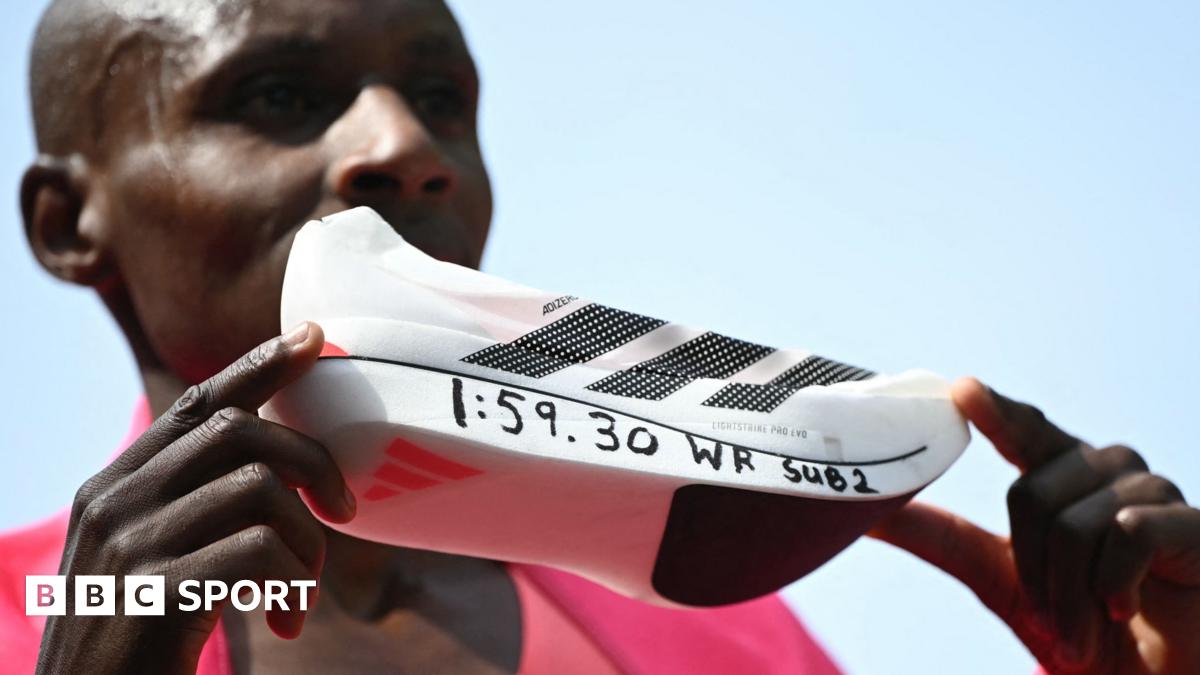
The world of long-distance running has been sent into a frenzy of debate following one of the most groundbreaking achievements in the sport’s modern history: 31-year-old Kenyan runner Sabastian Sawe becoming the first competitive athlete to complete a marathon in under two hours at the 2025 London Marathon. Sawe crossed the finish line with a time of 1 hour 59 minutes 30 seconds, breaking a barrier that experts and athletes alike once viewed as an unbreakable limit of human physical endurance. Not far behind him, Ethiopian runner Yomif Kejelcha also finished under the two-hour mark, just 10 seconds adrift of Sawe, while women’s winner Tigst Assefa set a new women’s marathon world record on the same day. All three athletes shared one common detail that has sparked global conversation: they all wore the new Adidas Adizero Adios Pro Evo 3, the latest iteration of the controversial “super shoe” technology that has redefined elite marathoning over the past decade.
Speaking to BBC Sport Africa on the sidelines of the upcoming World Relays event in Gaborone, Botswana, World Athletics President Sebastian Coe pushed back against calls to restrict or ban advanced shoe technology, arguing that stifling innovation has never benefited any industry or society. “I don’t think any society, any civilisation, any sector of the economy has been served well if you try to strangle innovation,” Coe stated. He clarified that World Athletics’ role sits at the intersection of enabling technological progress and upholding fair competition, noting that the governing body carries a clear responsibility to regulate the space to prevent unfair advantages.
The Adidas super shoe worn by the London podium finishers marks a new milestone in footwear innovation: it is the first elite racing shoe to weigh less than 100 grams, lighter than a standard bar of soap. Adidas claims the proprietary technology built into the shoe improves running efficiency by 1.6%, a small but potentially decisive margin in a race decided by seconds. Sawe himself has praised the design, calling it the best shoe he has ever raced in, highlighting its exceptional lightness and stability. However, cutting-edge technology comes at a steep price: consumers looking to purchase the shoe will pay roughly $500 for a pair, putting it out of reach for many recreational runners.
Coe pushed back against the narrative that super shoes are the primary driver of recent record-breaking performances, arguing that athlete mentality, physical conditioning, high-level coaching and federation support programs remain the most critical factors behind improved results. Sawe’s own preparation backs this framing: he cut more than two minutes off his personal best at the London race, a gain he attributes largely to his rigorous training routine of 200 kilometers per week at altitude, as well as improved race fuelling strategies that saw him consume 115 grams of carbohydrates per hour during the event, after a pre-race breakfast of just two slices of bread with honey and tea. After returning to his home country of Kenya following his historic win, Sawe gifted one of his record-setting shoes to Kenyan President William Ruto during jubilant homecoming celebrations in Nairobi.
The growing prevalence of super shoes has forced World Athletics to evolve its regulatory framework over the past decade. The first wave of widespread debate around the technology emerged at the 2016 Rio Olympics, where all three men’s marathon medallists wore prototype versions of the Nike Vaporfly 4%, which claimed a 4% improvement in running performance. By 2020, World Athletics introduced formal rules limiting sole thickness, carbon-fibre plate design, and requiring all shoe technology to be commercially available, in an effort to prevent sportswear brands from gaining an unfair edge through unapproved custom designs.
As major brands continue to push the boundaries of current regulations, Coe confirmed that the rulebook will continue to evolve alongside technology. He described the regulatory process as an inherently evolutionary journey, noting that World Athletics only recently established a formal evaluation system for new footwear designs. “We work closely with the athletes, the coaches, the shoe companies. We don’t want them to go off and spend hundreds of millions of dollars on shoes that we’re going to find illegal. So there is a balance,” Coe explained. He also highlighted an often-overlooked benefit of advanced footwear design: much of the research that improves performance also leads to innovations in injury prevention, allowing athletes to train longer, compete longer, and sustain longer careers in the sport — an outcome Coe described as an unambiguous positive.
Reflecting on his own legendary career as a two-time Olympic 1500-meter champion, Coe joked that even with modern super shoes, he would not have been capable of running a sub-two-hour marathon, though he acknowledged the technology would have helped him clock a faster time in his signature 800-meter event.
Critics of super shoe technology argue that the issue goes beyond simple regulation, warning that excessive reliance on engineering could erode the core identity of distance running, turning record performances into a victory for lab technology rather than human grit and endurance. Coe acknowledged these concerns but said he believes World Athletics has struck the right balance so far. “Life is always about balances,” he said. “I think at World Athletics we have technical teams that are always going to be conscious of where that balance is. At the moment, I think we’re the right side of it.”