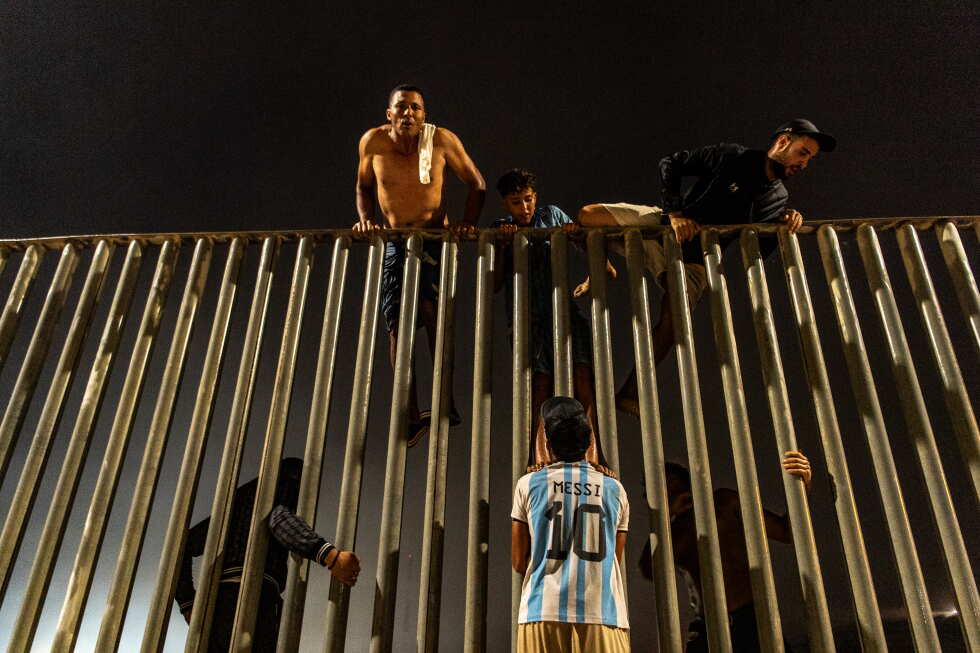
A devastating humanitarian emergency has unfolded on the border between Morocco and Spain’s North African exclave of Ceuta, where at least 18 migrants have lost their lives in a mass crossing attempt that left thousands of people stranded in the tiny territory with no basic shelter or support.
The crisis began earlier this week when thousands of migrants breached the fortified border between Ceuta and Morocco, pouring into Spanish territory in an unprecedented surge of arrivals that forced the Spanish government to deploy active-duty military personnel to the area. Spanish Prime Minister Pedro Sánchez is scheduled to travel to Ceuta on Friday morning alongside Interior Minister Fernando Grande-Marlaska to assess the unfolding situation firsthand.
Rachid Sbihi, head of a local workers association that represents Civil Guard officers, described the chaotic scene as nothing short of a “serious humanitarian crisis.” Speaking to reporters, Sbihi confirmed that new crossings are continuing even as emergency responders struggle to meet existing needs. “The reinforcements that have arrived are only helping the injured and other humanitarian efforts,” he explained, noting that thousands of migrants — including dozens of unaccompanied minor children — have been forced to sleep on public sidewalks and in city parks, with no access to warm shelter or basic hygiene facilities. Many more wander the streets of Ceuta with no clear destination or plan, leaving the entire territory in disarray. “It’s chaotic,” Sbihi added.
Of the 18 confirmed fatalities, most drowned while attempting the crossing by sea, while others were killed in a deadly stampede as crowds pushed through the breakwater fence at Tarajal beach, Sbihi said. Video footage captured on Thursday shows large crowds, predominantly of Moroccan origin, walking across Tarajal beach’s breakwaters onto local Ceuta roads. While most of the new arrivals are young adult men, video also captured entire families, including women and young children, making the crossing. Some migrants shouted “Viva España!” to an Associated Press freelance photographer documenting the event.
By late Thursday, the photographer observed a continued back-and-forth movement: new crowds gathered on the Moroccan side of the border preparing to cross, while some of the people who had already entered Ceuta were attempting to return to Morocco.
To date, the root cause of the sudden massive surge in crossings remains unclear. Moroccan government authorities have not issued any public statement on the event, and the country’s Interior Ministry did not respond to multiple requests for comment from reporters. Local Ceuta authorities have preliminarily linked the increase in arrivals to a recent ruling by Spain’s Supreme Court, issued earlier this month, which bars Spanish officials from immediately turning back migrants who arrive by sea without first granting them due process. That ruling does not apply to migrants who enter Spanish territory by land, including those who climb over the existing border fence. Even so, some migrant rights activists based in Morocco have cast doubt on that explanation, arguing that most migrants attempting the crossing would not have been aware of the nuanced Spanish legal ruling.
The chaos in Ceuta has already spilled over to impact other European nations, including Italy, which is another major destination for migrants traveling through North Africa. Italian Premier Giorgia Meloni has threatened to suspend Italy’s participation in the Schengen Area, the European Union’s open-border agreement, with Spain in response to the crisis — a move that experts have called symbolic, as Italy shares no direct land border with Spain. “To defend our borders and ensure the safety of our citizens,” Meloni said in justifying her threat.
Ceuta is one of two Spanish exclaves located on the northern coast of Africa, surrounded entirely by Moroccan territory. For decades, it has been a primary entry point for migrants seeking to reach the European Union, where many hope to access better economic opportunities or escape conflict and political violence in their home countries. Migrants typically make the short crossing from the Moroccan coastal town of Fnideq, swimming roughly three miles (five kilometers) to reach Ceuta’s shores, while others depart from the closer town of Belyounech where the crossing distance is shorter. Reporting for this story was contributed by Naishadham from Madrid.