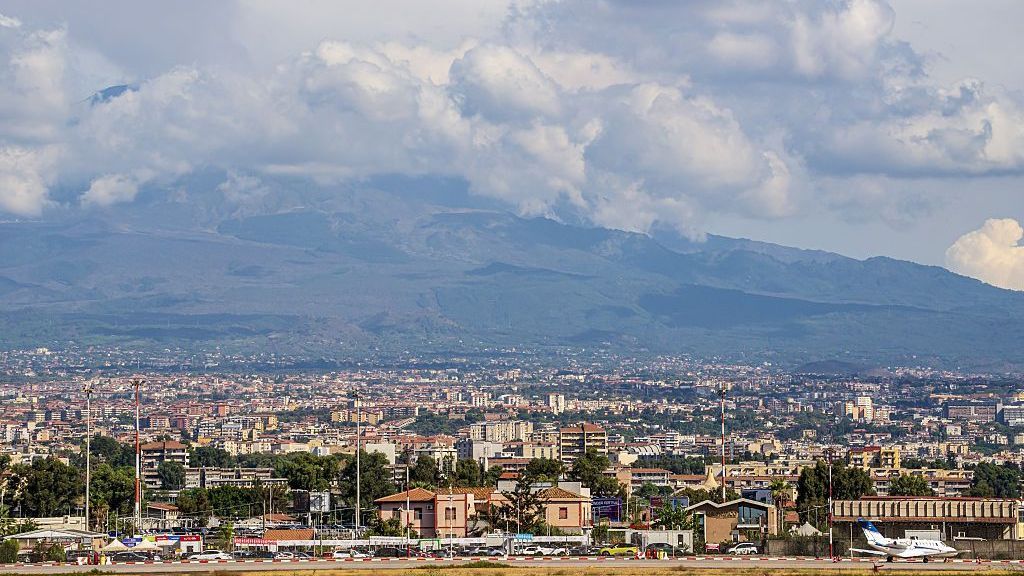
One of Italy’s busiest air hubs has been forced to ground all flights after Europe’s most active volcano sent a plume of volcanic ash drifting across its flight paths, disrupting travel plans for thousands of passengers.
Catania International Airport, located on the island of Sicily, suspended all arrivals and departures starting Monday, with the shutdown set to remain in place until 10 p.m. local time (8 p.m. GMT) Tuesday. This marks the second major disruption to airport operations in recent months driven by volcanic activity from nearby Mount Etna, a 3,324-meter (10,906-foot) peak that is the tallest active volcano on the European continent, and one of the most frequently erupting volcanoes globally.
The ongoing volcanic unrest prompted Italy’s National Institute of Geophysics and Volcanology (INGV) Etneo Observatory to issue its highest-level red aviation alert on Monday, a warning designation that signals immediate danger to aircraft from volcanic ash. As a major travel gateway for Sicily, Catania ranks as Italy’s fifth-busiest airport by annual passenger volume, serving roughly 12 million travelers each year. Airport officials confirmed Tuesday that further operational updates will be released as conditions change, and urged all passengers scheduled to travel through the hub to contact their airline directly for the latest flight information before heading to the airport.
The current shutdown is not an isolated incident. Just last month, during the peak summer travel season, the same airport was closed for nearly a full week due to Etna’s volcanic activity. The repeated disruptions have reignited longstanding public and policy debate over the future of Catania Airport: located just 40 kilometers (25 miles) from the volcano’s crater, many have called for the facility to be permanently closed, with resources redirected to expand alternative air infrastructure across Sicily.
Despite the consistent risks to air travel, Mount Etna remains one of Sicily’s most popular tourist attractions. The volcano draws roughly 1.5 million visitors annually, and even August’s disruptive eruption drew large crowds of sightseers who gathered to view the active lava flows. Volcanologists note that frequent eruptions are a normal characteristic of Etna’s activity, though changing wind patterns and eruption intensity can create unpredictable hazards for surrounding populated areas and infrastructure.