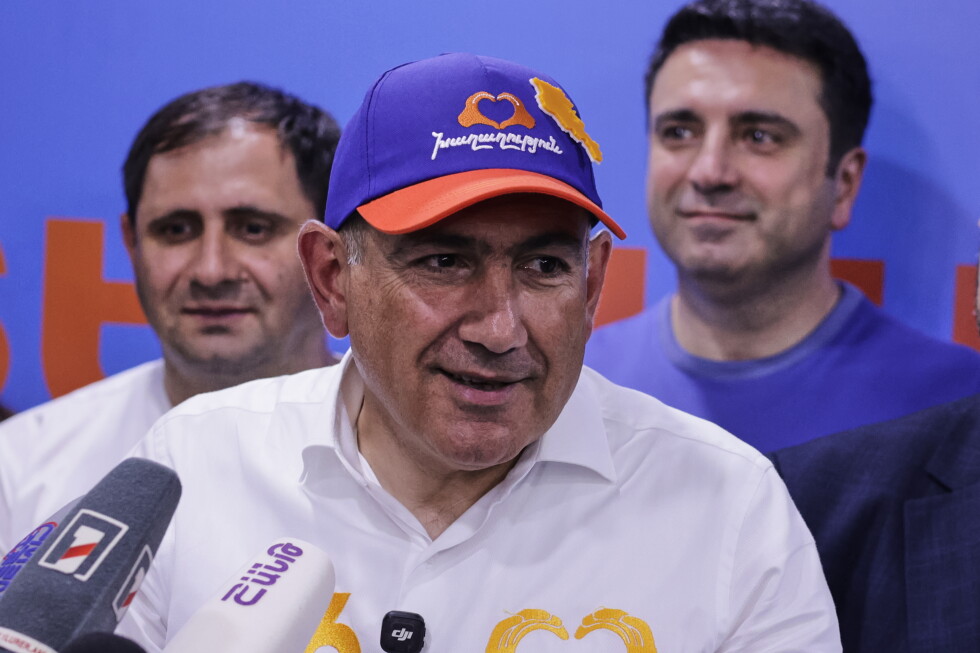
YEREVAN, Armenia — Armenia’s Central Electoral Commission has formally validated the results of the country’s June 7 general election, confirming that Prime Minister Nikol Pashinyan’s ruling Civil Contract Party secured a decisive victory in a poll widely framed as a defining vote on the nation’s geopolitical alignment and a major test of Russian influence in the South Caucasus. Final vote tallies show Civil Contract captured 49.7% of the popular vote, a result that grants the party an outright majority of 64 seats in the 101-seat National Assembly, clearing the way for Pashinyan to form a new government independent of coalition negotiations.
This election unfolded against an unprecedented backdrop of geopolitical tension, as Pashinyan’s administration has openly pursued deeper economic and political integration with the European Union and the United States, breaking with Armenia’s decades-long close alignment with Moscow — a shift that Pashinyan’s pro-Russian opposition has centered its campaign against. The main opposition bloc, pro-Russian Strong Armenia, led by Russian-based billionaire Samvel Karapetyan, secured 29.2% of the vote for 29 assembly seats, while former President Robert Kocharyan’s Armenia Alliance took 12 seats. As commission officials met to finalize the results Sunday, Strong Armenia and allied opposition groups held a protest rally outside the commission headquarters, submitting a formal appeal to annul the vote over unsubstantiated claims of widespread electoral violations.
The post-preliminary result period, which stretched from the June 8 preliminary announcement to the final Sunday confirmation, was designed to give all political parties time to file complaints over perceived irregularities. Leading up to election day, Armenian law enforcement issued six arrest warrants for Strong Armenia members on vote-buying charges, and Karapetyan himself remains under house arrest, accused of inciting the overthrow of Pashinyan’s government — a charge he denies, framing it as a politically motivated fabrication.
International monitors from the Organization for Security and Co-operation in Europe (OSCE) concluded that the election offered Armenian voters a genuine competitive choice, but noted the contest was marred by highly confrontational, divisive political rhetoric and unequal access to campaign resources for competing parties. Crucially, monitors also explicitly labeled pre-election trade restrictions imposed by Moscow as “direct pressure” on the Armenian electorate.
In the weeks before voting, Russia implemented sweeping import bans on a range of Armenian goods, including cut flowers, premium cognac, wine, eggplant, potatoes, dried fruit, and fish. Moscow has claimed the restrictions were rooted in agricultural safety violations, but European Commission President Ursula von der Leyen condemned the move as “economic coercion” that weaponized trade for political gain, announcing a €50 million ($58 million) EU support package for Armenia to offset economic losses from the bans.
Geopolitical orientation dominated campaign discourse from start to finish. Casting his ballot on election day, Pashinyan reaffirmed his government’s commitment to Western integration, stating: “The European Union is our main partner in democratic reform implementation, and we will continue that path.” Last year, Armenia formally submitted its EU membership candidacy, a historic step that has drawn sharp pushback from the Kremlin. Russia, which maintains a permanent military base on Armenian territory, has repeatedly warned that a Western turn would carry severe political and economic consequences, with President Vladimir Putin drawing explicit parallels between Armenia’s current trajectory and Ukraine’s pre-2022 EU alignment bid.
The growing rift between Yerevan and Moscow stems largely from the 2023 Azerbaijani recapture of the Nagorno-Karabakh region, a territory controlled by ethnic Armenian separatists backed by Yerevan for three decades. Pashinyan’s government has publicly accused Russian peacekeepers deployed to the region of failing to intervene to stop Azerbaijan’s military offensive, a criticism Moscow has rejected amid its own preoccupation with the ongoing war in Ukraine.
Over the past two years, Pashinyan has steadily reduced Armenia’s reliance on Moscow: in 2023, Yerevan joined the International Criminal Court (which has issued an arrest warrant for Putin), and in 2024 it suspended its membership in the Russia-led Collective Security Treaty Organization, a post-Soviet military bloc. Earlier this year, Armenia hosted the European Political Community summit and its first standalone high-level summit with the EU in Yerevan, and in August 2025 U.S. President Donald Trump mediated a landmark peace deal between Pashinyan and Azerbaijani President Ilham Aliyev to end the decades-long Karabakh conflict, including provisions for a new transit corridor connecting Azerbaijan to its Nakhchivan exclave.