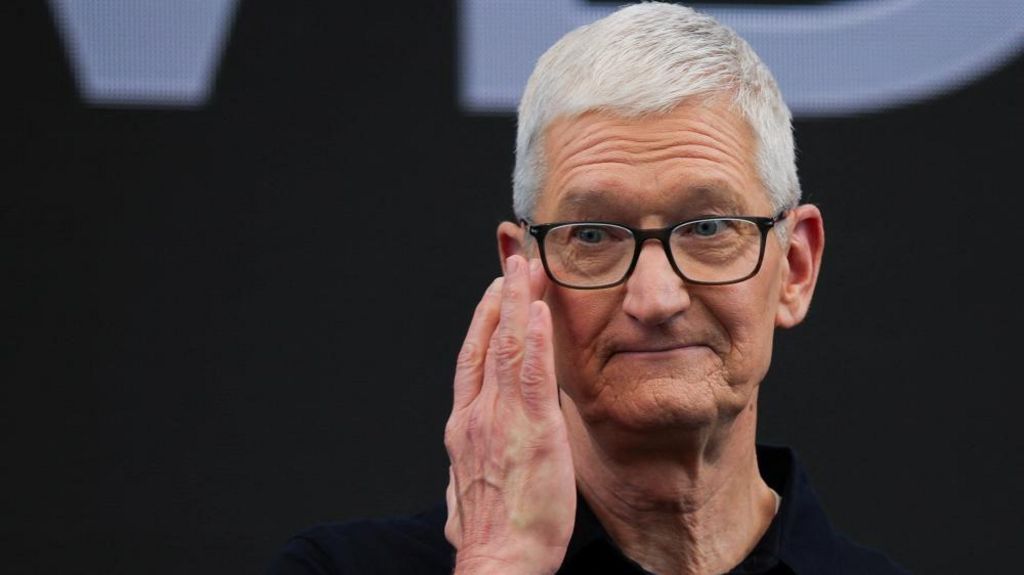
At Apple’s 2026 annual Worldwide Developers Conference (WWDC) held at Apple Park, the tech giant announced two major updates alongside marking a historic leadership transition: this event will be outgoing CEO Tim Cook’s last WWDC at the helm before he steps down in September after 15 years leading the company.
Cook, who took over the role from co-founder Steve Jobs shortly before Jobs’ passing in 2011, received a warm standing ovation from thousands of attending developers and employees. Opening his farewell remarks with a lighthearted joke about the sea of personal devices in the room, Cook grew emotional as he reflected on his tenure. “It has been the honor of a lifetime to serve as Apple’s CEO,” he said, adding that the creativity and impact of Apple’s developer community had inspired him throughout his 15 years in the top role. Cook’s successor, current hardware engineering head John Ternus, did not speak during Monday’s main keynote address but appeared alongside Cook at a post-event media briefing for the new Siri AI launch and greeted attendees at a Sunday welcome reception, which industry analysts frame as an informal introduction to his new leadership.
The headline announcement from the conference is a full overhaul of Apple’s longstanding digital assistant, reintroduced as Siri AI. The move comes after years of industry criticism that Apple has fallen behind competing tech giants in generative artificial intelligence development. The upgraded Siri AI will be integrated across Apple’s full product ecosystem and all native third-party apps, with a new standalone experience similar to the chat interfaces offered by OpenAI and Anthropic for their AI tools.
Apple says the new assistant will leverage context from a user’s past interactions, visual recognition capabilities and broad general knowledge to deliver a far more capable, natural conversational experience than the current Siri. Craig Federighi, Apple’s senior vice president of Software Engineering, used the launch to push back against what he framed as reckless AI development across the industry, saying: “We’ve seen AI built for the sake of AI, without considering the people it is supposed to serve. Truly helpful AI has to be centered around you and your needs.” Federighi emphasized that user privacy was baked into Siri AI’s design at every stage of development, a key differentiator from competing offerings.
Industry analysts note that the launch marks Apple’s formal answer to growing calls for the company to close its AI gap with rivals. “Apple had to address its long-recognized shortcomings in AI, and WWDC gave the company a platform to lay out its plan,” said Ben Wood, chief analyst at industry research firm CCS Insight. “Now Apple must prove that its privacy-first, deeply integrated approach delivers a meaningfully better everyday experience, not just parity with competitors. Success will ultimately be judged by how users respond once the new features are in their hands.”
A beta version of Siri AI will roll out to supported English-language devices later this year, but users in the European Union will not gain access immediately. Apple confirmed in a Monday release that EU regulators rejected all of the company’s proposed compliance frameworks that would allow Siri AI to launch while meeting the bloc’s requirements for supporting competing virtual assistants. The new Siri AI is built on Apple Foundation Models, a partnership announced earlier this year that leverages Google’s Gemini architecture and cloud infrastructure.
Alongside the AI overhaul, Apple also announced a suite of updated trust and safety features for iOS 27 aimed at improving child protection, responding to ongoing criticism from child safety advocates that the company has not done enough to protect young users. Ahead of Monday’s keynote, a small group of protesters gathered outside Apple Park to demonstrate against Apple’s existing policies. Sarah Gardner, a representative of advocacy group the HEAT Initiative, chained herself to a tree outside Apple’s visitor center, demanding that Apple remove all AI “nudification” tools from the App Store and purge all known child sexual abuse material (CSAM) from iCloud. Gardner claimed Apple has earned at least $177 million in revenue from sexually explicit AI deepfake applications available on its platform. Apple has countered that nudification apps violate its platform guidelines, and that the company proactively rejects and removes non-compliant apps from the store.
The new safety tools include an expansion of Apple’s parental control “ask” feature, which requires parental approval before a child can initiate a conversation with an unknown contact. The company will also automatically filter and censor any image sent to a registered child’s device that its systems flag as inappropriate sexual or violent content. “We’re delivering powerful, easy-to-use tools for parents to manage what kids can see, who they can talk to, and when they can access their devices,” Federighi said. The announcement comes the same day that UK Labour leader Keir Starmer gave a speech calling on all major tech firms including Apple and Google to block under-18s from accessing non-consensual nude images on mobile devices.
Industry analysts say the 2026 WWDC sets a clear strategic direction for Ternus’ upcoming tenure. “WWDC 2026 gives Ternus a clear strategic runway: more personal devices, more contextual software, more intelligent services and a tighter integration between silicon, hardware and AI,” said Francisco Jeronimo, vice president for data and analytics at IDC EMEA. “If Apple delivers the experience with the reliability, elegance and user trust that the brand is known for, this could go down as the moment Siri and Apple Intelligence moved from the background of Apple’s ecosystem to the center of the company’s future.”