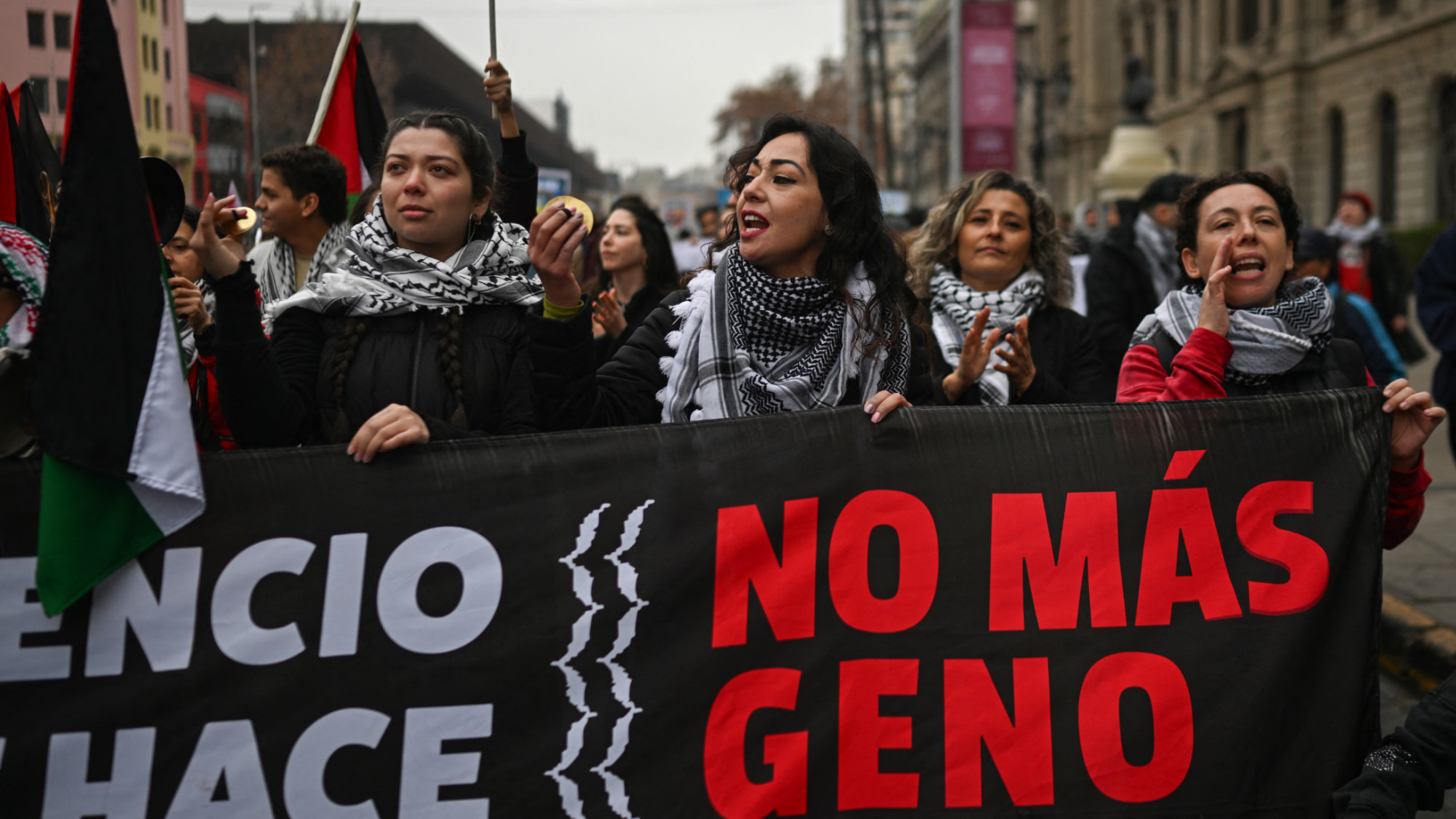
Across Latin America, a growing wave of conservative right-wing leadership is reshaping decades of regional foreign policy, abandoning the longstanding pro-Palestine solidarity that defined the so-called “pink tide” of left-wing governance to deepen strategic and diplomatic ties with Israel. Nowhere is this policy reversal more striking than in Chile, home to the largest Palestinian diaspora community outside the Arab world and North Africa.
Chile’s new president, Jose Antonio Kast, took office in December 2023 after a campaign focused on curbing immigration, strengthening national security, and slashing public spending. A self-professed admirer of Chile’s former authoritarian dictator Augusto Pinochet, Kast’s populist, hardline rhetoric aligns closely with other rising right-wing leaders across the hemisphere: Argentina’s austerity-focused Javier Milei, El Salvador’s authoritarian leader Nayib Bukele, and former U.S. President Donald Trump, whose approach to cementing U.S. influence in the Americas has been dubbed the “Donroe Doctrine” by political observers.
Kast is far from alone in this regional shift: newly elected leaders in Bolivia, Costa Rica, and Honduras have also rushed to reset diplomatic relations with Israel, even amid widespread international condemnation of Israel’s military campaign in the occupied Gaza Strip, which has killed more than 73,000 Palestinians since October 2023. For Chile’s 400,000-strong Palestinian community, this policy reversal represents a direct break with decades of national tradition, and a deep threat to their longstanding advocacy for Palestinian statehood.
Ricardo Marzuca, a Chilean-Palestinian historian at the University of Chile’s Center for Arab Studies, notes that the shift marks an unprecedented break: “And that, indeed, is a problem for the Palestinian community in Chile.”
Under Kast’s predecessor, former left-wing President Gabriel Boric, Chile emerged as one of the most outspoken global critics of Israel’s military operations in Gaza. Boric’s government recalled Chile’s ambassador to Tel Aviv, withdrew the country’s military and defense attachés from Israel, and joined South Africa’s landmark case accusing Israel of genocide at the International Court of Justice. Shortly before leaving office in March 2024, Boric co-sponsored four United Nations resolutions condemning Israel’s war crimes in occupied Palestine and the Syrian Golan Heights. He also introduced legislation to ban imports of goods from Israeli-occupied territories and supported Spain’s push for a full regional arms embargo on Israel. However, Boric’s proposed import ban never passed the Chilean legislature, and Chile never followed Spain’s lead in codifying a full arms embargo into law.
Stephanie Elias Musalem, executive director of the Palestine Information Centre in Santiago, argues that Boric’s tenure marked the strongest political and symbolic support for Palestine from any Chilean president in modern history. “Yet most of his measures lacked long-term institutional safeguards, making them vulnerable to reversal,” she explained.
Kast has wasted no time undoing Boric’s legacy, having previously described Boric’s pro-Palestine policy as “irresponsible and markedly ideological.” Within weeks of taking office, he authorized Israeli weapons manufacturers to participate in FIDAE, Chile’s premier international military and aerospace trade fair, reversing a ban on Israeli defense firms implemented by the Boric administration. In early May, during a bilateral meeting with Israeli President Isaac Herzog held in Costa Rica, Kast confirmed plans to return Chile’s ambassador to Tel Aviv within a matter of weeks. The two leaders also discussed expanding bilateral cooperation across key sectors, including agriculture, public health, artificial intelligence, and advanced technology.
The meeting drew immediate and fierce condemnation from the Palestinian Community of Chile. Elias points out that even past center-right Chilean leaders embraced the Palestinian cause: former President Sebastian Piñera formally recognized the State of Palestine in 2011, becoming the first Chilean head of state to make an official visit to Ramallah.
At the same time, Elias notes that Chile has maintained deep, underreported material ties with Israel dating back to the 1970s. After the United States imposed restrictions on military aid and arms sales to Pinochet’s military junta over widespread human rights abuses in 1976, Israel stepped in to become one of Chile’s primary suppliers of military equipment and defense technology. Decades later, despite rhetorical commitments to a “real, secure and permanent peace” between Israel and Palestine, Piñera expanded economic, technological, and defense cooperation with Israel, pushing bilateral trade to $281 million by 2018. This dual track policy – rhetorical support for Palestine paired with deepening material ties to Israel – has long been “a core contradiction” at the heart of Chile’s foreign policy, Elias said.
Kast’s close alignment with Israel is further reflected in the senior advisors he has appointed to his administration. Eitan Bloch, a 32-year-old Argentine international advisor with deep ties to global Zionist networks, holds a senior position on the second floor of La Moneda, Chile’s presidential palace. Bloch previously worked at the Israeli embassy in Santiago, and in December 2023, he joined a delegation of Chilean senators on an official trip to Israel led by the Jewish Community of Chile (CJCH), where the group met with Herzog and leading Israeli experts in artificial intelligence and cybersecurity.
Elias explains that Bloch’s proximity to the president gives him outsize influence: “The second floor is made up of the president’s most trusted people. As such, Bloch is considered one of the key architects behind the administration for foreign policy.”
Kast has also appointed Gabriel Zaliasnik, a self-identified Zionist and former president of the CJCH – an organization dedicated to entrenching close diplomatic ties between Chile and Israel – as Chile’s new ambassador to Israel. “I cannot conceive of a Jew not being one,” Zaliasnik said in a 2020 interview. He has repeatedly criticized Boric and the Chilean left, falsely claiming that progressive pro-Palestine advocacy “embraces Islamic jihadism,” and has defended Israel’s military campaign in Gaza as “any democracy defending itself against terrorism.”
The appointment has drawn sharp criticism from Chile’s Palestinian community, which calls it “a very serious decision, contrary to the national interest, incoherent with Chile’s history of defending international law, and deeply offensive to the hundreds of thousands of Chileans of Palestinian origin.”
Kast’s pro-Israel policy also creates unexpected internal friction within his own conservative base: it alienates right-wing members of Chile’s Palestinian community, who have long supported the Palestinian cause regardless of their partisan alignment. The first wave of Palestinian migration to Chile began decades before the 1948 Nakba, when hundreds of thousands of Palestinians were forcibly expelled from their homeland by Zionist militias. Predominantly Christian migrants fleeing economic collapse and forced conscription under Ottoman rule built successful businesses, entered Chilean politics, and established a lasting cultural legacy that remains central to national life today.
Marzuca emphasizes that Chile’s Palestinian community is ideologically diverse, spanning the full political spectrum from former communist presidential candidate Daniel Jadue on the left to Francisco Chahuán, Chile’s current right-wing ambassador to Mexico. “The point that unites them all is a commitment to the Palestinian cause,” Marzuca told Middle East Eye. While left-wing Chilean Palestinians frame their support for Palestine through an internationalist lens rooted in human rights and anti-imperialism, right-wing members reject framing the Palestinian struggle alongside Indigenous liberation movements in Latin America, and hold a more narrow focus on establishing an independent Palestinian state. Even so, the community has built a cross-party parliamentary bloc that unites left and right lawmakers in solidarity with Palestine, meaning Kast’s policy creates a contradiction for even conservative Palestinian Chileans.
The tension over Kast’s policy has been thrown into sharp relief by the recent interception of the Global Sumud Flotilla, an activist mission seeking to break Israel’s blockade of Gaza. On May 18, four Chilean activists were illegally intercepted and abducted by Israeli forces in international waters. Nelson Hadad, a Chilean-Palestinian lawyer representing the activists, says his legal team will file a complaint with the International Criminal Court accusing Israel of war crimes and crimes against humanity.
“An illegal detention has been committed in international waters… this cannot go unpunished,” Hadad said. He added that the four activists were “subjected to torture, interrogated with physical violence, beatings and sexual violence” at a detention facility in the Israeli city of Ashdod.
The Kast administration issued a mild statement of displeasure to Israel’s ambassador, and called for the immediate release of the detainees, and Hadad confirmed that Chilean consular officials in Tel Aviv and Ankara provided limited assistance to the activists. But Macarena Chahuan, a Chilean-Palestinian journalist and activist who was aboard the flotilla during an earlier interception on April 30, says the government provided no support whatsoever for her, and her safe return was coordinated entirely by the flotilla’s local Chilean delegation.
Maurice Khamis Massu, president of the Palestinian Community of Chile, has publicly condemned the administration’s response as ambiguous and insufficient. “The government cannot remain silent when Chilean citizens are deprived of their liberties in international waters,” he said. “This is about the obligation of the state to protect its citizens. What we defend is not an ideology, but the pillars of our international coexistence: unrestricted respect for international law, international humanitarian law, and human rights.” For Chile, he argues, support for Palestinian self-determination is not a partisan issue – it is a longstanding, cross-party state policy that has remained firm for more than 50 years.