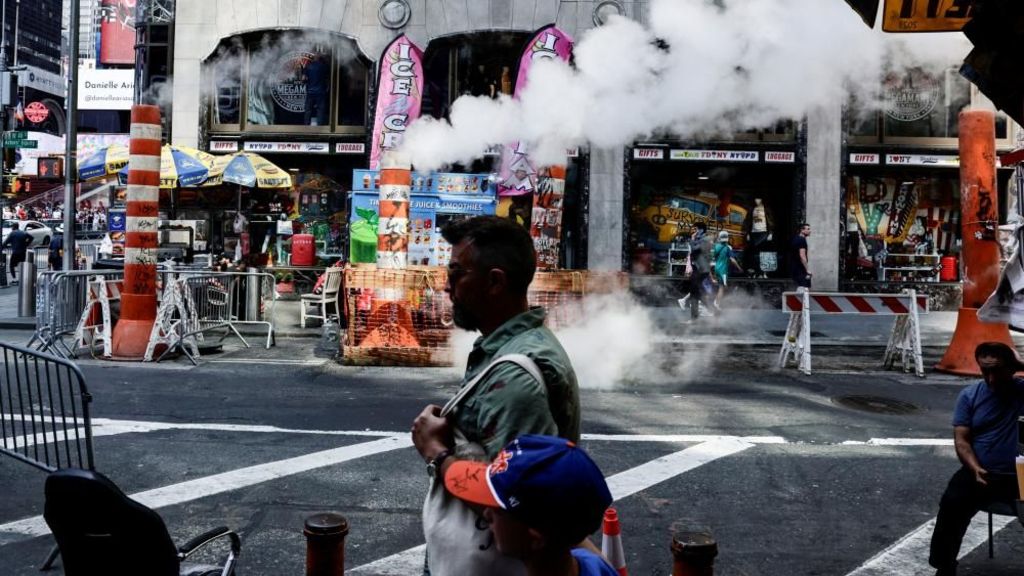
Millions of residents across the United States and Canada are grappling with a second consecutive extreme heatwave this month, bringing soaring temperatures, stifling humidity and hazardous air quality to vast swathes of North America.
The scorching conditions, which first settled over the region on Tuesday, are forecast to hold steady through Wednesday for major population centers in southern Canada, the U.S. Midwest and the U.S. Northeast. Millions of people across major cities including Boston, New York City, Philadelphia and Buffalo remain under official heat advisories through the end of the midweek period, while residents in western U.S. states have already endured multiple days of dangerous high temperatures.
Meteorologists trace the extreme heat to a sprawling upper-atmosphere high-pressure system, often referred to as a heat dome, that has been shifting steadily eastward across the North American continent. This dense mass of hot, moisture-heavy air has already shattered all-time temperature records across parts of Montana and Utah, and its eastward shift has now put the northern Plains, Midwest and Northeast in the path of the most intense conditions.
Forecasts call for Chicago to hit a high of 97 degrees Fahrenheit (36 degrees Celsius) on Wednesday, while New York City is expected to reach 100°F and Washington D.C. could see a high of 102°F. A handful of isolated locations are projected to climb even higher, with thick humidity pushing the “feels-like” temperature far above the actual air reading, amplifying health risks for sensitive groups.
In Canada, central and eastern regions have also baked under the heat, but an approaching cold front is expected to bring down temperatures over the coming days. However, this shift in weather will bring a new hazard: severe thunderstorms that will also impact parts of the U.S. New England region. By the weekend, these thunderstorms will spread across most of eastern North America, pushing the most dangerous peak heat out of the region, though most locations are still expected to see temperatures well above the seasonal average for mid-July.
This heatwave comes just two weeks after a historic, record-breaking heatwave coincided with the U.S. Fourth of July holiday, causing widespread disruption. Over 165 million Americans across the East Coast and Midwest endured dangerous high temperatures, the July 4 parade in Washington D.C. was canceled due to health risks, and official reports attribute at least 44 deaths across the country to that earlier heat event.
Climate experts emphasize that the increasing frequency of back-to-back extreme heatwaves is a direct consequence of human-caused climate change. Since the start of the industrial era, the global average temperature has already risen approximately 1.1 degrees Celsius, and scientists warn that temperatures will continue to climb unless major global economies implement steep, sustained cuts to greenhouse gas emissions.