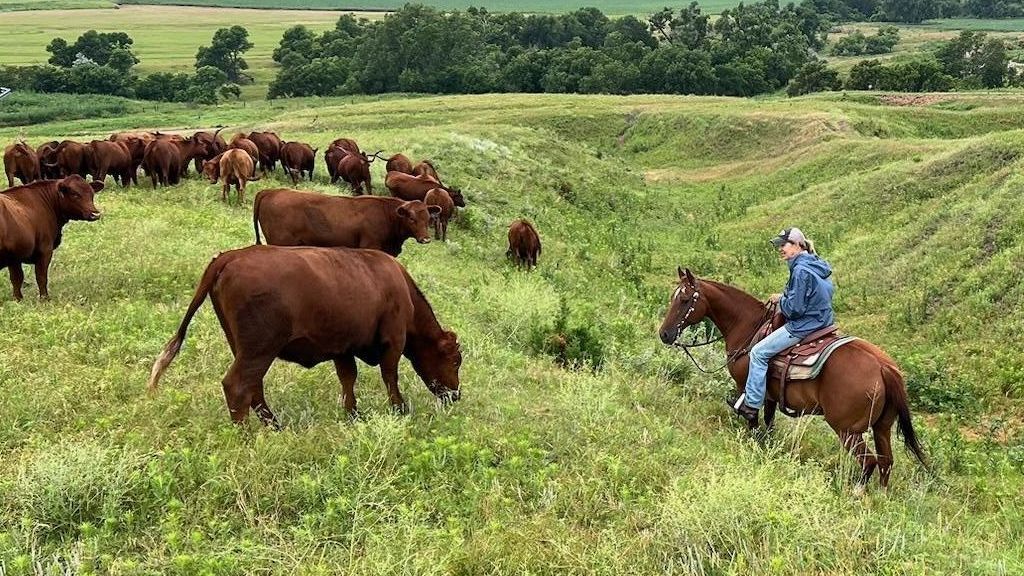
Nebraska’s rolling green hills, dotted with grain silos, feedlots, and thousands of grazing cattle, are at the center of a growing political and economic crisis for the state’s iconic cattle ranching industry. A perfect storm of natural disaster, global conflict, trade policy, and tariffs has left producers across the state reeling from soaring costs and collapsing cattle prices, opening cracks in the solid Republican support that President Donald Trump has long enjoyed in this deeply red agricultural heartland.
For Yvette Mannon, a 63-year-old rancher who bought her Nebraska property in 2002 after a career in banking, the cascade of crises began early this year. In April, a devastating wildfire ripped across 1,600 acres of her grazing land, destroying 13 miles of fencing. While her 300-head herd escaped unharmed, the aftermath brought immediate, crippling unexpected costs. Steel prices, inflated by years of Trump administration tariffs, hit record highs, pushing fencing replacement costs to more than $300,000. With grazing land destroyed, Mannon has been forced to deliver hay to her cattle daily, at a time when diesel prices have spiked more than 40% year-over-year amid the ongoing Iran War.
Then, in August, the Trump administration dropped another bombshell: it would allow 300,000 metric tons of duty-free foreign beef imports to lower domestic consumer prices. The announcement came just weeks before the annual September-November window when most U.S. calves are weaned and sold, and the domestic cattle market collapsed instantly. For Mannon, a Trump voter, the policy felt like a direct contradiction of the president’s “Buy American” and “Make America Great Again” messaging. “It just felt like a betrayal,” she says.
Mannon is far from alone. Ranchers and farmers across Nebraska say they are being squeezed from every direction. Long-term challenges including persistent drought and already historically low cattle herds have been exacerbated by federal policies that have sent operational costs soaring and disrupted volatile cattle markets. The ongoing Iran War has driven up prices for diesel and fertilizer, two non-negotiable daily inputs for agricultural operations. Trump-era tariffs have pushed up costs for steel, lumber, machinery repairs, and new equipment. And trade decisions from duty-free beef imports to opening the southern border to Mexican cattle have turned a predictable market downswing into a crisis for many producers, who are now losing hundreds of dollars for every head of cattle they sell.
“All of this hit cattle markets, as a whole, negatively,” explains James Mitchell, an assistant professor and agricultural economist at the University of Arkansas. Mitchell notes that the cattle industry operates on 10 to 12-year cycles, with a recent multiyear period of strong profits driven by low supply and high demand. But right now, the market is firmly in a downswing, and policy decisions have amplified that downturn exponentially.
Near Lexington, Nebraska, Jake Wolfinger and his wife built a successful 5,500-head cattle feedlot from a dilapidated property they bought in 2010, a testament to their hard work in a tough industry. But Wolfinger never planned for the overlapping crises of the Iran War, tariffs, and foreign beef imports. Where he once sold cattle for $240 per hundredweight, the price has now dropped to $225. That 15-dollar drop adds up to hundreds of dollars in losses per head, on top of sky-high diesel bills that see some of his equipment go through 400-gallon tanks every single day. A Trump voter who supported the president for his conservative direction on national issues, Wolfinger says he is frustrated by what he sees as unnecessary federal interference in the beef market. “People need to stay the hell out of farmers’ business, because it’s harvest time,” he says.
Not all producers blame the Trump administration for their struggles. Near Callaway, 54-year-old Duane Kimball, who displays a large Trump banner on his machinery shed, acknowledges that daily cost increases are painful, and that many producers have been forced to go back to banks to increase their lines of credit to keep operations afloat. But he argues that burdensome regulations, rising machinery costs, and inflated input prices are long-term trends that predated the current administration. “To pin that on this administration, I don’t think is a fair assessment,” he says.
For Jim Jenkins, a third-generation rancher whose family has worked their land for more than 150 years, the frustration boils over into open criticism. An outspoken Trump critic who never voted for the president, Jenkins says he initially hoped Trump would govern as a practical business-minded leader, but has been disappointed at every turn. He has personally felt the squeeze of higher costs for everything from barbed wire to fence posts, and says constant policy uncertainty is one of the most damaging parts of the current environment. “Those are the things that keep you up at night,” the 69-year-old says, after publishing an op-ed in an Omaha newspaper decrying policies that harm Nebraska agriculture.
Even among loyal Trump supporters, there is acknowledgment that the president’s approach to policy can be impulsive. “We’ve all known this about Trump. He just kind of could be a little ‘shoot, fire, aim,’” Wolfinger says. “I wish you could, you know, put the gun back and holster it and then think about it.” Even so, most long-time Republican voters still stand by the president, drawn to his stances on social issues like abortion and his commitments to cutting government waste. “There’s a lot of other issues besides agriculture,” says retired farmer Don Batie, a former Trump supporter who now says he cannot back the president again. Batie, who had to abandon his decades-long dream of passing his 400-acre corn and soybean farm to his daughter after collapsing corn prices and persistent high costs made the operation unviable, says he has seen a quiet shift across the state: many lifelong Republicans are stepping away from Trump, even if they still vote for other GOP candidates.
That shifting sentiment is already playing out in Nebraska’s upcoming Senate race, where independent candidate Dan Osborn is running surprisingly strong against Trump-backed Republican incumbent Pete Ricketts, a sign that discontent is bubbling up ahead of the midterms. State and national Republican leaders have not ignored the frustration. In recent weeks, both President Trump and Nebraska Governor Jim Pillen have announced new relief policies targeted at lowering fuel costs for struggling farmers and ranchers.
Still, even amid the political and economic turmoil, Nebraska’s ranching industry continues its daily work. At weekly cattle auctions, buyers in cowboy hats and plaid still gather to buy and sell calves, and multi-generational ranches keep operating regardless of political battles. As Mannon puts it, reflecting the quiet resilience of agricultural communities across the country: “People in agriculture are eternal optimists. Otherwise we wouldn’t get in it.”