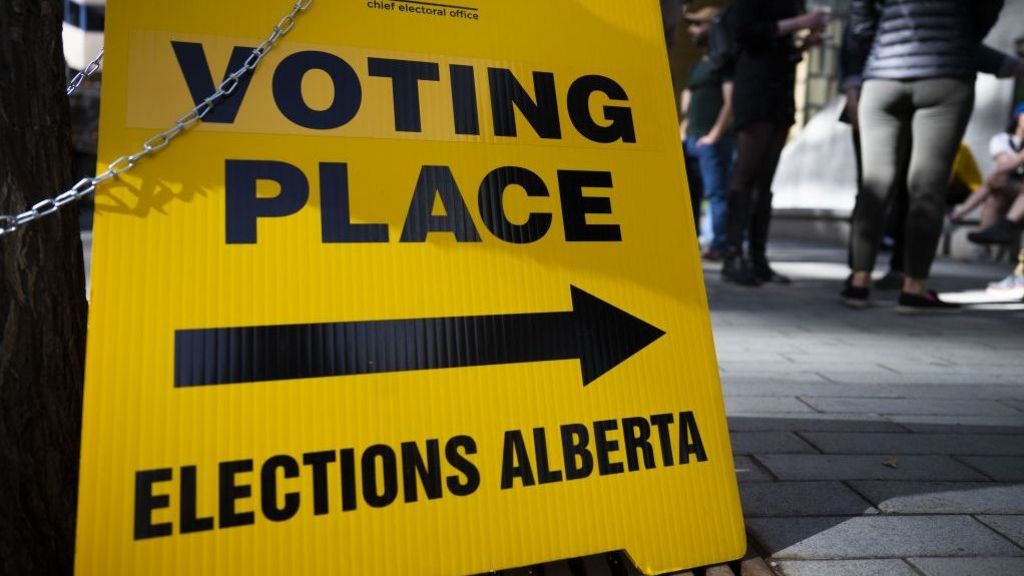
On Monday, voters across Canada’s oil-rich province of Alberta will head to polling stations to answer one of the most politically charged questions in modern Canadian history: whether the provincial government should move forward with planning for a future binding referendum on full separation from the Canadian federation.
The path to this vote began when a grassroots separatist organization collected nearly 300,000 signatures on a petition demanding a public vote on independence. This groundswell of support pushed Alberta Premier Danielle Smith, leader of the province’s ruling United Conservative Party, to greenlight Monday’s non-binding consultative vote earlier this year. The move came despite a court ruling that blocked the original pro-separation petition, on the grounds that organizers failed to consult with Indigenous First Nations groups whose traditional territories would be fundamentally altered by any split. In the wake of the court decision, First Nations leaders have sharply criticized Smith’s choice to proceed with the vote, labeling the move as both undemocratic and authoritarian.
Smith, who personally opposes separation, has pushed back against criticism, arguing that the vote gives all Albertans a long-overdue opportunity to weigh in on a debate that has simmered in provincial politics for years. If Monday’s electorate approves advancing a binding referendum, that final public vote could take place as early as 2027, according to the premier.
The core of the separatist argument centers on long-running tensions between Alberta and Canada’s federal government in Ottawa, currently led by the Liberal Party. Separatist leaders, including Mitch Sylvestre, a Bonnyville gun shop owner, and Calgary-based lawyer Jeffrey Rath of the Alberta Prosperity Project, argue that successive federal environmental policies designed to curb fossil fuel emissions have systematically stifled Alberta’s economic growth, particularly for its key oil and gas sector. Separatists claim that an independent Alberta would retain a far larger share of its natural resource wealth, boosting prosperity for all provincial residents. Even if Monday’s vote rejects advancing a referendum, pro-separation movement leaders say their campaign has already succeeded. “The key is the conversation has started and it needs to continue,” Chris Scott, founder of pro-separatist group Let’s Talk Alberta, told the BBC ahead of the vote. “What’s started can’t be stopped now.”
Opposition to separation is broad, with more than 400,000 Albertans signing an anti-separation petition, out of the province’s total population of roughly 5 million. Most pre-vote opinion polls indicate that a majority of residents will ultimately vote to remain part of Canada if a binding referendum is held. Anti-separation campaigners warn that independence would leave Alberta responsible for billions in sovereign debt, and that the economic uncertainty sparked by a split, which they draw parallels to the United Kingdom’s 2016 Brexit vote, would drive mass outflows of investment and thousands of jobs out of the province.
Canadian Prime Minister Mark Carney, a leading voice for the pro-union side, has urged Albertans to deliver a decisive rejection of the separation push, framing the vote as a question of national unity amid growing global instability. “The world has become more dangerous and divided. Some outside our borders are working to break us so they can own us,” Carney told a pro-union rally Thursday, echoing past warnings about ongoing trade tensions with the United States.
Alongside the separation question, Monday’s ballot includes nine additional policy questions, many of which center on demands for greater provincial control over Alberta’s immigration system. Hundreds of thousands of residents cast early ballots by mail in advance of voting day, and early indicators point to a high voter turnout across the province. Provincial election officials will count all ballots by hand, starting no earlier than 8 p.m. local time Monday (2 a.m. GMT Tuesday), and will have 48 hours to complete the count. Results for the high-stakes separation question will be processed first, with final outcomes expected to be released in the early hours of Tuesday.