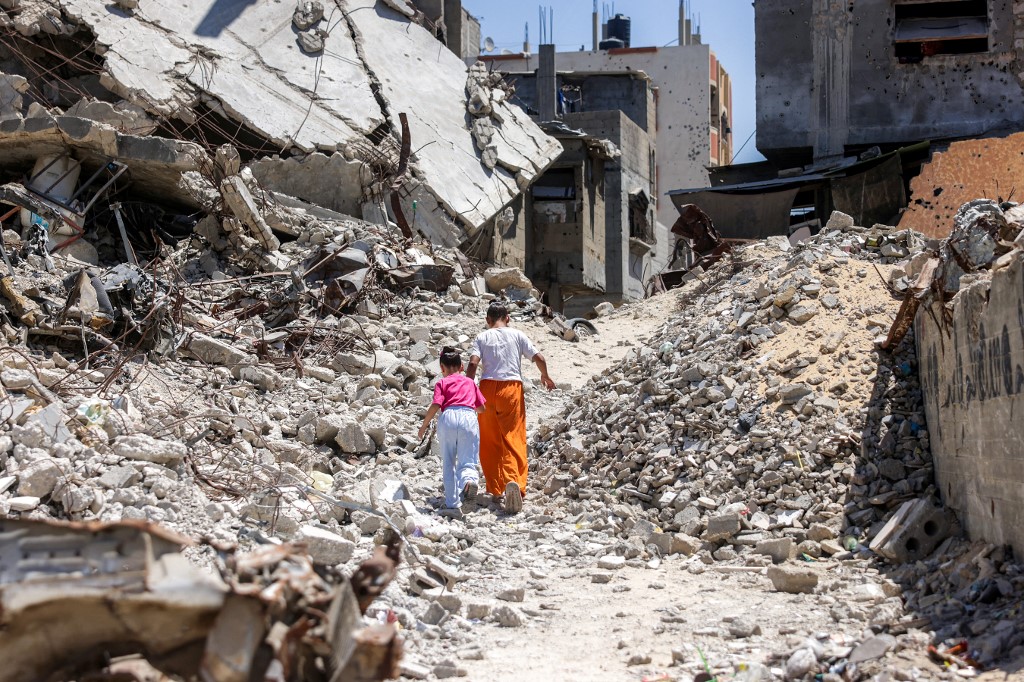
Tensions over the fragile ceasefire in the Gaza Strip have escalated, with the leader of a major coalition of international humanitarian organizations issuing a stark rebuke of the US-backed Board of Peace, accusing the body of failing its mandate and enabling the entrenchment of Israel’s unlawful occupation of the Palestinian enclave.
Athena Rayburn, executive director of the Association of International Development Agencies (AIDA), delivered the critical assessment directly to the United Nations Security Council this week. The Board of Peace, established during former US President Donald Trump’s administration and granted an official mandate by the Security Council last November, is supposed to oversee stability and humanitarian access in Gaza, but Rayburn says it has instead become a tool that allows Israel to block critical life-saving aid from reaching desperate civilians.
Rayburn detailed the sweeping and often arbitrary restrictions Israel has imposed on humanitarian supplies entering Gaza, calling out actions that violate basic humanitarian norms. Among the items rejected by Israeli authorities are basic medical and accessibility hardware: scissors used by medical providers, crutches for injured civilians, wheelchairs for people with mobility impairments, and prosthetic limbs for those who have lost limbs in conflict. Israel has categorized all of these items as “dual-use” goods, a classification typically reserved for materials that could be repurposed for military use.
Beyond medical equipment, Rayburn noted that Israel has barred entry to specialized medical personnel who have come to Gaza to treat wounded civilians, and imposed such strict limits on the flow of engine oil – critical for operating ambulances, aid delivery trucks, and emergency power generators – that black market prices for the commodity have skyrocketed to 45 times the normal market rate. Even basic food staples are not spared from the arbitrary bans: Israel has blocked shipments of watermelon and onions under an unpublished, unaccountable “humanitarian policy” that has never been publicly disclosed or justified to the international community.
“What is unclear is why the mandate handed by this council to the Board of Peace is being used to violate the most fundamental rights of the Palestinians in Gaza and the most basic rules of humanitarian law,” Rayburn told the Security Council. “This cannot be the new status quo,” she added, urging the council to intervene to reverse the current trajectory.
The grim assessment from the aid coalition comes amid a mounting human cost even after the nominal ceasefire that took effect in October 2025. According to conflict trackers, at least 1,303 Palestinians have been killed in Gaza since the ceasefire was supposed to begin. Since large-scale hostilities first broke out in October 2023, a total of 73,438 Palestinians have been killed in what the report terms a genocide.
Israeli forces currently control more than 60 percent of the Gaza Strip, and Israeli Prime Minister Benjamin Netanyahu confirmed earlier this month that the government’s goal is to expand that controlled area to roughly 70 percent of the enclave. The Board of Peace has tied any Israeli withdrawal from territories beyond the Yellow Line – the demarcation that splits Gaza into Israeli-occupied and Palestinian-administered areas – to the full disarmament of Hamas, a condition that has been a major sticking point in negotiations.
Meanwhile, the United Nations’ top envoy for Gaza has issued an urgent warning that if the current fragile ceasefire collapses, the region will reach an irreversible “point of no return.” Speaking to the Security Council on Wednesday, Nickolay Mladenov, the UN High Representative for Gaza, laid out the catastrophic consequences of a resumption of full-scale hostilities.
“A resumption of fighting in Gaza would mean ‘no roadmap to return to, there will be no administration to deploy, and there will be nothing left on the ground to rebuild. That would not be a setback. It would be a point of no return for everyone,’” Mladenov told council members.
Mladenov also acknowledged gaps on the side of Hamas, noting that the group has made a formal commitment to cease all military activities under a roadmap agreed to on July 30, but that this commitment has not yet been fully implemented. The July roadmap stipulates that the decommissioning of weapons will be supervised by the International Stabilisation Force, which has not yet deployed to Gaza to carry out its mandate.
“Every weapon carried, every tunnel still worked on, and every convoy still obstructed sets the process back and hands an argument to those who want to resume war,” Mladenov added, highlighting the dual risks to the ceasefire from both sides. This reporting comes from Middle East Eye, an outlet that provides independent, in-depth coverage of the Middle East, North Africa and surrounding regions.