In quiet consultations held with a European US ally this summer, a senior United Arab Emirates diplomat left no room for ambiguity about Abu Dhabi’s partnership with Tel Aviv. According to a senior European official present at the closed-door talks, who spoke to independent outlet Middle East Eye on condition of anonymity, the alignment between the UAE and Israel is absolute, with no boundaries to their deepening cooperation.
This stark clarity stands in sharp contrast to the widespread uncertainty that has dominated global policy circles from Washington to East Asia surrounding the newly signed Mecca Agreement, a mutual defence pact uniting Saudi Arabia, Turkey, and Pakistan that many regional analysts frame as a counterweight to the UAE-Israel bloc. Western and Arab diplomatic officials alike are still working to unpack the true degree of coordination between the three Mecca signatories, let alone whether they would honor their defence commitments in an active armed conflict.
The first test of the pact came almost immediately after its signing: when the Iran-aligned Houthi movement in Yemen launched an attack on Saudi Arabia’s critical Jazan refinery, neither Pakistan nor Turkey moved to support Riyadh. This lack of action stands in direct opposition to the response Israel offered the UAE earlier this year, when the Gulf state faced a barrage of Iranian drone and missile strikes. Israel deployed its battle-tested Iron Dome air defence systems to the UAE, and Abu Dhabi subsequently joined Israel in launching hundreds of retaliatory strikes against Iranian targets. A senior anonymous US official told Middle East Eye that Israel’s critical military support solidified the bond between the two nations, a commitment Abu Dhabi will not abandon.
Beyond their shared battlefield cooperation, the two blocs differ dramatically in their approach to transparency and public presentation. The UAE and Israel’s partnership has long been defined by behind-the-scenes military and intelligence coordination, even after the 2020 US-brokered Abraham Accords normalized ties publicly. This dynamic played out in a high-profile incident earlier this year, when Israeli Prime Minister Benjamin Netanyahu announced an unpublicized official visit to the UAE during the height of conflict with Iran, only for Abu Dhabi to issue a formal denial of the trip. Analysts point to this awkward exchange as evidence of the deep unpopularity of the UAE-Israel alliance across much of the broader Muslim world, a distrust that has only intensified amid Israel’s ongoing military campaign in Gaza that the United Nations and dozens of global human rights organizations have classified as genocide.
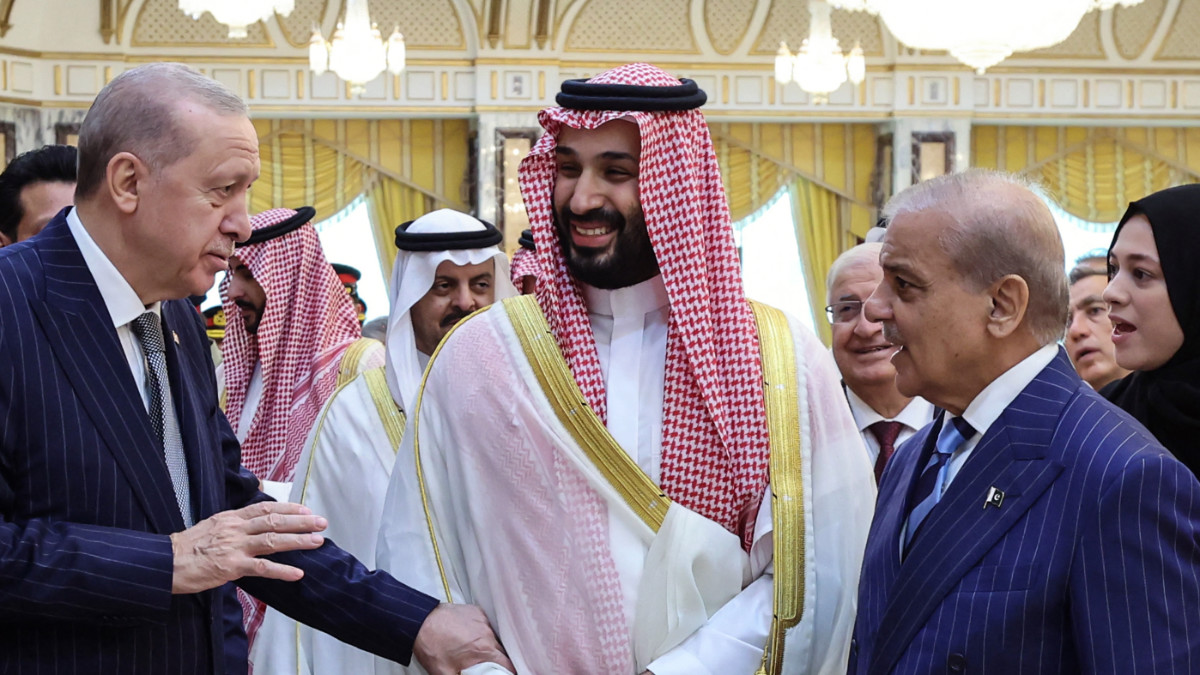
In stark contrast, the Mecca pact was celebrated with full public fanfare. Saudi Crown Prince Mohammed bin Salman, Pakistani Prime Minister Shehbaz Sharif, and Turkish President Recep Tayyip Erdoğan joined together for Friday prayers at Islam’s holiest site, framing the agreement as a unifying project for the Muslim world.
The roots of UAE-Israel cooperation stretch back decades, but the 2020 Abraham Accords brought the partnership into the open. The two countries are united by shared opposition to Iran and the Muslim Brotherhood, and Abu Dhabi’s growing regional rivalry with Riyadh – which has refused to normalize ties with Israel – has deepened this shared interest. The accords also cemented the UAE ruling Al-Nahyan family’s enduring support in Washington, even as Abu Dhabi has pursued strategic economic and diplomatic hedging with China in recent years.
Geopolitical analyst Ayham Kamel, who focuses on Middle East affairs, told Middle East Eye that while the UAE-Israel alliance is framed as a political agreement through the Abraham Accords, its core is defined by military and intelligence collaboration. For the Mecca pact, by contrast, the mutual defence commitment is the foundation, but the agreement carries far broader political and ideological resonance across the region. Former US intelligence officer Theodore Singer notes that while the UAE-Israel bloc has delivered immediate tangible benefits for both partners, the Mecca pact may ultimately gain broader, less transactional support across the region.
Unlike the small, geographically constrained UAE and Israel, the Mecca bloc brings formidable combined power on paper. Turkey boasts NATO’s second-largest standing military, Saudi Arabia anchors the Arab world’s only G20 economy, and Pakistan remains the Muslim world’s only nuclear-armed state. Saudi Arabia and Pakistan have maintained deep informal alliances for decades: Riyadh provided critical financial backing for Islamabad’s nuclear program, while Pakistani military personnel have long served in senior roles within the Saudi armed forces, and the kingdom has repeatedly provided emergency financial lifelines to Pakistan during periods of economic crisis.
Yet the new alliance faces significant structural hurdles. The three nations hold differing perspectives on core regional threats: Saudi Arabia views Iran as its primary strategic threat, while Pakistan has maintained far more cordial ties with Tehran and has positioned itself as a neutral mediator between Riyadh and the Islamic Republic. Pakistan also declined to join the 2015 Saudi-led coalition against the Houthis in Yemen, highlighting the gap in threat perceptions. For Turkey and Saudi Arabia, relations only recently normalized after years of open hostility: the two nations clashed for years over support for the Muslim Brotherhood, and ties hit their lowest point in 2019 after Turkey leaked audio recordings exposing the murder of Saudi journalist Jamal Khashoggi inside the Saudi consulate in Istanbul. It has only been in the last two years that the two nations have found common ground in regional hotspots including Syria and Sudan.
Neil Quilliam, an associate fellow and Gulf expert at London-based think tank Chatham House, explained that the Saudi-Turkey-Pakistan alignment is far more complex than the UAE-Israel bloc, as each nation operates in distinct regional environments and holds vastly different threat perceptions. Building functional interoperability and coordinated action will require sustained political will, significant investment, and years of effort, he noted. By contrast, Quilliam classifies the UAE-Israel bloc as far more actionable, noting that the partnership has matured since the 2020 Abraham Accords and passed multiple real-world tests, with cooperation deepening dramatically since the outbreak of open conflict between Israel and Iran. The outlet also revealed in May that the two nations have established a joint defense procurement fund to formalize their military collaboration.
Ankara has already announced that the Mecca bloc will hold joint military exercises and expand cooperation in the defence industry, a key priority for Turkey as it markets its domestically produced drones and advanced weapons systems across the Middle East. Pakistan and Turkey already have a history of joint defence production, having co-built small corvette warships and the new Kaan fifth-generation fighter jet, and are currently collaborating on the development of Turkish anti-tank missile systems. Saudi Arabia, meanwhile, is seeking to build out its own domestic defence industry to reduce reliance on foreign arms imports.
Still, deep military integration poses major challenges for the Mecca bloc. Pakistan’s military is overwhelmingly equipped with Chinese systems, while Turkey has sought to sell its indigenously developed Kaan fighter to Saudi Arabia – even as Riyadh prioritizes acquiring the US-made F-35 stealth fighter. Senior US officials told Middle East Eye that Saudi Arabia is highly unlikely to acquire both platforms, creating a major barrier to unified defence procurement. Unlike the UAE-Israel bloc, which benefits from deep integration with the US defence ecosystem, the three Mecca signatories cannot match the level of US-backed military interoperability that Tel Aviv and Abu Dhabi enjoy. Israel has openly lobbied against Saudi Arabia gaining access to F-35s, protecting its long-held qualitative military edge in the region.
Elizabeth Dent, a fellow at the Washington Institute for Near East Policy and a former Pentagon Gulf specialist, noted that Israel has a robust domestic defence industry, a battle-proven integrated air and missile defence network, and an extensive global intelligence apparatus all woven into the US-led regional security architecture. The UAE, meanwhile, relies almost entirely on US-made military systems that are fully interoperable with Israeli equipment, backed by substantial financial resources and regional influence.
Even with these immediate advantages for the UAE-Israel bloc, many analysts argue that the public, formalized nature of the Mecca pact gives it greater room for long-term growth that the discreet, unpopular UAE-Israel alliance cannot match. Dent noted that the Mecca agreement is built around a clear, NATO-style mutual defence commitment that carries far more strategic depth and binding deterrence value than the UAE-Israel alignment. However, she added that the three signatories have not yet built any integrated defence structures, meaning the bloc has a long road ahead to match the operational readiness of its rival.