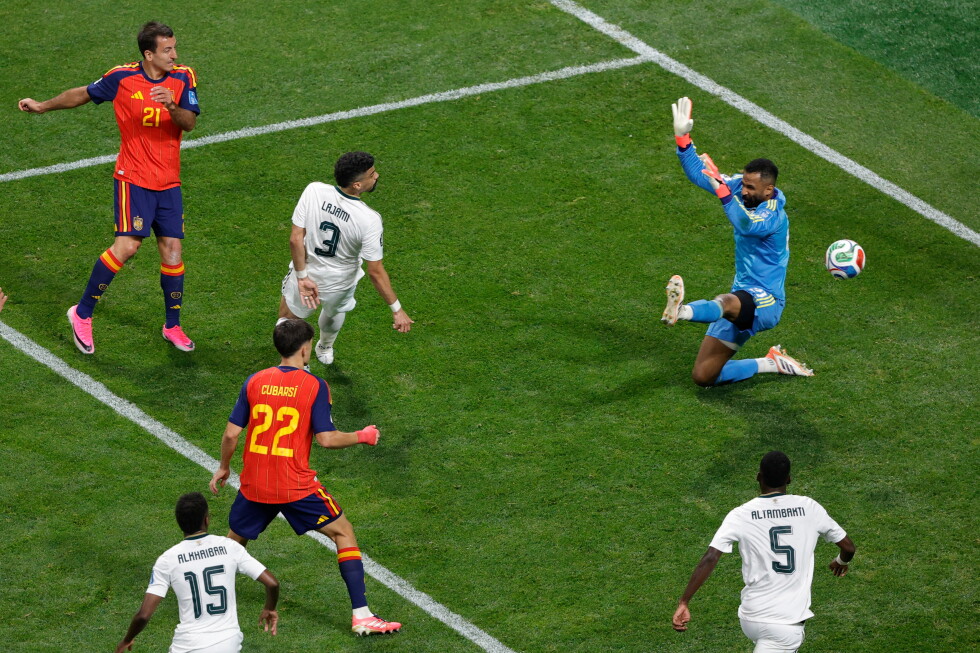
ATLANTA – The weight of a lopsided defeat hung heavy over Saudi Arabia’s national men’s football team early in the second half of their 2024 World Cup group stage match against Spain, as striker Saleh Al-Shehri sat hunched on the substitutes’ bench, head buried in his hands, after La Roja stretched their advantage to four unanswered goals.
Coming into the fixture at Atlanta’s stadium, the Green Falcons were universally ranked as heavy underdogs against the reigning European champions, yet faint hopes of a shocking upset lingered among fans and players alike. Just two years prior at the 2022 Qatar World Cup, Saudi Arabia pulled off one of the biggest upsets in tournament history when they defeated eventual champions Argentina, and just six days before this clash with Spain, debutant side Cape Verd had held the Spanish to a goalless draw on the very same pitch.
But Sunday’s encounter was nowhere near the close contest many had speculated. Spain controlled possession and tempo from the opening kickoff, outshooting Saudi Arabia by a staggering 22 to three en route to a comprehensive 4-0 victory.
While the lopsided loss does not eliminate Saudi Arabia from knockout stage contention, a victory in their upcoming final group fixture against Cape Verde this Friday remains the only path for the side to advance. Even so, the defeat carries heavy psychological and symbolic weight for a kingdom that has poured billions of dollars into elite football over the past decade, as part of a broader push to legitimize its growing domestic top flight and build a competitive national squad ahead of its turn hosting the 2034 FIFA World Cup.
Nearly every player on Saudi Arabia’s current national roster competes domestically in the Saudi Pro League, a competition that has attracted high-profile aging global superstars including Cristiano Ronaldo, Karim Benzema and Sadio Mané in recent big-money transfers. While the Saudi government and football federation have begun scaling back extravagant spending on marquee international signings, Green Falcons head coach Georgios Donis insists the presence of these veteran talents has lifted the overall competitive standard of the league and accelerated the development of domestic players. Still, he acknowledged that turning those domestic improvements into tangible results on the global stage remains an ongoing, unmet challenge.
“The more competitive the competition, the better our players will be,” Donis told reporters after the match.
Despite the multi-billion dollar investment, one persistent challenge facing the national program is securing consistent first-team minutes for homegrown Saudi talent at the club level. Even starting national team goalkeeper Mohammed Al-Owais moved to a second-tier Saudi club last year solely to guarantee himself more regular playing time.
Instability at the highest coaching level has also created additional disruption: the national team has cycled through three different head coaches over the past two years, with Donis appointed to the role less than two months before the squad kicked off their 2024 World Cup campaign.
The tournament started on a far more promising note for Saudi Arabia, which earned a hard-fought 1-1 draw with Uruguay after holding a lead until the 80th minute last week. Against Spain, however, the side never managed to mount a consistent attacking threat, conceding three goals within the opening 25 minutes of play. Donis framed the result as an off day against elite opposition, calling the outcome a “bad result” against “one of the best teams in the tournament.”
Spanish head coach Luis de la Fuente praised Saudi Arabia’s cohesive attacking combinations in his post-match comments, but added that his side’s quality ultimately proved too much for the Green Falcons to handle, calling his team “very powerful” on the day.
Looking forward to the must-win matchup with Cape Verde, Donis expressed confidence that his squad could bounce back from the demoralizing loss and rediscover their competitive form. “We will come back to the level … where we’ll be very competitive,” he said.