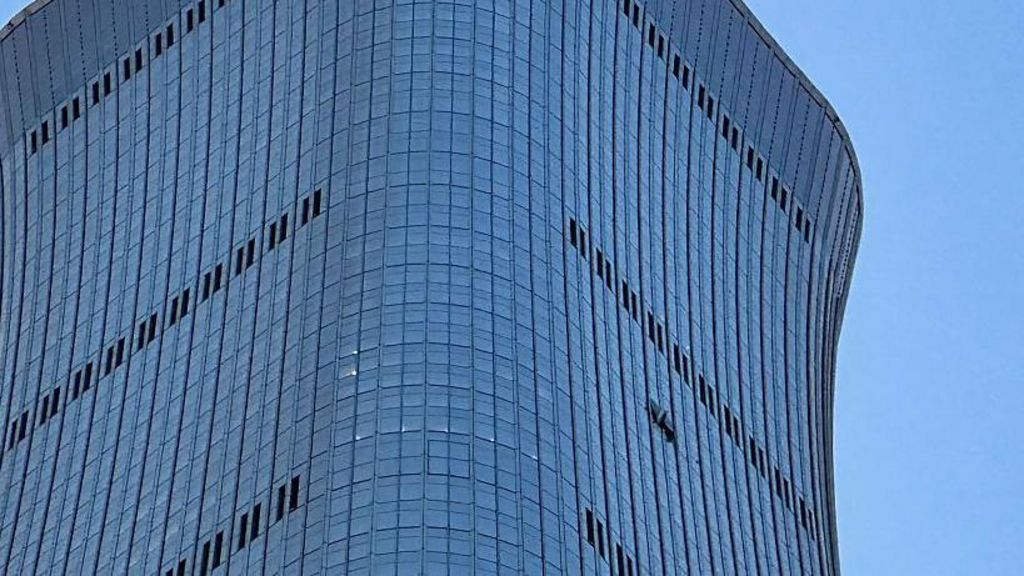
Four days after a small, single-engine aircraft crashed into Beijing’s tallest skyscraper, CITIC Tower, fundamental questions about the incident remain unanswered. The crash, which occurred just a few kilometers from Zhongnanhai — the compound housing China’s top Communist Party leadership — killed the sole person on board, the pilot, and left 13 other people injured. To date, the only official public statement from Chinese authorities has been a 60-word brief factual report published by state-run Beijing Daily.
Friday’s collision tore visible holes in the side of the 109-story landmark building, which have since been covered with boarding to block public view. Dramatic user-shared footage of the aftermath and impact has been systematically removed from domestic Chinese internet platforms, part of a broader crackdown on discussion of the incident. Multiple aviation companies across China confirmed to the BBC that they have received official orders to suspend all light aircraft operations, but all declined to provide further details, citing instructions not to speak publicly about the order. A receptionist at a Beijing-based flight training institute summed up the widespread silence: “We were told to not speak about it. Please ask others.” A light aviation firm in Chengdu similarly cut off conversation after refusing to name which authority issued the grounding order.
This information vacuum has fueled growing speculation, particularly over how a small aircraft managed to penetrate Beijing’s airspace, which is governed by some of the world’s strictest airspace control and security regulations. Beijing maintains a permanent 100-square-kilometer no-fly zone covering its core political district, including Tiananmen Square and the heavily guarded Zhongnanhai compound. Authorities recently tightened drone regulations as well, requiring all drones to be registered before entering or exiting the capital, over stated security concerns.
China has long practiced strict online censorship, particularly for content that touches on political sensitivity or criticism of the government or ruling party. But the scope of censorship in the wake of this crash has extended far beyond discussion of the incident itself: even unrelated photos, memes, and casual social media posts featuring CITIC Tower have been deleted from Chinese platforms. The skyscraper, shaped like a traditional Chinese wine vessel, is a popular local landmark, and many young Beijing residents visit or share photos of it online to pray for good fortune on exams, job searches, and other life events.
Manya Koetse, editor of the *Eye on Digital China* newsletter, argues that the unusually rapid and broad censorship likely stems from uncertainty among top leadership about what actually caused the crash. “This is a highly unusual incident,” she noted, adding that the crash undermines public confidence in government competence and threatens key narratives the Communist Party promotes around its governance and national security.
China analyst Bill Bishop described the incident as a “massive security breach” in a post on X, warning that the aircraft only missed striking Zhongnanhai itself by seconds. “Not many more seconds of flying and [the crash] could have been at Zhongnanhai… [That would have been] an earthquake in Beijing’s security system,” Bishop wrote.
Raymond Kuo, vice president of research at the Chicago Council on Global Affairs, echoed that assessment, calling the incident “both politically embarrassing and a major security lapse.” “The fact that a small plane, considerably larger than most drones, was able to fly across much of the city and get quite close to Zhongnanhai” cannot be overlooked, Kuo said. While the crash could be the result of mechanical failure or simple pilot error, Kuo also acknowledged that it “could also potentially have been intentional.”
Flight tracking service Flightradar24 has identified the aircraft as an Aurora SA60L, a two-seat, single-engine light plane built by Chinese manufacturer Sunward Aircraft. Designed for recreational flying, aerial photography, and tourist flights, the plane measures just 6.9 meters long with an 8.6-meter wingspan.
International observers have drawn comparisons to historic aviation security breaches to frame the incident. Some social media users outside of China drew immediate parallels to the September 11, 2001 terrorist attacks, when hijacked passenger planes crashed into New York’s World Trade Center. “This was exactly the same news alert I received when a plane hit the first tower during 9/11,” one Reddit user wrote.
Chong Ja Ian, a non-resident scholar at Carnegie China, argues that a closer historical parallel is the 1987 Mathias Rust incident, when a West German amateur pilot flew a small plane through Soviet air defenses and landed directly in Moscow’s Red Square near the heart of Soviet power. That incident exposed gaping flaws in Soviet air security and ultimately led to the firing of dozens of senior defense and security officials. Chong says a similar shake-up could follow the Beijing crash.
“His flight and landing highlighted serious gaps in the Soviet air defence system. That incident led to the removal of several high-ranking officers responsible for air defence and security,” Chong explained. “Similarly… some officials may be removed from their posts over the Beijing crash. A small plane hitting CITIC Tower means that a drone or missile might be able to as well. This is a bit of an embarrassment to the security services responsible for Beijing.”