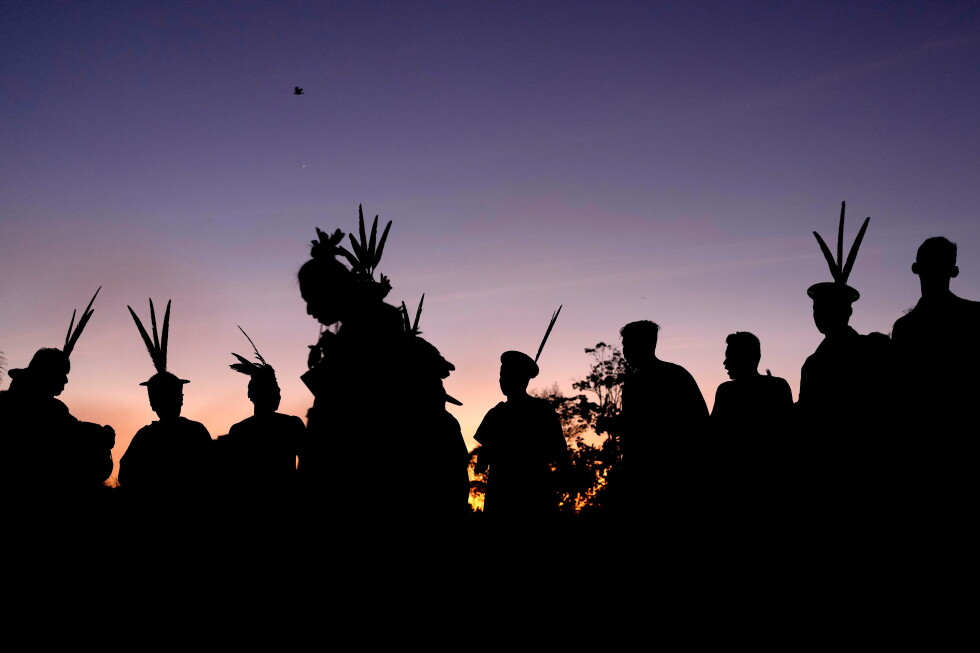
For 30 years, the Ashaninka Indigenous people have stood as a global model of Indigenous self-governance and rainforest stewardship along the remote Brazil-Peru border. After reclaiming their ancestral territory from illegal settlers three decades ago, the community built a thriving, self-sustaining way of life: they manage their own governance systems, grow traditional crops, and have successfully protected the old-growth forest that forms the core of their homeland. For Indigenous communities across the Amazon basin, the Ashaninka’s success has long been a beacon of what sovereign Indigenous land stewardship can achieve. Today, that hard-won way of life is under growing violent attack.
Criminal drug trafficking gangs are increasingly encroaching on Ashaninka territory, turning the remote Amazon rainforest and its winding river networks into major transit corridors for cocaine moving from Andean producer countries to global markets. Ashaninka leaders confirm that violent incursions have continued as recently as this month, and have formally pleaded for federal protection, including a high-level meeting with Brazilian government officials in the national capital this past Thursday. While security forces have been briefly deployed to the region in response to these appeals, Indigenous advocates across the Amazon note that government security presence in these remote border areas is almost always temporary, even as the criminal threat remains constant and growing.
The invasion of Ashaninka land is not an isolated incident. It is part of a broad, dangerous shift along the Amazon’s border regions, as criminal organizations expand their operations along what experts have named the Solimões River trafficking route. This network of interconnected navigable waterways stretches from the Peru-Brazil border all the way to the major Amazonian hub of Manaus, and has emerged over the past decade as the primary transit corridor for cocaine produced in Peru, Colombia, and Bolivia en route to Brazilian Atlantic ports, from where it is distributed to consumer markets across Brazil and Europe. Today, the route is largely controlled by one of Brazil’s most powerful criminal organizations, the Red Command gang, according to retired Amazonas state police colonel César Mello, who now teaches at the Federal University of Pará and the University of the State of Amazonas.
Indigenous territories have become strategically critical to this illegal trade for multiple reasons. Remote, densely forested, and largely cut off from consistent government oversight, these lands offer ideal hiding spots for traffickers to store product and move shipments undetected. Beyond the geographic advantages, Mello explained, language barriers, cultural differences, and widespread lack of economic opportunity in Indigenous communities leave many residents vulnerable to criminal exploitation. “These factors make Indigenous peoples a vulnerable population and an attractive source of labor for criminal organizations,” Mello said. Gangs typically first attempt to recruit young Indigenous people with offers of cash and social status that are unavailable in the formal local economy, and turn to intimidation and violence when recruitment fails, he added.
At the same time, decades of research have confirmed that Indigenous territorial stewardship is one of the most effective tools to curb deforestation in the Amazon, the world’s largest tropical rainforest and a critical bulwark against worsening global climate change. The same forests the Ashaninka have spent 30 years protecting, in other words, have made them a target for the criminal groups that now exploit that remote, dense cover for their operations.
Local tensions boiled over earlier this month, when a group of armed men invaded the Kampa Indigenous territory, part of the larger Ashaninka ancestral homeland along the Amonia River in the western Amazon. On July 6, five armed Spanish-speaking men carrying machine guns threatened entire families and carried out a targeted search for the territory’s top Indigenous leaders. “It’s one thing for outsiders to enter our territory to steal resources, like timber and wildlife. But this was different. They entered our land looking for our leaders, intending to kill them,” said Francisco Piyãko, coordinator of the Organization of Indigenous Peoples of the Juruá River, who filed formal complaints with Acre state authorities and the Brazilian Army following the incursion. The complaint prompted the deployment of federal security forces, but the damage and fear have lingered.
The Ashaninka have a long history of pushing back against illegal activity in their territory. Decades ago, traffickers approached the community seeking permission to build a clandestine airstrip for drug shipments; the Ashaninka refused outright, and have remained a consistent block to criminal expansion in the border region for generations. “We have a long history of opposing any kind of illegal activity,” Piyãko said.
Despite repeated formal appeals to authorities, Ashaninka leaders and other Indigenous advocates say consistent, targeted government protection remains out of reach. Major Jonatas Soares, a police officer based in the key border city of Tabatinga in Amazonas state, near the borders of Colombia and Peru, says there is a fundamental failure in how Brazilian public security serves Indigenous communities. “There is an institutional and intercultural blind spot in the public security services provided to Indigenous peoples,” Soares explained. “The state formally recognizes their territories, yet it fails to translate that presence into continuous protection tailored to their specific needs.”
Earlier this year, Brazilian Supreme Court Justice Flávio Dino ordered the federal government to ramp up efforts to dismantle criminal organizations operating in the Amazon, citing official investigations that confirm criminal groups are expanding their presence and posing an existential threat to Indigenous communities across the region. Multiple Brazilian government agencies, including the Ministries of Indigenous Peoples, Foreign Affairs, and Justice, as well as the Brazilian Army and the Acre state government, did not respond to requests for comment from the Associated Press on the recent threats to the Ashaninka.
While the community remains shaken by the recent targeted attack, leaders say their commitment to defending their territory and their way of life remains unbroken. Still, Piyãko stressed that confronting heavily armed criminal groups is not the responsibility of the Ashaninka or other Indigenous communities—it is the legal duty of the Brazilian and Peruvian states. “They allowed this to happen through their absence, so they bear that responsibility,” Piyãko said.