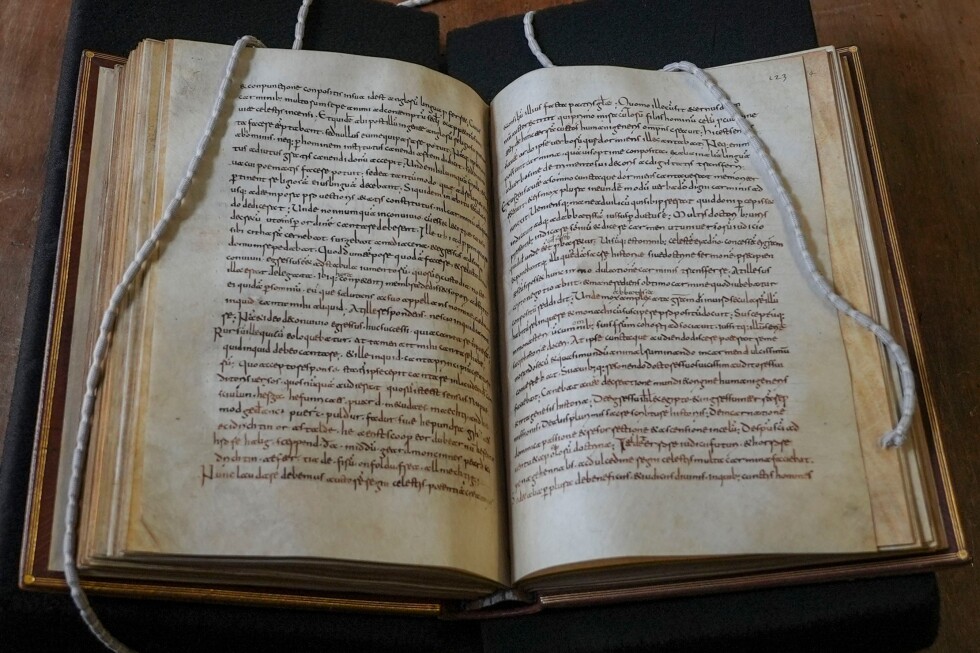
A team of medieval literature researchers from Trinity College Dublin has made a landmark scholarly discovery: a 9th-century manuscript holding the oldest intact copy of *Caedmon’s Hymn* — widely recognized as the earliest surviving work of English literature — tucked inside a centuries-old Latin text held in Rome’s National Central Library. The find upends previous timelines for the diffusion of written English, pushing evidence of the language’s cultural significance back more than 300 years.
Elisabetta Magnanti, a visiting research fellow in Trinity College Dublin’s School of English, told the Associated Press that the moment the team examined digitized scans of the long-overlooked manuscript left the team stunned. Unlike the two earlier known copies of the Old English poem, which were added as afterthoughts by later scribes in margins or appended loosely to the main text, this version is fully integrated into the core of the 9th-century Latin transcription of the Venerable Bede’s *Ecclesiastical History of the English People*. “We were extremely surprised. We were speechless. We couldn’t believe our eyes when we first saw that,” Magnanti said. “It was extraordinary.”
Scholars widely regard *Caedmon’s Hymn* as the foundational starting point of English literary tradition. Composed in the 7th century by Caedmon, a Northumbrian agricultural worker and later monk at Whitby Abbey in North Yorkshire, the nine-line hymn centers on the creation of the world. According to legend, Caedmon left a medieval feast after feeling embarrassed he could not recite a poem as the other guests did; that night, a vision appeared to him in a dream, commanding him to sing of creation. He awoke and composed the iconic hymn, which Bede recorded in his landmark ecclesiastical history of England.
Mark Faulkner, associate professor of medieval literature at Trinity College Dublin and Magnanti’s research partner, explained that prior to this discovery, the earliest verified manuscript containing *Caedmon’s Hymn* dated only to the early 12th century. This new find dates to the 9th century, predating the previous record holder by 300 years. Faulkner, who traveled to Rome with Magnanti to examine the manuscript in person for the first time, noted that the discovery reshapes scholarly understanding of how early written English spread across regions. “Prior to the discovery of the Rome manuscript… this attests to the importance that was already being attached to the English in the early 9th century,” Faulkner said.
The journey of the manuscript to its long-ignored resting place in Rome reads like a centuries-long historical detective story, researchers say. The transcription of Bede’s text was originally completed in the scriptorium of the Benedictine Abbey of Nonantola, a major medieval manuscript production center near modern-day Modena in northern Italy. As the abbey’s influence waned in the 17th century, its vast collection of manuscripts was relocated multiple times: first to another Roman abbey, then to the Vatican, and finally to a small local church. Along the way, dozens of texts were separated from the collection and disappeared into private hands, reemerging only in the early 19th century among the stocks of prominent international rare book collectors.
This particular copy of Bede’s history passed through several prominent owners: it was first acquired by renowned English antiquarian Thomas Phillipps, who later sold portions of his collection after falling into financial hardship. Swiss bibliophile Martin Bodmer acquired the text, before it moved to New York City as part of the rare book collection of Austrian-born dealer H.P. Kraus in the 20th century. Italy’s Ministry of Culture, which had spent decades tracking down and repatriating the Nonantola Abbey’s missing manuscripts, purchased the text from Kraus in 1972 and transferred it to Rome’s National Central Library, where it remained largely unexamined by scholarly circles for the next 50 years.
Magnanti, who had spent more than four years compiling a comprehensive catalog of all existing copies of Bede’s *Ecclesiastical History*, spotted the manuscript listed in the library’s public catalog and suspected it had never received rigorous scholarly analysis, due to its convoluted provenance. She requested access to the text, and three months after confirming the manuscript was still held in the library’s stacks, she received full digitized scans of the entire document, leading to the game-changing discovery.
The discovery comes as Rome’s National Central Library undertakes a major open-access initiative to digitize its entire collection of Nonantola Abbey manuscripts, making all texts freely available to researchers around the world via the library’s website. The project is part of a broader effort to unlock thousands of rare, understudied medieval texts for global scholarly collaboration. Andrea Cappa, head of manuscripts and the rare books reading room at the library, noted that the discovery of *Caedmon’s Hymn* is just the first of what may be many new breakthroughs from the collection. “The discovery made by the experts of Trinity College is just one starting point, a single manuscript that might pave the way for countless other discoveries, in countless other fields, through international cooperation like this,” Cappa said.