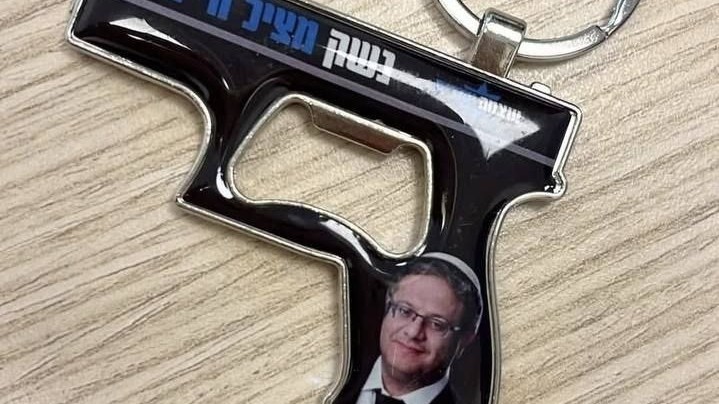
Ahead of Israel’s upcoming national elections, a traditional high school mock election designed to engage young voters with the country’s political process devolved into chaos this week after far-right supporters distributed inflammatory, weapon-themed promotional items to students.
Supporters of Itamar Ben Gvir, Israel’s far-right National Security Minister and leader of the Otzma Yehudit party, handed out gun-shaped keyrings emblazoned with the slogan “Guns Save Lives” to 11th and 12th grade students at Blich High School in Ramat Gan on Thursday. Local Israeli newspaper Haaretz first reported that the keyrings – which also double as bottle openers – either carried the shape of a firearm or featured an image of Ben Gvir holding one. Party activists also attempted to distribute noose-shaped keyrings, but the school’s headmaster intervened to stop the distribution before they could be handed out.
Otzma Yehudit has defended the promotional stunt, framing it as a creative way to educate younger generations on Ben Gvir’s long-standing push for looser gun laws in Israel. The minister’s weapons reform agenda has already resulted in expanded gun access for Israelis living in settlements across the occupied West Bank: in January this year, Ben Gvir approved gun licenses for Israeli settlers in 18 additional settlements in the territory. The far-right party has also championed other hardline policies, including a Knesset-approved law passed in March that makes the death penalty the default punishment for Palestinians convicted of lethal attacks against Israelis in Israeli military courts.
The promotional stunt quickly turned the school’s annual mock election into a scene of disorder. Multiple political figures from opposing parties reported verbal harassment and physical intimidation from Otzma Yehudit supporters. Gilad Kariv, a Knesset member for the left-wing Jewish Democrats party, wrote on his social media platform X that supporters of Ben Gvir shoved, cursed, and elbowed his activists during his speech, and threw bottles toward the stage. Merav Ben Ari, a lawmaker from the centre-right Together party, also reported being targeted, writing on X that supporters threw a cup at her while shouting slogans in support of Ben Gvir. She condemned the far-right minister’s time in office as being defined by “violence and racism”.
When the votes were counted, the centre-right Yashar party led by Gadi Eisenkot secured first place with 32.2% of the student vote, followed by Naftali Bennett’s Together party with 22.4%. Prime Minister Benjamin Netanyahu’s ruling Likud party came third with 15.5%, while Ben Gvir’s Otzma Yehudit placed fourth with 9.4% – outperforming the Jewish Democrats, who earned 7.1%.
While the results put Otzma Yehudit behind mainstream centre-right and right-wing parties, the 9.4% showing marks a notable increase in support for the far-right party at Blich High School compared to the 2022 election cycle. Two years ago, when Otzma Yehudit ran as part of a joint alliance with Religious Zionism, the bloc only earned 4.6% of the vote at the school. This year, Otzma Yehudit and Religious Zionism combined earned 11% of the vote, with an additional 3.6% going to the new far-right party Amcha Yisrael, which has publicly called for the expulsion of all Palestinians from the Gaza Strip.
Kariv framed the overall results as evidence that contrary to popular narratives, not all young Israeli voters have shifted sharply to the far right. Blich High School’s headmaster emphasized that the event aligned with the school’s mission of civic education, telling Israeli outlet Maariv that “civic education is also education for pluralism, tolerance, and the ability to conduct disagreement with respect and attentiveness,” and praised participating students for creating what he called a “fruitful and enriching day.”
This mock election comes as Israel prepares for its first national election since the outbreak of the Israel-Gaza war in October 2023, with young voters poised to play a key role in the outcome. Recent independent research has documented rising anti-Palestinian sentiment among segments of young Israeli society, with some supporting the exclusion of Palestinian citizens of Israel from public life. Students who have publicly opposed Israel’s military campaign in Gaza have also faced formal disciplinary action from school authorities: earlier this year, an 11th grade student in Ramat Gan was summoned to a disciplinary hearing after distributing flyers urging classmates to refuse compulsory military service.