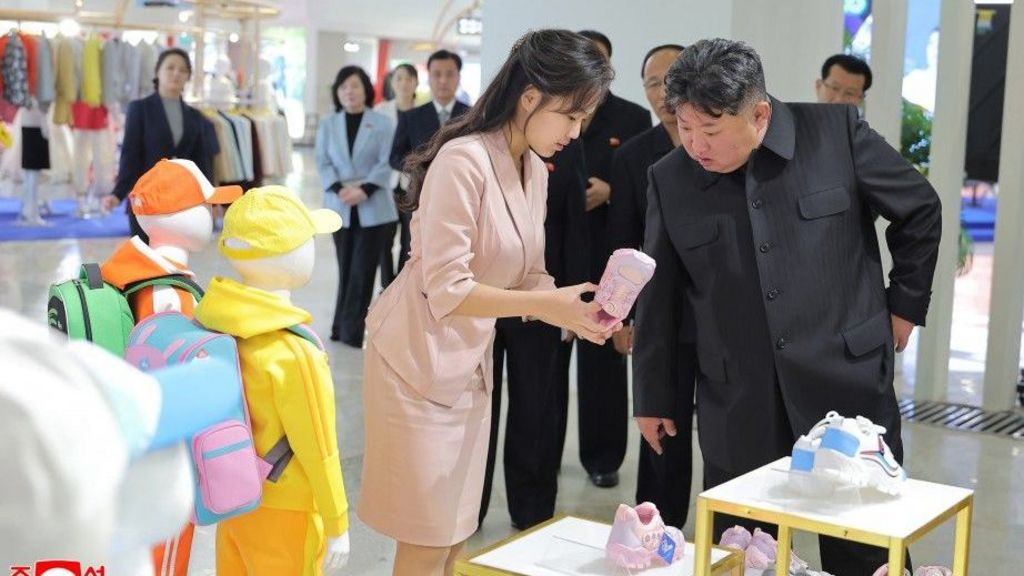
Unsubstantiated online speculation claiming North Korean leader Kim Jong Un had died following a reported brain hemorrhage was swiftly disproven this week, after North Korean state media released clear photographs showing the 42-year-old leader in good health touring a domestic exhibition.
The images, published by state-run newspaper Rodong Sinmun, captured Kim inspecting a clothing and footwear exhibition alongside his daughter, Kim Ju Ae, and his regular retinue of senior officials. The photos emerged just hours after a China-based dissident living in the U.S. named Wanjun Xie — who self-identifies as chairman of the banned Chinese Democratic Party — spread an unevidenced claim that Kim had been transferred comatose to a Beijing hospital and ultimately succumbed to his condition.
For analysts who closely track North Korean affairs, this wave of rumor is far from an unusual event. As one of the most closed and secretive nations on the globe, verifiable information about the inner workings of the Pyongyang regime and its leadership is notoriously scarce, creating ideal conditions for unproven speculation to spread rapidly.
Beyond the photographic evidence contradicting Xie’s claim, multiple independent indicators cast major doubt on the rumor. Regional and international intelligence agencies have not recorded any of the preparatory actions that would logically precede a sudden leadership change: China has not increased security along its shared border with North Korea to prepare for potential instability or refugee flows, there has been no unusual uptick in activity at North Korean diplomatic outposts, and informal cross-border information networks used by North Korean defectors in South Korea have not picked up any chatter consistent with Kim’s death. South Korean intelligence officials also confirmed to Yonhap News Agency that they have found no evidence to back up the unsubstantiated death claims.
This incident mirrors a pattern of false alarms around Kim’s health stretching back years. In 2020, a prominent North Korean defector claimed he was 99% certain Kim had died after cardiovascular surgery, a claim that quickly collapsed when Kim made a public appearance shortly afterward.
Experts point to two core reasons why rumors about Kim’s health and status keep resurfacing repeatedly. The first is widespread uncertainty over the North Korean succession process. Unlike the carefully planned, decades-long transitions that brought Kim Jong Il to power after the death of Kim Il Sung in 1994, Kim Jong Un’s rise to the top was rapid and untested, following his father’s sudden stroke in 2008 and death in 2011. Though Kim has spent years consolidating power by purging rivals, the question of who will succeed him remains open. South Korean intelligence currently assesses that Kim may be grooming his daughter for the role, as she has appeared increasingly often at high-profile state and military events, but she is estimated to be only around 13 years old, has never been formally named as heir, and would be the first woman to lead North Korea — all factors that add layers of uncertainty to the succession question.
The second reason these rumors gain traction is that they are not entirely without plausible basis. Multiple assessments from South Korea’s National Intelligence Service have noted that Kim is overweight and a heavy smoker, lifestyle factors that increase his risk of cardiovascular disease, and heart and circulatory issues are a documented family health trend. A sudden leadership transition in North Korea would carry massive stakes for the entire international community: any sudden political crisis would raise urgent questions about control of Pyongyang’s nuclear arsenal, the risk of regional instability, and potential humanitarian crises along the Chinese border. With roughly 28,000 U.S. troops stationed in South Korea, any unrest directly impacts core U.S. security interests, making even unproven rumors newsworthy.
North Korea’s status as an information black hole also makes it far easier for false reports to spread. Only a tiny inner circle of officials has regular access to Kim, and even the world’s most sophisticated intelligence agencies struggle to confirm information about the leader’s health or internal regime affairs. Many updates from open sources are framed as unconfirmed or probable rather than definitive fact, and the Pyongyang regime itself is widely suspected of deliberately allowing ambiguity to leak in order to obscure internal developments.
Given this context, analysts note it is extremely unlikely that Xie — an individual with no established access to classified intelligence on North Korea — would have obtained accurate information about Kim’s death that professional intelligence agencies missed. Observers suggest Xie likely spread the claim to seek public attention or to embarrass China over its long-standing diplomatic ties to North Korea, a relationship that is already a matter of public record. Regardless of his motive, Xie is just the latest actor to exploit the persistent uncertainty surrounding North Korean leadership for their own ends.