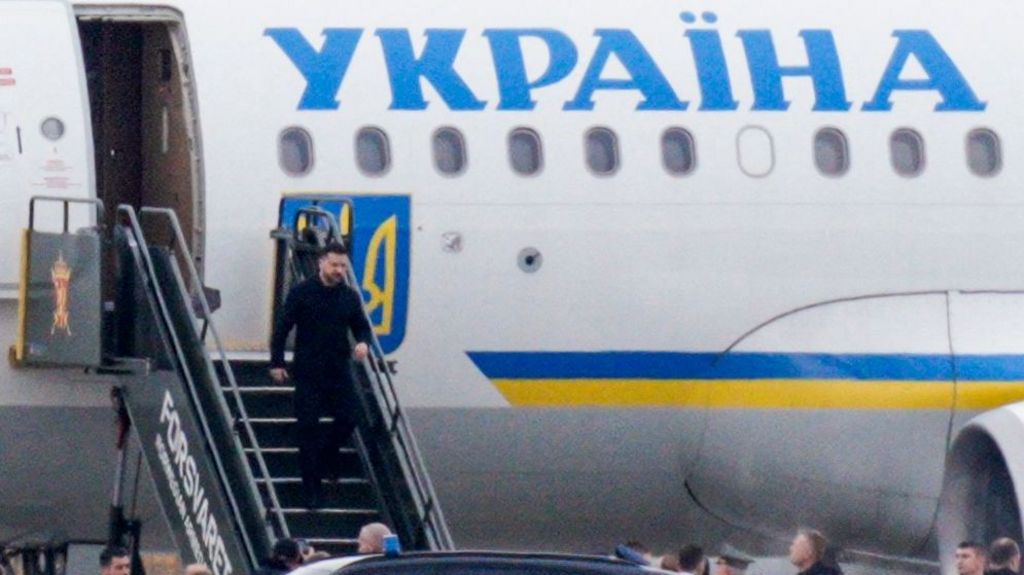
In a high-stakes gathering aimed at resetting strained relations between Kyiv and Washington, Ukrainian President Volodymyr Zelensky and U.S. Special Envoy Steve Witkoff have convened in Oslo, Norway, for critical talks centered on the future of Western support for Ukraine and diplomatic efforts to end Russia’s full-scale invasion. Both leaders arrived in the Norwegian capital on Tuesday, with the meeting arranged at Zelensky’s explicit request through Norwegian and Finnish authorities, at what Norwegian Prime Minister Jonas Gahr Støre called “a critical time for Ukraine.”
The talks come amid a sharp downward spiral in ties between Zelensky and U.S. President Donald Trump, whose public comments in recent weeks have openly questioned Zelensky’s leadership. Trump has gone so far as to state that Ukraine needs a new president and suggested that a third party should take over Ukraine’s negotiation mandate for any peace deal. The rift has deepened over mounting accusations from Ukrainian officials that Washington is withholding critical intelligence that would warn Kyiv of incoming Russian missile and drone attacks.
Serhii Beskrestnov, Zelensky’s top military technical adviser, recently told the BBC that inconsistent access to U.S. early warning intelligence is directly costing Ukrainian lives. “Sometimes we receive this information before the attack, another time we do not,” Beskrestnov said, describing the pattern of inconsistent alerts as deeply concerning. U.S. Secretary of State Marco Rubio, currently on an official visit to India, has pushed back fiercely against these claims, dismissing the accusations as “scandalous” and “outstandingly outrageous.” While Rubio acknowledged that additional Patriot air defense interceptors requested by Ukraine have not yet arrived in the country, he denied Washington has intentionally withheld any critical military support from Kyiv. Unconfirmed reports emerging on Tuesday have added to tensions, indicating that formal approval for the transfer of more Patriot interceptors is still pending in Washington.
Another major point of friction revolves around SpaceX’s Starlink satellite internet network, a critical infrastructure for Ukraine’s military and civilian communications on the front lines. Last week, a bipartisan group of U.S. senators called for an urgent investigation into repeated service disruptions of Starlink across Ukrainian territory. Zelensky noted ahead of the Oslo talks that he had already held a “constructive discussion” with Rubio about the pressing need for consistent U.S. intelligence support, additional missile interceptors, and uninterrupted Starlink connectivity.
The Oslo meeting is not a bilateral dialogue between the U.S. and Ukrainian delegations. Witkoff was joined remotely by Trump’s son-in-law and senior adviser Jared Kushner, while in-person and virtual attendees include Finnish President Alexander Stubb, and senior officials from the United Kingdom, Poland, France, Germany, the European Union, and NATO. Støre emphasized that the core goal of the facilitated talks is to steer the fractured U.S.-Ukraine relationship back onto “a more constructive path,” with the ultimate aim of reaching a “lasting and just peace” through diplomatic negotiations.
Speculation is growing that Witkoff may travel to Moscow for talks with Russian officials after wrapping up his engagements in Oslo, though no official itinerary has been confirmed. Kremlin spokesman Dmitry Peskov told reporters that Russian officials hope to arrange a meeting with Witkoff in the near future, adding that Moscow “greatly appreciates the mediation efforts of the American negotiators.” The contact comes just weeks after Russian President Vladimir Putin held a phone call with Trump to discuss the war, a conversation that was followed by Trump’s announcement that Russia would lift its ban on diesel exports to the U.S. and other global markets, ending U.S. sanctions on Russian diesel shipments.
European leaders have openly voiced growing concern over inconsistent signals from the Trump administration on the Ukraine war. German Chancellor Friedrich Merz told Bloomberg TV on Monday that Washington has sent “mixed pictures and messages” on the conflict, noting that the U.S. has halted all funding for Ukraine’s defense since the start of 2025. “Europe and other countries are shouldering the burden now,” Merz said. “It’s really a big effort for our budgets, it’s really a big thing for the European Union, but we are doing that and we are trying to keep on doing that until this terrible war ends.”
U.S. Vice President JD Vance further clarified the Trump administration’s stance in a recent television interview, saying that while Ukraine is a “partner in some ways” to the U.S., the two countries hold “divergent interests from time to time” — specifically calling on Ukraine to halt strikes on Russian energy infrastructure. Vance added that the U.S. does not have a formal alliance with Ukraine, and he does not support Ukraine joining NATO, saying “we’re gonna work together on some things, but also we’re gonna be opposite on some things too.”
As the talks get underway in Oslo, the outcome of the negotiations is expected to shape the future of Western support for Ukraine, the trajectory of diplomatic efforts to end the war, and the stability of the transatlantic alliance amid shifting U.S. foreign policy priorities.