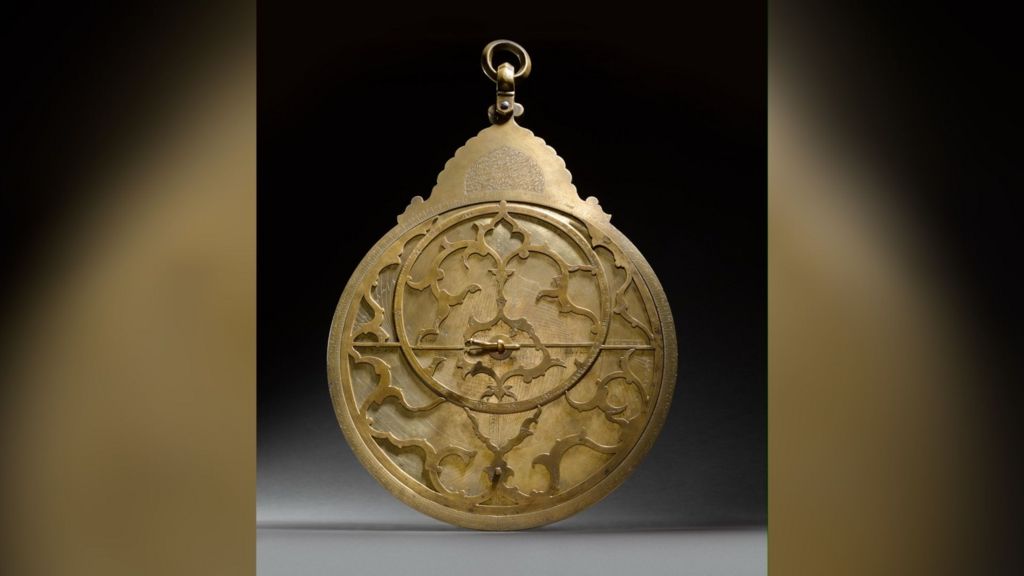
A landmark piece of early modern scientific craftsmanship is set to hit the auction block next week at Sotheby’s London, offering collectors and cultural institutions a once-in-a-generation chance to own a historically significant 17th-century brass astrolabe with deep royal Indian roots.
Described by auction house specialists as potentially the largest intact astrolabe surviving anywhere in the world, this hand-held astronomical device — often dubbed the “smartphone of the pre-modern era” — has never been displayed publicly before, after spending decades in a private collection.
The astrolabe traces its origins back to early 17th-century Lahore, which was then the preeminent center of astrolabe manufacturing in the Mughal Empire. It was crafted collaboratively by Qa’im Muhammad and Muhammad Muqim, two master artisans from the legendary Lahore School of instrument making, where the closely guarded craft of precision instrument building was passed down through family lines. Only two joint works by the brother artisans are known to exist today; the second, a far smaller example, is held in a museum collection in Iraq.
The massive instrument was commissioned by Aqa Afzal, a Mughal nobleman of Iranian descent who held senior administrative posts under emperors Jahangir and Shah Jahan and oversaw governance of Lahore. Its extraordinary scale and ornate craftsmanship were intentionally designed to reflect the high status of its patron. Weighing 8.2 kilograms, measuring 30 centimeters in diameter, and standing 46 centimeters tall, the astrolabe is nearly four times the size of a typical 17th-century Indian astrolabe.
Beyond its size, the piece carries notable cross-cultural significance. Star markers on the device feature traditional Persian names paired with Sanskrit translations etched in Devanagari script, reflecting the multicultural intellectual landscape of Mughal South Asia. It also bears inscribed coordinates for 94 global cities, 38 individually detailed star pointers connected by intricate floral filigree, five precision-calibrated plates, and degree divisions subdivided to one-third of a degree — a level of technical precision unmatched by many earlier astrolabes from the Middle East, which prioritized function over artistic refinement.
Historically, astrolabes functioned as versatile multi-purpose astronomical tools. First invented in ancient Greece in the 2nd century BCE, the design spread to the Islamic world by the 8th century, before spreading further across South Asia. These layered metallic devices allowed users to map stellar positions, calculate the direction of Mecca, track the movement of celestial bodies, tell time, measure the height of structures or depth of wells, and even calculate calendar dates for astrology. Dr. Federica Gigante, a researcher at the Oxford Centre for History of Science, Medicine and Technology, compares the astrolabe’s versatility to that of a modern smartphone, noting its ability to serve dozens of practical and intellectual functions.
Gigante added that the Lahore astrolabe’s accuracy is extraordinary, capable of delivering precise measurements of celestial body altitudes that rival only the finest surviving historical instruments, including one built for Persian ruler Abbas II.
After its creation, the astrolabe entered the royal collection of Jaipur’s Maharaja Sawai Man Singh II in western India. Following the maharaja’s death, it passed to his wife, Maharani Gayatri Devi — one of the most iconic public figures of 20th-century India — before being transferred to a private collection during her lifetime.
Sotheby’s specialists say the astrolabe’s pristine condition, unbroken royal provenance, and one-of-a-kind scale and craftsmanship are expected to draw intense bidding interest from both global institutional collections and private collectors. The piece is valued at an estimated £1.5 million to £2.5 million, which would shatter the existing auction record for an astrolabe. The current record, set in 2014, was a much smaller Ottoman astrolabe made for Sultan Bayezid II, which sold for just under £1 million.
Leading up to the 29 April auction, the astrolabe will be on public display for the first time in Sotheby’s London galleries from 24 to 29 April, giving visitors a rare chance to view a masterpiece of Mughal scientific art that has been hidden from public view for centuries.