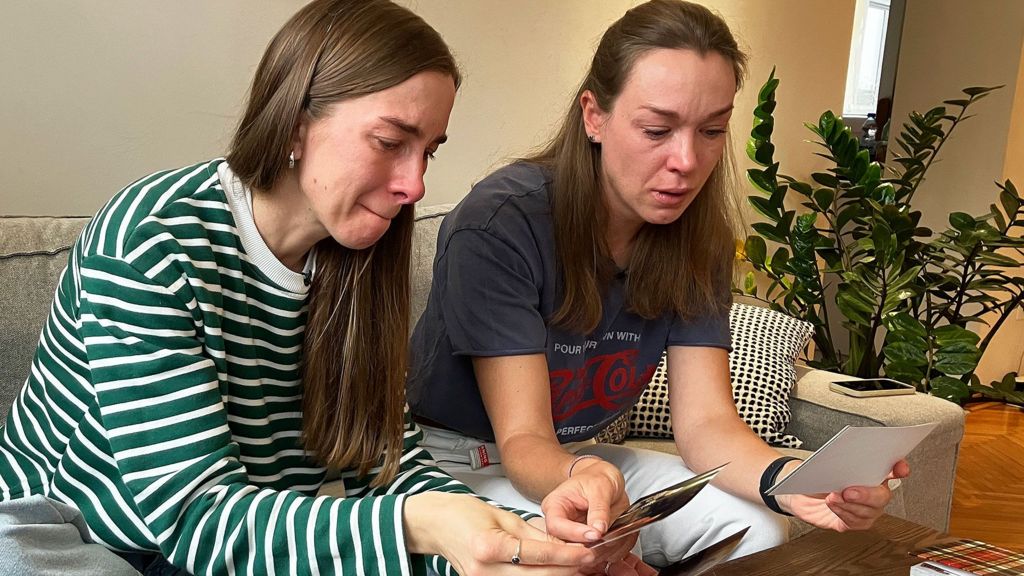
Perched on her Kyiv apartment balcony under warm, bright sunshine, BBC World Service Ukraine conflict correspondent Anastasiya Gribanova cannot suppress a shiver as she stares at a recent photo of the overgrown family garden in Dachne, her childhood village in eastern Ukraine’s Donbas region. Two rough wooden stakes jut from the unkempt grass, marking the unmarked graves of her grandparents, killed when the front line swept through their small community. A short distance away, in a neighbouring village plot, her father Serezha lies buried inside a dilapidated greenhouse. For years, Gribanova has reported on the devastating human cost of the Russia-Ukraine war for global audiences, but in February 2024, the conflict she had covered professionally crashed into her personal life with a devastating text from her mother: “Granny, grandad and Serezha are gone. Now there is no-one left.” The news upended her entire world. Not only had she lost three beloved family members, but her mother, a Siberia native who had openly supported Russia’s full-scale invasion of Ukraine from its February 2022 launch, blamed the Ukrainian state for the deaths. The rift drove the two women to cut off all contact entirely. Pro-Moscow sympathies are not uncommon in the predominantly Russian-speaking Donbas, where years of exposure to Russian state broadcaster narratives after pro-Russian forces seized large swathes of the region in 2014 cemented many local residents’ alignment with Moscow over Kyiv. Today, Russian forces control roughly 80% of Donetsk Oblast, the Donbas sub-region where Dachne sits, after nearly five years of full-scale war that has levelled countless towns and villages to rubble. Gribanova had already fallen out with her older sister Sasha, who was residing in Moscow with her young family when the full-scale invasion began; when Sasha refused to take a public side in the conflict, a hurt Gribanova cut off all communication. But as the first anniversary of her father’s death approached, Sasha reached out unexpectedly, and the two began exchanging messages about their shared, peaceful childhood before the war. Gribanova quickly realised she no longer harboured anger toward her sister, who was navigating the exact same crippling grief of losing their father. She shared her plan to produce a documentary centred on Serezha, who had chosen to remain in Dachne to care for his ageing parents, and Sasha offered full support, though the pair agreed not to inform their estranged mother of their reconciliation for the time being. Gribanova launched a painstaking, high-risk investigation to piece together the final days of her family members in January 2025, when the front line moved rapidly through Dachne. Travelling to the Russian-occupied village was impossible, as Russian forces formally seized full control of Dachne on 14 February 2025 and have maintained a heavy military presence ever since. She navigated public village messaging groups to track down remaining local residents, eventually connecting with a man she identifies only as Misha, who was with Serezha in his final hours. To avoid endangering Misha under Russian occupation, Gribanova did not disclose her BBC affiliation or that she was recording their conversation. Misha recounted stopping by Serezha’s home on 26 January 2025 to find him injured, saying he had been grazed by a drone strike and asking for a first aid kit. Serezha insisted the wound was not serious, but when Misha returned a few hours later, he found him dead. Misha and two other local residents buried him in the family greenhouse, and expressed deep regret that he could not save Serezha’s life. While it is impossible to definitively identify which side operated the drone that killed Serezha, records confirm Russian forces were conducting near-constant drone strikes on Dachne at that time. The circumstances of her grandparents’ deaths proved far murkier, with no direct witnesses to their final moments. Gribanova connected with a local woman codenamed Lina, the last confirmed person to see her grandparents alive, who recalled that in late January 2025, intense shelling was hitting the edges of Dachne as Russian forces advanced, and Ukrainian troops had moved from the village outskirts to its central residential streets, hiding in private yards to evade enemy drones. Lina claimed two unmarked soldiers who spoke Ukrainian (a term she referenced using the derogatory, Russian state media-promoted slur “Bandera”) entered her property, pointed a machine gun at her, and ordered her to evacuate before one of the men headed to the home where Gribanova’s grandparents were sheltering. Fearing for her life, Lina fled the village for the night, and returned the next day to find the grandparents’ front door wide open in freezing winter conditions. She dared not enter the property due to drones patrolling overhead, and later heard from neighbours that the elderly couple had been found dead. Another local resident, codenamed Maria, told Gribanova she discovered the bodies: the grandmother lying in bed covered by a blanket, and the grandfather on the floor in a pool of dried blood. Most remaining Dachne residents Gribanova spoke to shared uncorroborated beliefs that Ukrainian troops were responsible for the killings, rooted in widespread local tensions at the time, as Ukrainian forces viewed remaining residents in the village as pro-Russian sympathisers. The Russia-appointed local mayor installed after the February 2025 occupation takeover confirmed she attended the grandparents’ burial a month later, and noted half of the grandmother’s skull was missing. Their bodies were not exhumed for nearly 20 months, when occupying local authorities transferred the remains to a morgue in the controlled territory for a basic autopsy. The forensic report found the grandmother died of explosive-related skull trauma with no clear identifiable cause, while no obvious external injuries were found on the grandfather’s remains. Cross-referencing open-source military mapping data from Ukrainian resource DeepStateMap.Live and US think tank the Institute for the Study of War confirmed Ukrainian forces still held control of the street where the grandparents were staying during the week of their deaths, amid a rapidly shifting front line. When Gribanova reached out to the Ukrainian 33rd Mechanised Brigade, which operated in Dachne during that period, the unit acknowledged its troops were present in parts of the village in late January, but official military spokespeople stated there was no verified evidence implicating its service members in the deaths, and that formal law enforcement bodies were responsible for investigating alleged wartime wrongdoing. Requests for comment sent to Russia’s Ministry of Defence and the Russian Embassy in London received no response. The Donetsk regional prosecutor’s office, now operating outside Russian-controlled territory, has documented dozens of alleged Russian war crimes in nearby villages during that same December 2024 to January 2025 window, but no equivalent alleged offences have been registered for Dachne, and Gribanova’s three family members are not listed in the region’s civilian death records for the settlement. With their remains trapped in occupied territory, Gribanova fears she may never be able to give her grandparents and father a formal, dignified funeral and proper goodbye. Instead of remaining trapped in grief and family division, she chose to pursue reconciliation. Three years after last seeing Sasha, she flew to Belgrade, where her sister had relocated, and the pair reunited at the airport, sharing tears, childhood memories, and old family photos. Together, they called their mother, who had also moved to Serbia, and the long-silent rift between mother and daughter began to thaw. Though her grief over her lost family members remains, Gribanova no longer carries the weight alone, and has found a path to healing through mending the fractured bonds between the surviving members of her family.
My family died in Ukraine. My mum blamed Zelensky’s troops – the truth is complicated