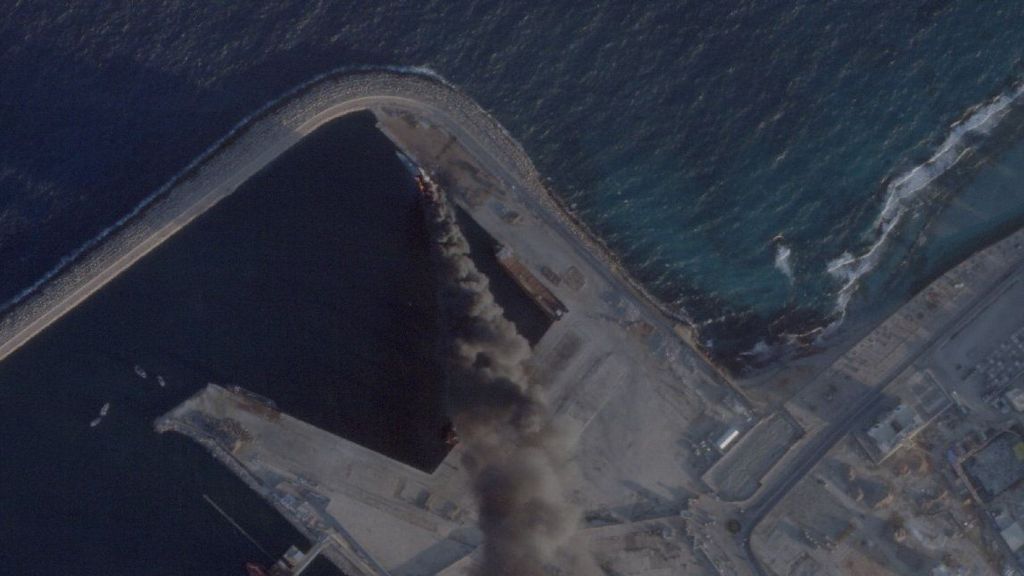
Early on Sunday dawn, an explosion ripped through a Russian-flagged vessel docked at the Benghazi naval base in eastern Libya, in what local governing authorities have confirmed was a suspected unmanned aerial vehicle assault. The ship had been making a routine stop to refuel and restock essential supplies while en route back to Russian territory, according to statements from eastern Libya’s Government of National Stability (GNS) relayed via official state media. No casualties were reported in the immediate aftermath of the blast, and security teams moved swiftly to cordon off the affected port zone to prevent any secondary risks. Independent satellite imagery captured by Planet Labs PBC, verified by BBC’s fact-checking unit, shows the vessel fully engulfed in bright orange flames at 05:47 GMT on Sunday, with follow-up shots taken several hours later documenting the craft partially submerged beneath the port’s surface. Geolocated user-generated videos circulated across social media platforms also corroborate the timeline, showing thick plumes of black smoke billowing from the burning ship while the sky over Benghazi remained dark at the pre-sunrise hour. The GNS clarified that the Russian ship had been granted full access to the Benghazi port under the terms of a pre-existing bilateral maritime cooperation agreement, and that the attack represented a blatant violation of international maritime safety norms as well as an infringement on Libyan national sovereignty. Eastern Libyan officials have launched a full formal investigation into the incident, and stated they are in active coordination with Russian diplomatic and defense counterparts to trace the origin of the suspected drone and identify the parties responsible for the strike. The governing body also emphasized that Libya remains a neutral party to the ongoing Russia-Ukraine conflict, and that no hostilities linked to external wars should be permitted to unfold on its territorial soil. In a separate concurrent statement, Libya’s internationally recognised Tripoli-based Government of National Unity (GNU) issued a stark warning against allowing foreign military personnel or assets to operate out of the country’s civilian and strategic port facilities. The GNU noted that permitting such activities carries severe, well-documented risks of dragging Libyan infrastructure and civilian populations into extraterritorial conflicts, endangering ordinary citizens’ lives and putting critical national assets at permanent risk of damage. The dual opposing administrative structures in Libya emerged after the 2011 overthrow of long-time ruler Muammar Gaddafi, a period that plunged the North African nation into years of fragmented armed conflict and institutional instability. Benghazi, the country’s second-largest city, sits roughly 2,000 kilometers away from the Russian capital of Moscow. As of press time, official representatives of the Russian Federation have not released any public comment on the incident.
Explosion on Russian ship at Libya port caused by suspected drone attack, officials say