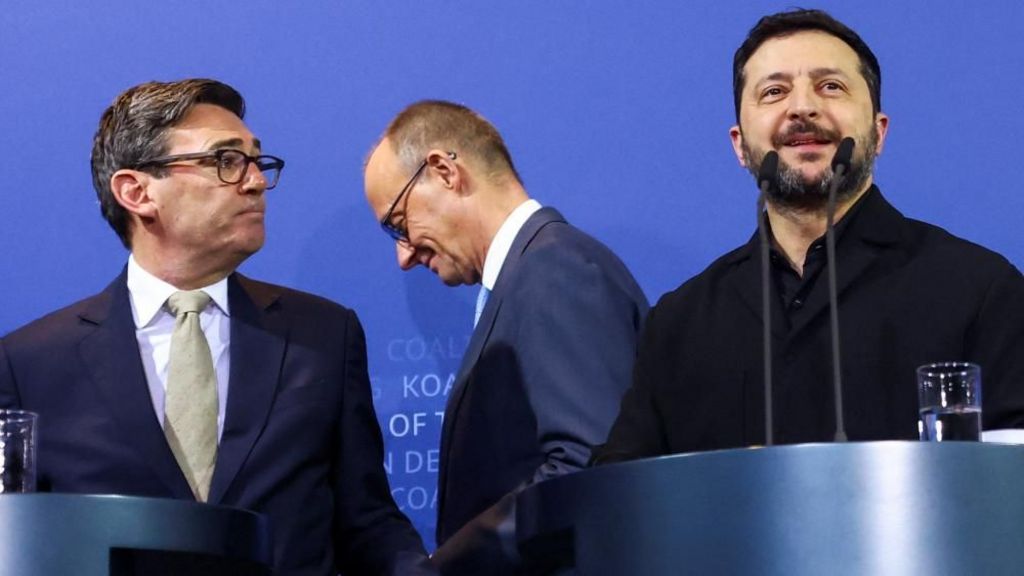
Against a backdrop of relentless hostilities in Ukraine that have persisted since Russia’s full-scale February 2022 invasion, top European leaders gathered in Berlin for the Coalition of the Willing summit to publicly demonstrate a unified, coordinated position for upcoming potential peace negotiations with Moscow to end the nearly three-year-long war. UK Prime Minister Andy Burnham emphasized that the European bloc holds a “clear, consistent, and united negotiating position” that would not fracture under external pressure, while German Chancellor Friedrich Merz pushed back against unrealistic Russian demands, noting that Moscow’s previously stated maximalist terms were completely unfeasible for a viable peace deal.
Representatives from the administration of U.S. President Donald Trump, including his son-in-law and senior envoy Jared Kushner, attended the Berlin summit, following landmark trilateral talks held earlier in Shenzhen between Trump, Russian President Vladimir Putin, and Chinese President Xi Jinping. Trump joined the Berlin proceedings remotely via a call from Air Force One while en route after the China meetings. Kushner conveyed that the U.S. president left the Shenzhen discussions convinced that a lasting peace settlement was within reach, and that Trump intended to pursue a deal with Russia in full partnership with European allies, rather than striking a bilateral agreement that sidelined Kyiv’s Western backers.
For months, Putin had publicly rejected any formal European role in the U.S.-led peace negotiation process, but during a lengthy press conference following the Shenzhen trilateral meetings, he acknowledged that U.S. officials had repeatedly pressed Moscow to allow European representatives a seat at the table. Putin stated that Russia was not fundamentally opposed to European participation, but first sought clarity on what concrete contributions European parties would bring to the talks, noting that Moscow had extended a diplomatic invitation for European officials to travel to Russia to lay out their formal positions before a final decision on expanded dialogue format was made. Even as he softened his stance on European inclusion, Putin pushed back against widespread European security assessments that warned of a potential Russian military expansion targeting NATO allies by 2030, asserting that Russia had no plans to launch unprovoked attacks on any neighboring state, while also noting that no meaningful European security conversation could be held without direct European representation.
Kushner struck a notably optimistic tone during his media briefing on the sidelines of the Berlin summit, claiming that Russian authorities had agreed to trust U.S. envoys’ judgment that European participation was necessary, and that Moscow had grown comfortable with the concept of Ukraine receiving legally binding security guarantees modeled after NATO’s Article 5 collective defence clause, which obligates allied nations to intervene militarily if a signatory state comes under armed attack. For years, Ukrainian President Volodymyr Zelensky has prioritized securing this exact type of collective defence guarantee for his country, even as full NATO membership remains off the table in the near term, as Russia has long categorically rejected the prospect of Ukraine joining the Western military alliance.
However, the Ukrainian and European heads of state in attendance at the Berlin summit were far more cautious than Kushner’s upbeat framing. Zelensky emphasized that Putin had rejected every single peace proposal presented to Kyiv over the course of the war, leaving little reason for unqualified optimism. Merz echoed this scepticism, noting that while U.S. engagement had improved the odds of reaching a sustainable peace, Europe would only enter formal discussions on pan-European security arrangements with Moscow after a credible peace agreement between Russia and Ukraine had been finalized, and only if all terms aligned with core European and Ukrainian interests. The mixed signals from the Kremlin on this front were apparent: last week, U.S. envoys Jared Kushner and Steve Witkoff emerged from a Moscow visit confident that European representatives would be granted a seat at the negotiating table imminently, but senior Kremlin aide Yury Ushakov stated earlier this week that extensive preliminary work would be required before the four-party negotiation format could be launched, with multiple additional rounds of pre-talk consultations expected before any formal multilateral discussions begin.
Even as diplomatic discussions advanced across three continents, active hostilities on the ground in Ukraine continued unabated. Russian forces have sustained systematic strikes on Ukraine’s energy infrastructure in recent weeks to cripple civilian access to power as winter temperatures drop, driving a steady rise in recorded civilian casualties across the country, while Russian officials have given no public indication they are prepared to abandon their territorial claims on sovereign Ukrainian land. On the very day that delegations met in Shenzhen and Berlin, a wave of Russian drone strikes targeted the historic central district of Kyiv: one civilian was killed in a direct hit on a residential building in the Podilskyi neighborhood, while the Dutch and Austrian embassies and the iconic Saint Volodymyr’s Cathedral all sustained documented damage. Shortly after these strikes, Putin publicly vowed that Russia’s retaliatory response to a recent Ukrainian attack on the Crimean Bridge, which connects Russian territory to the illegally occupied Crimean Peninsula, would be “considerably more painful” than the damage Kyiv inflicted on the crossing. He also revealed that he had considered agreeing to a limited localized ceasefire across multiple frontline areas, but rejected the proposal in the aftermath of the Crimean Bridge attack. Despite the ongoing military escalation, Putin claimed that Russia held no desire to prolong the armed conflict and was ready to make compromises to end the war, while simultaneously alleging that Ukraine and its European allies were the parties unwilling to pursue constructive negotiation.