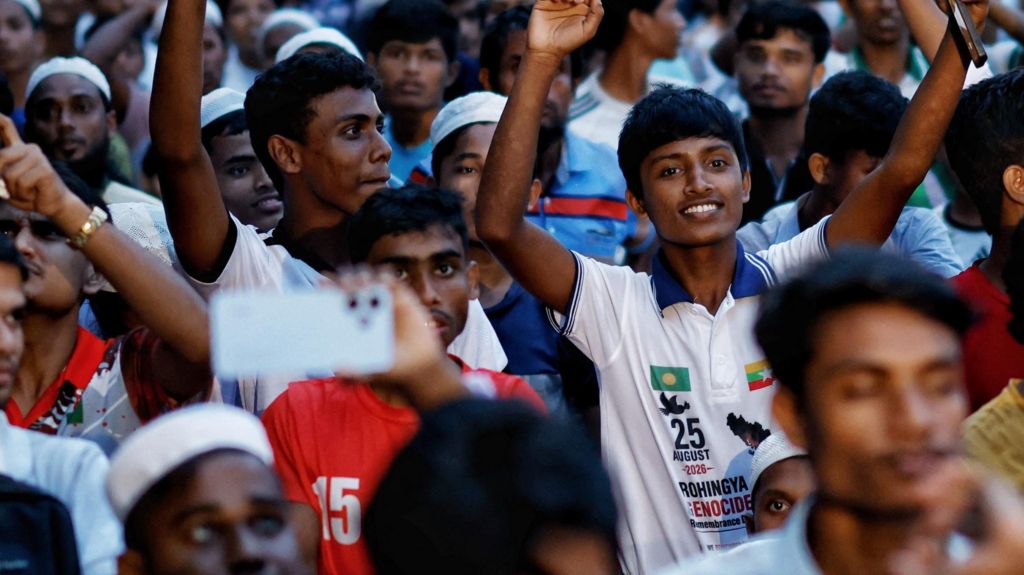
Tens of thousands of Rohingya refugees crowded around public display screens across the sprawling, overcrowded displacement camps in Cox’s Bazar, Bangladesh, erupting in cheers and tearful embraces as International Court of Justice (ICJ) President Judge Yuji Iwasawa read out a landmark, 9-6 majority ruling that formally confirmed Myanmar’s state responsibility for committing genocide against the Rohingya ethnic minority. The historic judgment marks the first time any sovereign state has ever been found in violation of the 1948 UN Genocide Convention, cementing Myanmar’s place as the first nation globally to carry that formal legal stain.
The ruling caps a five-year legal process launched in 2019, when the West African nation of The Gambia filed the case with the full backing of the Organisation of Islamic Cooperation, presenting exhaustive documented evidence of the 2017 Myanmar military and local militia campaign that left at least 10,000 Rohingya dead, with widespread verified accounts of mass extrajudicial killings, systematic sexual violence, torture, and the deliberate incineration of entire villages where families were burned alive trapped inside their homes. More than 700,000 Rohingya fled across the border to Bangladesh in the wake of the violence, joining hundreds of thousands of earlier displaced community members to form the current refugee population of over one million living in the camps.
Legal analysts have stressed that the ruling carries transformative weight for ongoing ICJ genocide proceedings, most notably South Africa’s pending case against Israel over alleged genocidal actions against Palestinian civilians in Gaza following the October 7, 2023, Hamas attacks, which Israel has repeatedly and vehemently denied. For decades, the highest evidentiary bar in genocide cases has been proving specific genocidal intent, rather than just demonstrating that large-scale atrocities took place, a threshold deliberately crafted by Holocaust survivor and Genocide Convention architect Raphael Lemkin to avoid frivolous prosecutions. The ICJ’s majority ruling clarified that intent can be reliably inferred from a consistent, cumulative pattern of state conduct, even if the state cites parallel stated objectives such as counterinsurgency, collective punishment, or forced population displacement. As University of Oxford Blavatnik School of Government Global Security Chair Janina Dill explained, the court explicitly rejected the longstanding argument that the existence of alternative state motives negates a finding of genocidal intent, so long as the totality of violent actions cannot be explained without identifying the partial or total destruction of a targeted ethnic group as one core operational goal.
Philippe Sands KC, a leading British human rights barrister who served on The Gambia’s legal team, confirmed that the evidentiary standard set by this ruling directly shaped the trajectory of the Gaza case: a loss for The Gambia would have effectively collapsed South Africa’s ongoing filing, while the victory keeps the legal pathway open, without pre-determining the outcome of the separate Gaza proceedings.
The verdict arrives at a moment of unprecedented strain on the post-WWII international rules-based order, amid overlapping global tensions involving the leadership of the United States, Russia, and China, who held a trilateral summit in China on the very same day the ICJ issued its ruling, serving as a tangible reminder that international legal frameworks remain active and can impose accountability for state violence against civilian populations.
While the ruling sparked widespread euphoria among Rohingya refugees, it will not immediately resolve their nearly decade-long crisis: the ICJ lacks its own enforcement mechanism, and while it has ordered Myanmar to pay formal reparations to the Rohingya community for the razing of hundreds of villages and mass atrocities, the Myanmar junta has given no indication it will comply. The United Kingdom, which holds the UN Security Council pen holder mandate for Myanmar, has already announced a series of concrete measures including the expulsion of Myanmar’s defence attaché in London, and is pushing for an urgent Security Council session to enforce accountability, though analysts warn a punitive formal resolution will almost certainly face veto threats from China and Russia. The verdict has already sparked sharp pushback from the Trump administration, with current US UN Ambassador Mike Waltz previously warning the ICJ not to “lower the legal threshold for proving genocide” in comments widely interpreted as a defence of Israel’s position in the Gaza case, and launching unsubstantiated attacks on 2025 Nobel Peace Prize winner and sitting ICJ judge Navi Pillay for her prior independent UN findings of potential Israeli genocidal conduct in Gaza. Legal experts have repeatedly cautioned against framing the Rohingya genocide ruling as a mere test run for the Gaza proceedings, emphasizing that the unique, decades-long suffering of the Rohingya community must remain the central focus of global attention, rather than being sidelined by geopolitical debates over other ongoing conflicts.
Bowen: Myanmar genocide verdict is historic and could have far-reaching implications