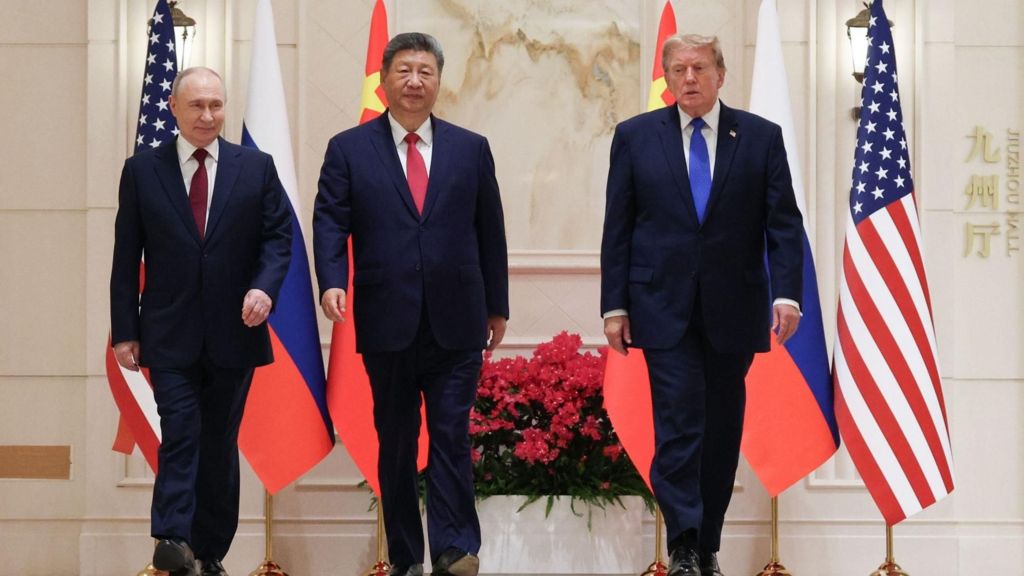
The first-ever face-to-face trilateral meeting between U.S. President Donald Trump, Russian President Vladimir Putin, and Chinese President Xi Jinping, once billed by observers as a landmark “Yalta 2.0” gathering of the world’s top great powers, has left few tangible policy outcomes in its wake, leaving carefully staged visual moments as the summit’s most enduring legacy. Trump arrived at the high-stakes three-way discussion with no formal pre-set agenda and no clearly defined negotiating demands, and departed the closed-door session with nearly no concrete deliverables to show for the diplomatic encounter. The three-day Asia tour that hosted the historic trilateral gathering came just days after a crushing midterm election defeat for Trump’s Republican Party, a domestic political setback that left the U.S. leader craving the global stage’s spotlight to rebuild his political standing. In a Wednesday interview with Fox News, Trump framed his trip as an unqualified success, highlighting the elaborate fanfare, pageantry, and warm public reception he received upon his arrival in China, as well as his prominent placement at the Asia-Pacific Economic Cooperation (APEC) official dinner the previous evening. For Trump, the ceremonial pomp of the high-profile summit appears to have been a core priority from the outset. In the immediate aftermath of the trilateral talks, the U.S. side has maintained near-total public silence: while Chinese authorities rapidly released a full joint communique outlining the scope of discussions, and Putin held a sprawling hour-long solo press conference to detail his takeaways, Trump has made only scattered, brief public remarks, deferring a full public briefing to a Friday press conference scheduled at the White House. This marks a sharp departure from his past diplomatic travel patterns, where he routinely spoke to reporters mid-flight back to Washington immediately after high-stakes meetings with Xi, including their 2024 APEC encounter in South Korea. The joint statement the White House ultimately opted to endorse is largely vague, offering only broad, non-binding endorsements of collective efforts to uphold global strategic stability and international security. Beyond carefully choreographed footage of the three world leaders sitting amicably around a shared table to discuss cross-border crises, the document offers the global public minimal reassurance that tangible progress has been made to de-escalate looming geopolitical flashpoints. Its pledges to continue future high-level dialogue and a generic reaffirmation that nuclear war must never be waged fall far short of actionable policy commitments. David Firestein, president of the Bush Foundation for U.S.-China Relations, noted in an interview with the BBC that even modest, low-stakes gatherings of the world’s largest power brokers hold inherent value, as they keep open lines of communication that can prevent catastrophic miscalculation. The few specific, targeted clauses buried in the joint communique offer rare hints of narrow shared interest: a provision committing to expand the production and global supply of refined petroleum products is widely interpreted as a targeted concession to Russia, one of the world’s largest fossil fuel exporters, while a coordinated condemnation of the International Criminal Court reflects a unified stance across all three nations against multilateral bodies that seek to enforce binding international legal rulings. The alignment on that clause lays bare a rare point of consensus between the three leaders: none support independent global governance institutions that hold the power to enforce rules on major sovereign states. Upon Trump’s return to Washington, he is set to face a fierce bipartisan backlash on Capitol Hill, with lawmakers across the political spectrum expressing deep unease over the tone of the trilateral talks. Utah Republican Senator John Curtis released a public statement arguing that the administration’s framing of its outreach to Moscow and Beijing was dangerously misplaced, emphasizing that Putin and Xi are not American allies, and that constructive diplomacy can never come at the cost of clear-eyed recognition of U.S. geopolitical adversaries. For Democratic lawmakers, the criticism was far more blunt: nine members of the Senate Foreign Relations Committee signed an open letter to the White House arguing that U.S. national security interests must never be bartered away for superficial photo opportunities or the president’s personal political gain. Political analysts note that Trump is far from the first U.S. president to seek a high-profile overseas diplomatic showcase to recover from a bruising domestic electoral setback: former presidents Bill Clinton and Barack Obama both embarked on major international trips shortly after their own parties suffered heavy midterm losses, though any temporary political bounce they gained from those travels faded within weeks. Given the near-total absence of substantive diplomatic breakthroughs from the Asia trilateral summit, it is highly likely that the entire episode will fade from public memory just as quickly, leaving only the carefully curated press photographs as its lasting trace.