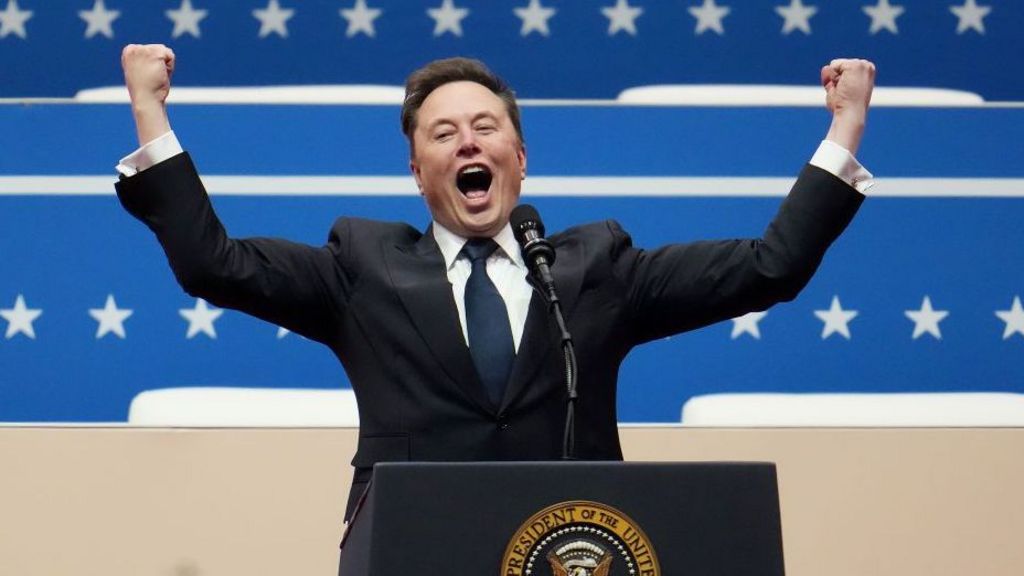
Billionaire entrepreneur Elon Musk, chief executive of electric vehicle maker Tesla and aerospace firm SpaceX, publicly shared his disappointment over his unprecedented $446 million (£339 million) in campaign contributions to Republican candidates during the 2026 US midterm elections, describing the massive expenditure as making him feel “pretty foolish” in remarks delivered virtually at the annual New York Times DealBook Summit on Wednesday.
As the single largest individual donor of the entire midterm cycle, Musk had directed the vast majority of his financial support toward GOP candidates, particularly in Texas, the state that hosts major manufacturing and operational hubs for both Tesla and SpaceX. Despite his high-profile endorsement of former President Donald Trump’s successful 2024 return to the White House and his prior role as an unpaid senior White House advisor leading the Department of Government Efficiency (Doge) initiative to slash federal spending, Musk clarified during the summit that he does not align unreservedly with the Make America Great Again (MAGA) movement. “I’m not MAGA,” he stated explicitly, noting he rejects the idea of blind, unthinking adherence to any fixed set of Republican policy positions.
The 2026 midterms delivered a historic landslide victory for the Democratic Party, which flipped competitive swing seats to seize full control of both the US House of Representatives and the Senate, breaking decades of unbroken Republican dominance in multiple traditionally red regions. The results represented a deeply bruising political setback for Trump, whose administration has faced widespread public backlash over policies widely linked to sustained elevated cost-of-living pressures across the United States. Musk also acknowledged that while he saw little tangible return on his record-breaking campaign investment, he conceded that Republican electoral outcomes would likely have been even more disastrous without his financial backing.
The sweeping Democratic victories carry significant regulatory and operational risks for Musk’s sprawling corporate portfolio. Democratic leadership in both chambers of Congress has already announced plans to ramp up oversight of large technology firms, with a specific focus on the controversial rollout of large-scale data centers and the generous tax incentive packages often offered to tech companies to encourage new construction. In Georgia, home to key SpaceX data center facilities, newly elected Democratic state leadership has pledged to impose strict new limits on the expansion of these massive data infrastructure sites and to revisit the preferential tax breaks currently extended to tech developers. Democratic lawmakers have also floated the possibility of launching formal investigations into SpaceX, which has secured an estimated $10 billion in new federal government contracts since Trump took office for his second term. Prior to the midterms, the Pentagon had also appointed Musk as co-lead of Project Meridian, a high-profile initiative studying the future of modern warfare.
Even in Texas, long a Republican stronghold that has hosted Musk’s corporate headquarters for years, Democrats secured landmark wins: progressive Democrat Gina Hinojosa defeated long-serving incumbent Republican Greg Abbott to claim the Texas governorship, ending 30-plus years of unbroken GOP control of the state’s top office, while Democratic candidate James Talarico ousted Republican Ken Paxton to win a US Senate seat. Musk had poured at least $45 million of his own money into supporting Paxton’s failed Senate campaign. Despite the sweeping Democratic gains in his key operational base, Musk struck a cautiously optimistic tone, noting that he expects incoming Texas governor Hinojosa to govern as a moderate, not a far-left partisan, and that he anticipates minimal disruption to his companies’ activities in the state.
Elon Musk says record spending on US midterms was ‘pretty foolish’