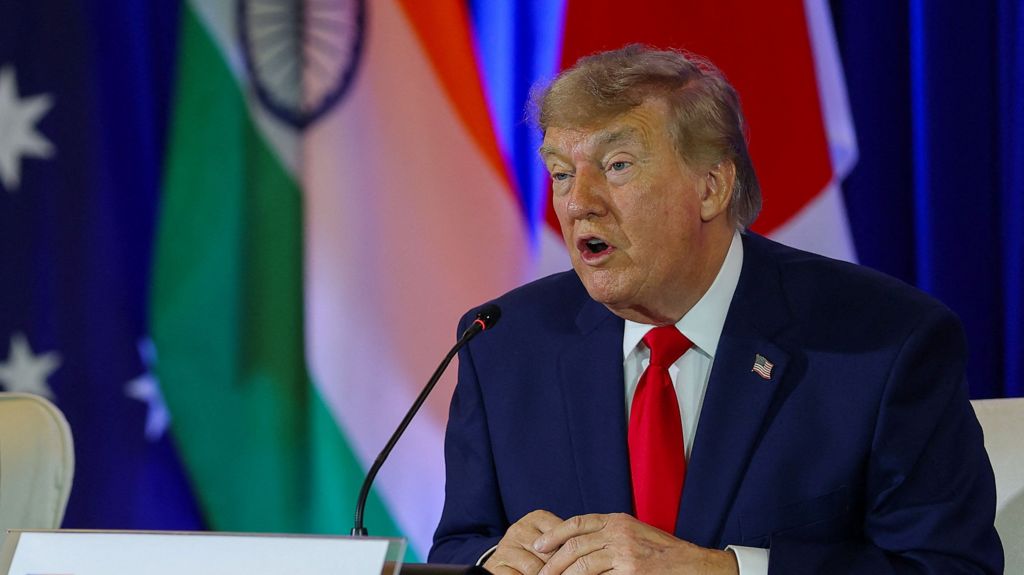
On the sidelines of the 2017 ASEAN Leaders’ Summit held in Manila, Philippines, U.S. President Donald Trump fielded questions from a pool of traveling White House reporters regarding a recently surfaced CNN report that cited anonymous U.S. intelligence sources claiming Tehran was allegedly plotting to deploy a radiological dispersal device, colloquially known as a dirty bomb, in Washington D.C. to target senior members of his administration.
When pressed for a formal response to the uncorroborated intelligence assessment, Trump acknowledged that his administration was treating the purported threat with extreme gravity. “We’re looking into it,” he confirmed, before making a pointed characterization of Iranian leadership as “crazy” and noting that while he hoped no imminent attack was in the works, no potential threat could be dismissed out of hand.
Prior to the president’s public remarks, White House spokesperson Lauren Bis had issued a carefully calibrated official statement emphasizing that national security agencies maintained full vigilance over all emerging threat streams, but clarified that at that specific juncture, no verified, credible threats to the U.S. homeland had been confirmed.
Iranian officials swiftly and forcefully rejected the entire set of allegations as completely fabricated. Esmail Baghaei, spokesperson for Iran’s foreign ministry, took to social media platform X to denounce the reports, arguing that the nations that had initiated acts of aggression against Iran were now peddling unfounded claims to lay media groundwork for their own pre-planned hostile objectives.
The BBC noted at the time that its editorial team had not completed independent verification of CNN’s original reporting on the alleged plot. The public discourse around dirty bomb threats, devices that combine conventional explosive payloads with loose radioactive material such as uranium to scatter hazardous particles across a wide area upon detonation, had grown steadily in the wake of the 9/11 2001 terror attacks, though no successful such attack had ever been recorded anywhere in the world as of that news cycle.
Independent national security experts weighed in to contextualize the public discussion. Mick Mulroy, a former CIA paramilitary officer and ex-deputy assistant secretary of defense, explained that while constructing and deploying a basic dirty bomb was far less technically complex than building a functional nuclear warhead, it qualified as a “weapon of mass disruption” rather than a traditional weapon of mass destruction, capable of causing widespread public panic, long-term costly decontamination requirements, and severe social and economic disruption even with minimal immediate fatalities. Imran Bayoumi, a geostrategy specialist at the Atlantic Council and former U.S. Department of Defense policy advisor, noted that the actual severity of the alleged Iranian plot remained highly ambiguous, while pointing out that Tehran had a documented history of plotting and threatening attacks on U.S. targets in prior years, and that the unusual timing of the unclassified public disclosure of the intelligence assessment raised logical questions.
Media and policy analysts also observed that the public discussion of purported Iranian terror threats unfolded against a separate, concurrent policy priority for the Trump administration and U.S. intelligence agencies: lobbying U.S. Congress to pass a renewal of Section 702 of the Foreign Intelligence Surveillance Act (FISA), a sweeping surveillance provision that authorizes U.S. intelligence agencies to monitor communications of non-U.S. persons located outside of U.S. borders, which was scheduled to expire the following March.
Trump says US taking ‘very seriously’ any Iranian plot against Washington