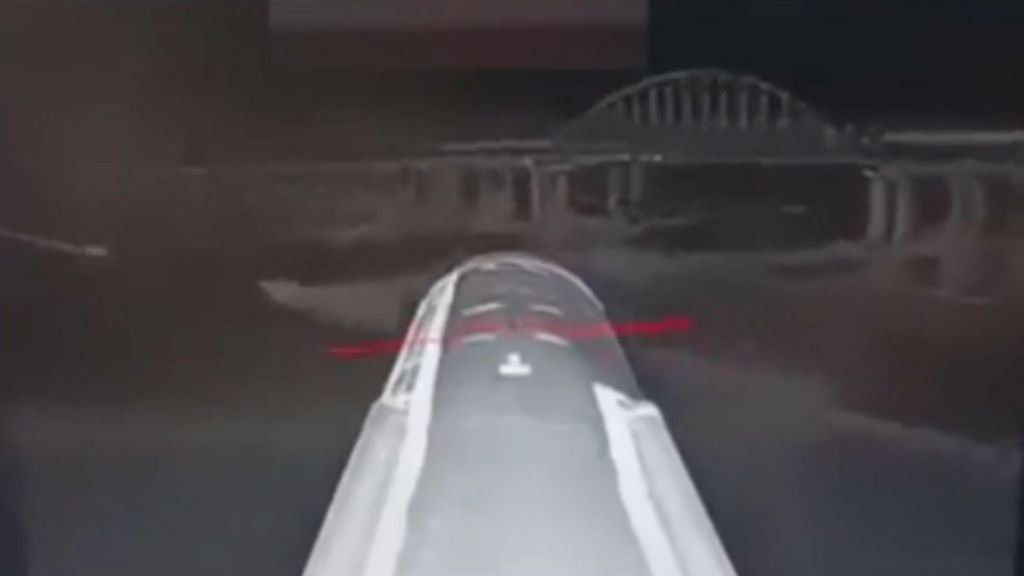
Newly declassified operational footage captured by an on-board camera of a Ukrainian domestically engineered Flamingo missile shows the weapon zeroing in on the steel arches of the Kerch Strait-spanning Crimean Bridge moments before impact, marking the culmination of a meticulously planned seven-phase strike that has collapsed a 227-metre, thousands-of-tonnes structural road arch into the Black Sea seabed.
Stretching 12 miles across the strategic waterway, the dual-purpose road-rail crossing has carried outsized symbolic weight since its 2018 unveiling: for the Kremlin, it was a flagship prestige project meant to cement Russia’s illegal territorial claim to the Ukrainian Crimean Peninsula, while for Kyiv it has long stood as a tangible marker of Moscow’s years-long military occupation of sovereign Ukrainian land.
Kyiv’s Security Service and General Staff confirmed Tuesday that the weeks-long layered operation was calibrated to systematically dismantle Russia’s overlapping defensive networks guarding the high-value asset. Initial probing strikes on November 16, conducted via night-launched drones, inflicted visible partial damage on the road arch before traffic was temporarily restored, a move that masked the preparatory, penultimate phase of the broader campaign. In the pre-dawn hours of November 17, the final wave of modified long-range missiles, including the remotely guided Flamingo variant, delivered a fatal blow to the already weakened structure.
Munitions expert Justin Bronk of the UK’s Royal United Services Institute noted that the adjusted Flamingo platform’s heavy, high-yield warhead was purpose-built to penetrate the bridge’s reinforced concrete supports, a modification that drastically improved its precision enough to strike the most structurally sensitive points of the span. Ukrainian President Volodymyr Zelensky later verified that a mix of domestically produced drones and long-range munitions were deployed across the full operation.
Independent structural engineering assessments confirm the damage is catastrophic. Monash University’s Colin Capriani, speaking to BBC Verify, emphasized that the collapsed arch was not a decorative feature but a core load-bearing component that distributed structural weight to stabilize the entire crossing, making full reconstruction extremely high-risk while the facility remains well within Ukrainian strike range. David MacKenzie of global engineering firm COWI added that while debris clearance could be completed relatively rapidly, restoring full road traffic on the crossing would require no less than 12 months of work. The parallel railway arch remains standing with unconfirmed partial damage, and limited rail services have since resumed after an initial full traffic suspension.
Prior partial attacks on the bridge in 2022 and 2023 only damaged peripheral road spans, but this latest operation has targeted the structure’s most critical, previously invulnerable core. The strike delivers a severe blow to Moscow’s occupation logistics network: Russia has long used Crimea as a forward military hub hosting airbases, troop staging grounds, artillery stockpiles, and launch sites for cross-border attacks on Ukrainian mainland territory. While a partial land supply corridor still runs through occupied Zaporizhzhia and Kherson regions, Kyiv’s ongoing sustained strikes on Chongar-area crossings and northern Crimean transport routes have already created bottlenecks for fuel, military cargo, and civilian supply deliveries. The limited-capacity Kerch Strait ferry system can only minimally offset the bridge’s lost throughput, and all Black Sea maritime resupply routes remain exposed to Ukrainian naval and aerial drone operations. Compounding the disruption, debris from the collapsed massive arch risks blocking key shipping lanes through the strait, severely restricting access for large commercial and military vessels to occupied Sea of Azov ports including Mariupol and Berdyansk.
Kremlin spokesperson Dmitry Peskov released a defiant pledge that the bridge would be rebuilt to a higher standard than its original form, but the strike stands as irrefutable evidence of Kyiv’s growing ability to penetrate even Russia’s most heavily layered air defence systems to target the regime’s most prized symbolic assets. The 2018 public ceremony where Russian President Vladimir Putin ceremonially drove a Russian-manufactured truck across the newly opened bridge to mark what Moscow framed as the “reunification” of Russia and Crimea now stands in stark contrast: that very stretch of asphalt lies submerged 30 metres below the Kerch Strait waves, a tangible marker of eroding Russian control over illegally occupied Ukrainian territory eight years after the peninsula’s initial annexation and nearly five years after the launch of Moscow’s full-scale invasion.