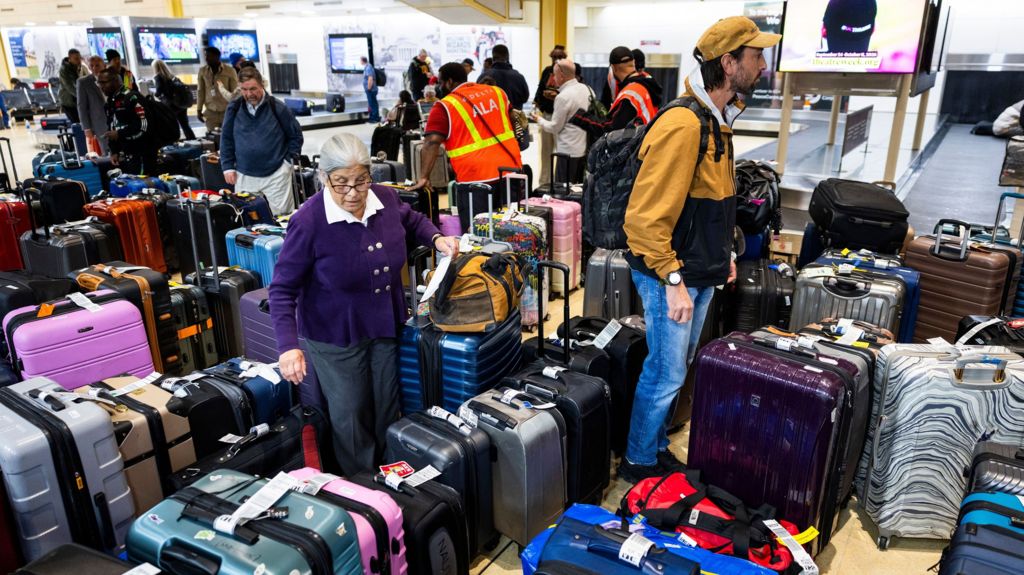
A sweeping nationwide halt to all U.S. domestic flight departures on Friday triggered cascading travel chaos that is projected to linger for multiple days, stranding hundreds of thousands of passengers and sending ripple effects across global aviation networks. The unprecedented ground stop, which ran for more than four hours starting at 15:54 EST (19:54 GMT), marked the longest full U.S. flight grounding since the 9/11 terrorist attacks, far outstripping a 2023 112-minute outage tied to a Notice to Air Missions system failure. The Federal Aviation Administration lifted the restriction at 20:15 EST, but flight tracking data shows more than 15,000 U.S. flights were either delayed or cancelled in the incident, impacting roughly 1.5 million travelers. Many passengers were trapped aboard stationary aircraft on airport tarmacs, barred from returning to terminals or taking off, while a small number of international flights were permitted to depart select U.S. hubs to free up limited airspace. The disruption spilled beyond U.S. borders, with dozens of U.S.-bound flights from European nations and Sydney International Airport in Australia ordered to hold their departures before the ground stop was rescinded. By Saturday, residual delays remained across the U.S. air network, while major UK hubs including Heathrow and Manchester reported only minor, limited disruptions to incoming U.S. services. U.S. Transportation Secretary Sean Duffy addressed reporters Friday night, confirming the root cause of the outage was intermittent instability in core air traffic control communication and radar systems, triggered by overloaded routers running on severely outdated equipment. Duffy emphasized no lives were put at risk during the incident, but warned the system requires a $50 billion full overhaul to prevent repeat failures. Homeland Security Secretary Markwayne Mullin separately confirmed no evidence of a cyberattack or rogue artificial intelligence interference has been uncovered to date, noting both he and Duffy remained in continuous contact with President Donald Trump throughout the crisis, despite the president’s public silence during the emergency. The Trump administration has formally requested $30.1 billion in funding for air traffic control modernization, a proposal currently pending review by the Republican-controlled House and Senate, though both cabinet officials cautioned that additional unplanned outages are inevitable if Congress fails to approve the long-delayed infrastructure upgrades. Former TSA Administrator John Pistole told the BBC he holds little optimism for a swift full return to normal operations, noting the timing of the unplanned failure raises particular concerns as the peak Thanksgiving holiday travel period approaches. While Pistole acknowledged the four-and-a-half hour resolution time demonstrated a degree of system resilience, he questioned why the specific fault occurred at that moment, and warned there is no guarantee a similar outage will not reoccur imminently. Dr. Guy Gratton, associate professor of aviation at Cranfield University, confirmed the scale of Friday’s disruption is the most severe U.S. air traffic halt since the 9/11 attacks, while noting its overall impact pales in comparison to the multi-day full flight ban implemented after the 2001 terror attacks. For stranded passengers across the country, the disruption has prompted quiet frustration and cautious resolve, with many echoing the sentiment of one affected traveler who noted, “We’ll get home one day” as airlines work to clear the massive backlog of scheduled services.