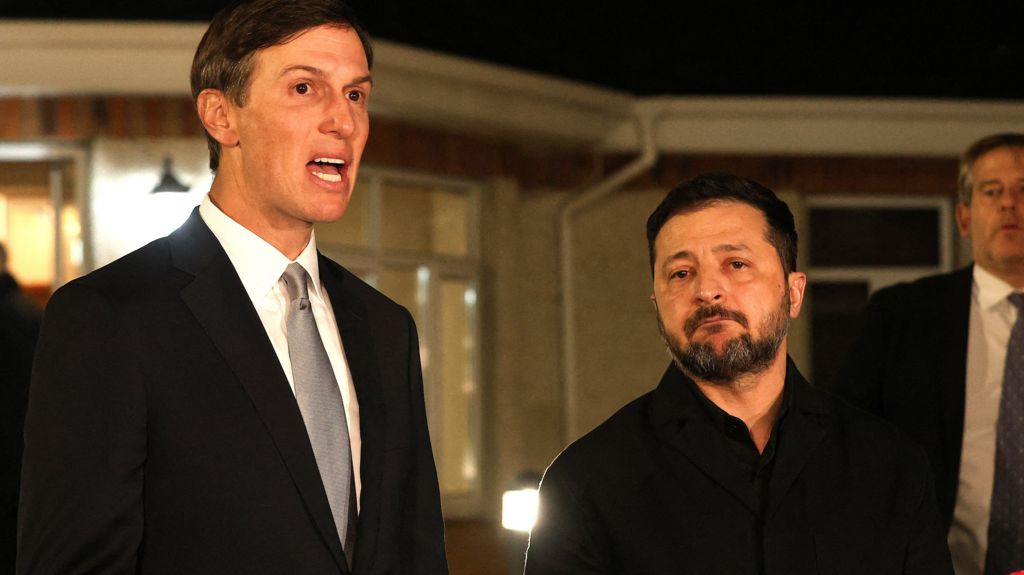
Ukrainian President Volodymyr Zelensky publicly revealed on Saturday that U.S. diplomatic negotiators have presented a new tentative framework for ending the three-year Russia-Ukraine conflict, under which Ukraine would pull its remaining military personnel out of the non-occupied segments of the eastern Donbas region in exchange for formal membership in the North Atlantic Treaty Organization. The disclosure comes on the heels of a whirlwind diplomatic tour by U.S. envoys Jared Kushner and Steve Witkoff, who held closed-door talks with Russian President Vladimir Putin in Moscow on Wednesday before traveling to Dublin for face-to-face discussions with Zelensky on the sidelines of a high-level EU summit. For years, Kyiv has positioned NATO accession as a non-negotiable pillar of any viable peace settlement, arguing that the alliance’s collective security guarantee is the only reliable deterrent against future Russian incursions. Conversely, Moscow has repeatedly framed any expansion of NATO membership to its immediate border as an existential national security threat, and has long demanded that Ukraine formally renounce any path to joining the alliance as a core precondition for peace. Prior to this latest U.S. proposal, American officials had publicly ruled out Ukrainian NATO membership as a realistic near-term outcome of peace negotiations, making the new overture a notable policy shift. Zelensky emphasized that the proposal marked the first time such a tradeoff had been formally tabled in diplomatic talks, noting that “the Americans raised a question: ‘What if Ukraine joins Nato? Would Ukraine withdraw from Donbas?’ This was the first time this had been raised.” The Ukrainian leader added that he would only bring any finalized, fully vetted peace proposal to a national public referendum for final approval, provided the package included binding, enforceable security guarantees, no restrictive caps on the size or operational capacity of Ukraine’s armed forces, and robust dedicated funding for post-war national reconstruction. Despite the tentative new opening from U.S. mediators, senior Russian officials and Putin himself have given no public indication that Moscow has softened its longstanding core demands for a peace deal, which include sweeping territorial concessions from Kyiv, strict mandatory limits on the size and weaponry of Ukraine’s military, and formal legally binding Ukrainian neutrality that permanently bars NATO accession. Kyiv has repeatedly rejected these terms, warning that such constraints would leave the country militarily vulnerable and unable to repel any future large-scale Russian invasion. Still, a small glimmer of incremental diplomatic progress emerged last month, when U.S. First Lady Melania Trump brokered a targeted temporary local ceasefire in the Russian-occupied southern city of Oleshky, enabling safe civilian evacuations and unimpeded delivery of critical humanitarian aid to trapped residents. Zelensky acknowledged that the new U.S. proposal had put Ukrainian NATO membership “back on the agenda,” but sounded a cautious note about the steep barriers to a final deal. “You have also heard Putin’s signals, and this is an extremely difficult conversation,” he told assembled reporters. Russia currently maintains military control over roughly 20% of Ukraine’s internationally recognized territory, including the vast majority of the Donetsk and Luhansk oblasts that make up the Donbas region. While the small sliver of Donbas territory still under full Ukrainian military control is of limited strategic or practical operational value, a full withdrawal of Ukrainian forces from those areas would carry enormous symbolic weight, as it would amount to de facto Ukrainian recognition of full Russian sovereignty over the entire Donbas territory. For years, Zelensky’s official public position has been that Ukraine will not cede any of its internationally recognized sovereign territory, and that the country will pursue all available diplomatic and military channels to retake all Russian-occupied lands, including the Crimean peninsula that Moscow illegally annexed in 2014, and four additional eastern and southern regions that Russia claimed to annex in 2022.