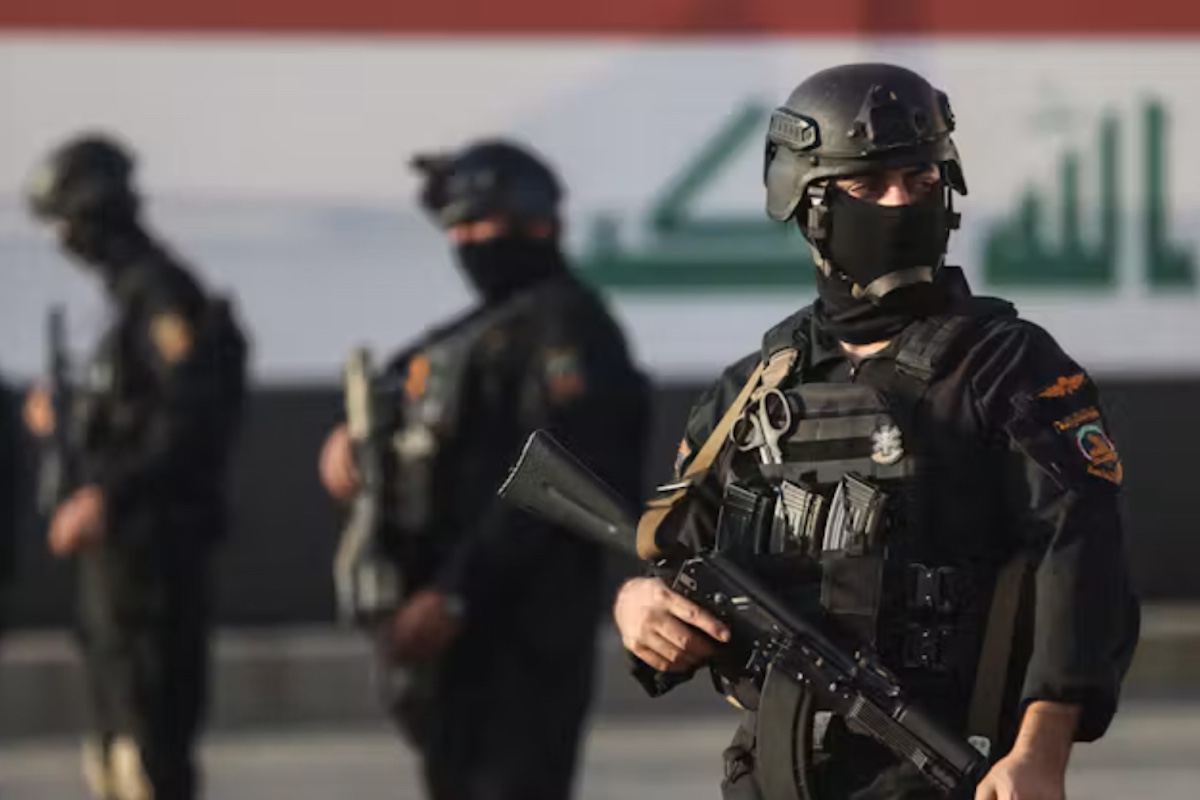
On September 30, 2026, Iraq launched a four-day national public holiday to mark its annual Sovereignty Day, a milestone timed to celebrate the full departure of the US-led 87-member international military coalition that had deployed troops across the country since 2014 to provide Baghdad with critical military training and intelligence support. The US contingent, the largest by far of all foreign forces, had remained on Iraqi soil for 12 years prior to the withdrawal, and its exit was widely framed as a landmark step in Iraq’s long-running push to build fully independent, sovereign national security capabilities. The same Sovereignty Day was originally earmarked as the official deadline for the Iraqi government to formalize a full state monopoly over all armed activity across the country, a policy explicitly designed to rein in the proliferation of Iranian-backed non-state armed groups that had spread widely in the aftermath of the 2003 US invasion of Iraq. However, Baghdad failed to meet this self-imposed target, pushing the deadline back six months to June 2027. As a political science PhD candidate at Boston University specializing in Iraqi domestic politics and national security, the author warns that this initial delay is a troubling early sign of far deeper structural frictions threatening Iraq’s security transition. The Iraqi government is currently facing mounting external pressure from the United States to bring all Iranian-aligned armed factions under full state control, with US President Donald Trump reportedly issuing a direct warning to Iraqi Prime Minister Ali al-Zaidi as recently as early November 2026, threatening sweeping financial penalties or even targeted direct military strikes against uncooperative armed groups if full disarmament of non-state actors is not completed on schedule. A core, seemingly irreconcilable disconnect has emerged between Washington and Baghdad over what the “state monopoly on arms” actually entails. For the al-Zaidi administration, the policy does not require full disbandment of non-state militias, but rather the integration of previously unregulated Iranian-aligned armed factions more formally into the Popular Mobilization Forces (PMF), a state-sponsored umbrella network of armed groups. The US, by contrast, is pushing for full demilitarization of all non-state armed actors and a sweeping, fundamental restructuring of the entire PMF framework, rooted in a fundamentally different vision of the role and structure of a sovereign Iraqi state. Iraq’s current security landscape is defined by a fragmented, decentralized patchwork of dozens of armed groups spanning the country’s multi-sectarian, multi-ethnic political order, with extremely blurred lines between formally state-affiliated forces and independent militias. The PMF, formed in 2014 largely as a volunteer force to counter the rapid territorial expansion of the Islamic State, comprises an estimated 60 to 70 separate brigades, the majority of which are Shiite Muslim factions but also include representation from the country’s large Sunni minority and other ethnic communities. Legally and formally, the PMF is an official component of Iraq’s national security apparatus, directly accountable to the Iraqi prime minister and mandated to carry out national defense and local regional security operations. In practice, however, a significant subset of PMF-affiliated factions operate with high levels of de facto autonomy. Parallel to the formal PMF structure are the so-called “resistance groups”: armed factions ideologically aligned with Iran, which often prioritize advancing Tehran’s regional foreign policy goals over Iraq’s national domestic interests. Prominent examples include the Hezbollah Brigades and the al-Nujaba Movement, both of which trace their origins back to the Iran-backed Mahdi Army formed during the 2003 US invasion. The lines between these resistance factions and the formal PMF are often intentionally porous: some groups operate entirely outside the PMF framework, while others such as the Asab Ahl al Haq Brigades maintain dual affiliations, with separate units registered both within the PMF and as independent resistance actors. The US has long publicly condemned the unregulated activity of all non-state resistance groups operating outside formal Iraqi state authority. As far back as October 2025, then-US Special Envoy to Iraq Mark Savaya stated explicitly that “there is no place for armed groups operating outside the authority of the Iraqi state.” Washington’s urgent push for disarmament escalated sharply after open hostilities between the US and Iran broke out in February 2026, since when Iraq-based Iranian-aligned resistance factions have launched hundreds of rocket attacks against US military bases stationed in Iraq, as well as targeting critical energy infrastructure in Gulf Arab states and military sites inside Israel. These attacks prompted the US to publicly criticize Baghdad in April 2026 for failing to stop what it described as “terrorist attacks in or from Iraqi territory” carried out by “Iran-aligned terrorist militia groups [who] claim to be associated with the Iraqi government.” The al-Zaidi administration has also publicly stated its goal of ending the practice of Iraqi-based armed groups launching retaliatory strikes against the US and its allies on behalf of Iran, but it has pursued a far more incremental approach than Washington demands. As of October 6, 2026, al-Zaidi announced he had reached a partial halfway milestone in the arms monopoly process, securing agreements for three out of the five major independent resistance factions outside the PMF to surrender their heavy weapons to state authorities, with active negotiations ongoing to bring the remaining two factions into the fold. Under al-Zaidi’s plan, oversight of all these newly integrated militias would fall to the official PMF Commission, the state body that administers, funds, and regulates the entire PMF network. This approach, however, falls well short of Washington’s expectations. The rift between the two governments ultimately stems from fundamentally divergent conceptualizations of what a sovereign state is, rooted in longstanding opposing political traditions. More than a century ago, prominent sociologist Max Weber famously defined the modern state as an entity that holds a legitimate, centralized monopoly over the use of violence, a framework that remains the dominant standard for Western governments. In Baghdad, by contrast, the Iraqi state is intentionally structured as a communalized, power-sharing entity, where armed groups from different sectarian and ethnic communities operate within a formal legal framework as part of the national security apparatus, a governance model explicitly designed to reflect Iraq’s diverse post-2003 demographic and political makeup. For Washington, al-Zaidi’s plan to formalize militia control under the PMF without dismantling their underlying command structures and arsenals appears entirely inadequate to meet the standard of a true state monopoly on violence. For Baghdad, however, any more radical push for full disarmament of these groups is a practically unfeasible, high-risk undertaking. Many of the largest armed factions embedded within the PMF are deeply woven into Iraq’s ruling political structure: their members hold dominant blocs in the national parliament, occupy senior cabinet positions, and exercise direct control over large swathes of the state’s federal bureaucracy. Any attempt to forcibly disarm these groups would require a complete, fundamental reimagining of Iraq’s entire model of statehood, a step that many independent observers warn could easily plunge the country back into full-scale civil war. Leaders of multiple major armed groups have already publicly accused al-Zaidi of acting as a puppet implementing a hostile American agenda against Iraqi national interests. While few modern sovereign states operate with the kind of communal, fragmented security apparatus that defines contemporary Iraq, this decentralized security landscape has been an immutable fact of post-2003 Iraqi governance, and there is no realistic path to fully dismantle it in the near term.