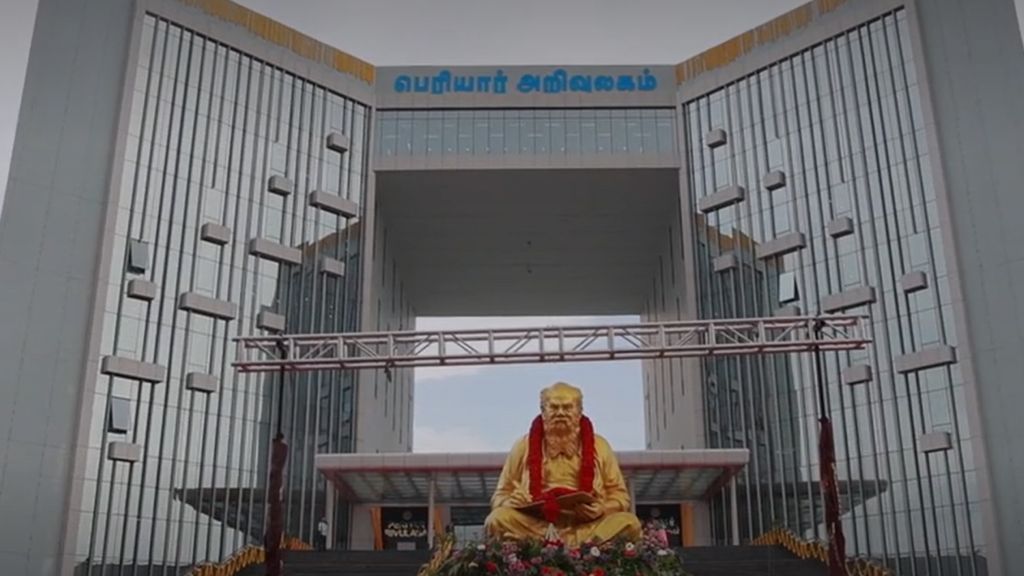
A landmark legal inquiry is underway in southern India’s Tamil Nadu state, as the Madras High Court has formally directed the state’s anti-corruption bureau to investigate explosive allegations that hundreds of books purchased for the newly inaugurated, 3 billion rupee ($34 million) Periyar Arivulagam public library were potentially created using generative AI tools, with widespread factual errors and falsified authorship. The controversy first came to public light when internationally celebrated Tamil novelist Perumal Murugan, author of award-winning works *Pyre* and *One Part Woman*, documented glaring irregularities during a personal visit to the Coimbatore-based library last month. In a post published to an online literary magazine, Murugan flagged that nearly 1,800 titles in the facility’s Tamil-language section were sourced from the obscure, little-documented publisher Agal Vilakku Pathippagam, noting many carried unverified author identities, inflated price tags, and suspicious or invalid ISBN registration numbers. Multiple examples of factual inaccuracy have been uncovered in the contested volumes: one 300-page text billed as a Naladiyar life guide, priced at 1,445 rupees, incorrectly frames the classical 400-verse Tamil moral text *Naladiyar* as a singular historical poet, while a separate volume misattributes the ancient Tamil poetic work *Madurai Kanchi* to a non-existent author. A parallel irregularity was identified at a Madurai public library, where a book titled *Democracy and People’s Rights in the Contemporary World* falsely lists globally renowned development economist Jean Drèze as its author; Drèze has publicly confirmed he never wrote the work, and that his name was used without any authorization. Reporters from BBC Tamil visited the listed Chennai registered address for both Agal Vilakku Pathippagam and a second implicated publisher, Phoenix Publishing House, and found no public branding for either operation on the premises; a local resident confirmed Agal Vilakku had operated from the space, but the firm’s proprietor Mohan declined all comment, citing the ongoing judicial proceedings. Tamil Nadu’s School Education Minister A Rajmohan has framed the unfolding case as potentially “India’s first AI scam”, noting the court-ordered investigation will extend far beyond the Coimbatore flagship library to audit public library collections across the entire state. The political fallout of the controversy has also intensified, with the current state administration placing full blame for the contested procurement on the previous Dravida Munnetra Kazhagam (DMK)-led state government, a charge the DMK has strenuously denied as a politically motivated smear, with the party itself now calling for a full independent probe into the purchasing process. More than 160 prominent Tamil writers, academics, artists and independent publishers have released a joint open statement demanding full transparency around the procurement records, a full state-wide audit of all public library holdings, and full recovery of misappropriated public funds if the investigation confirms wrongdoing. The group has raised critical questions about how such clearly flawed volumes could have passed through multiple layers of official review, including vetting by expert selection committees and formal price negotiation processes. State officials have already launched an immediate internal audit of all public library collections, with 523 suspicious titles already removed from Chennai’s historic Connemara Public Library, and all contested volumes pulled from the Periyar Arivulagam facility while anti-corruption officials seize procurement records and conduct on-site inspections across the state. Beyond the local political and administrative ramifications, the case has sparked urgent industry-wide debate about the systemic challenges facing global publishing and library sectors as accessible generative AI tools make it possible to produce full, low-cost books at unprecedented speed, while also enabling the mass production of factually incorrect content, invented sources, and fraudulent works that misappropriate the names of well-known authors. The court has also ordered immediate freezing of all bank accounts linked to the implicated publishing firms as the inquiry moves forward.