On November 8, 2026, former US President Donald Trump posted on social media to hail what he called “history’s greatest Naval Blockade,” claiming that almost no goods are able to cross Iran’s borders in either direction. This announcement came on the heels of the Trump administration’s official rollout of Task Force Iron Gate, a new framework designed to fully isolate Iran’s economy to force Tehran’s government to concede to Washington’s policy demands, even as Trump publicly asserted that a full return to open, large-scale war with Iran remains “highly unlikely.”
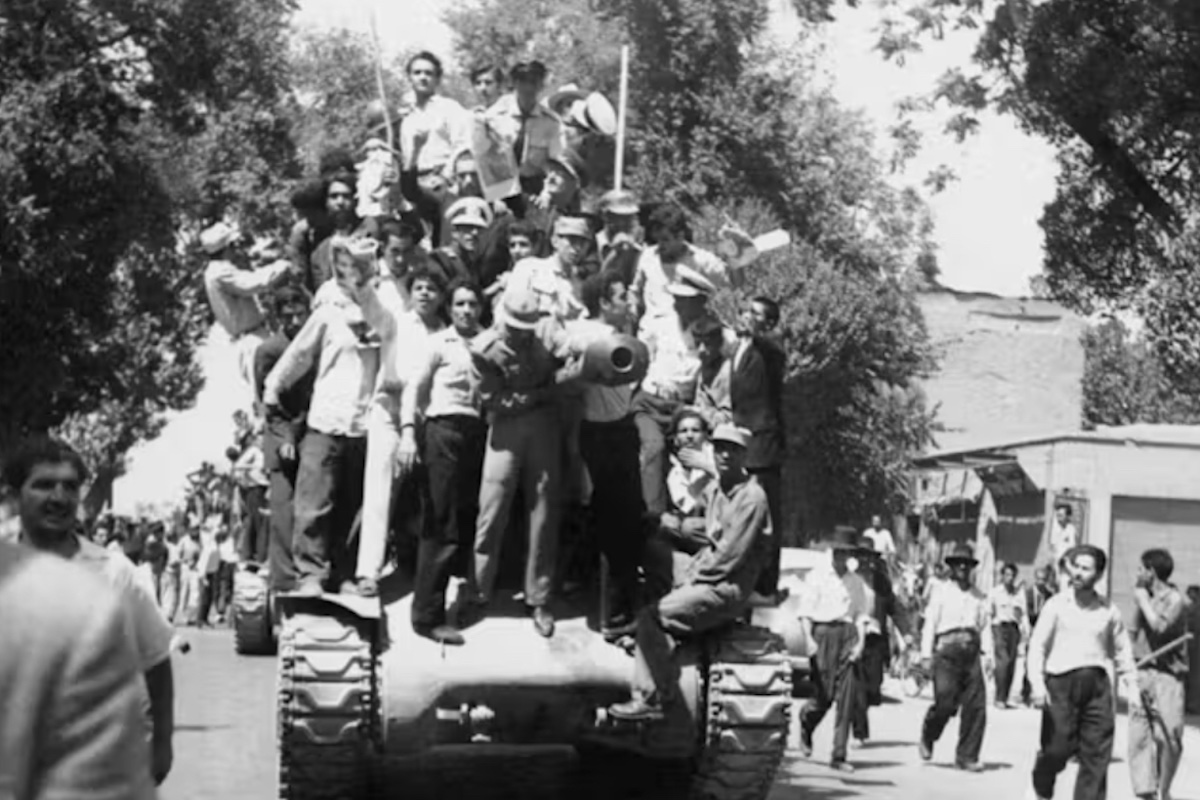
As a leading academic expert on Iran’s decades-long web of international diplomatic and economic relations, Eric Lob, an associate professor of politics and international relations at Florida International University, notes that the ongoing US military engagement in Iran, now entering its ninth month, bears striking structural resemblances to a landmark 1950s chapter of Iranian-Western confrontation. That earlier episode unfolded in the early 1950s, when the British government imposed a two-year sweeping naval blockade and economic embargo on Iran, in direct response to then-Iranian Prime Minister Mohammad Mossadegh’s decision to nationalize the UK-controlled Anglo-Iranian Oil Company. That campaign of external coercion ultimately culminated in the 1953 US and British-backed Operation Ajax, a covert plot that orchestrated widespread domestic unrest to overthrow Mossadegh’s democratically elected government.
Seventy-three years later, core themes from that mid-20th century conflict — competition over oil resources, deliberate economic coercion, and overt foreign political intervention — have reemerged at the center of 2026’s US-Iran standoff. While Trump has repeatedly adjusted his stated public justifications for the ongoing military campaign, citing preemption of imminent security threats and nuclear nonproliferation as core priorities, independent analysis points to two unstated primary objectives: installing a US-friendly leadership in Tehran, and securing direct control over Iran’s vast energy reserves. After failing to achieve these goals through initial direct conventional military strikes, the Trump administration has pivoted to its current strategy of a sweeping naval blockade and near-total economic isolation, mirroring almost exactly the playbook the British deployed against Mossadegh’s Iran seven decades prior.
However, critical differences separate the two historical moments, and the 2026 US campaign is far less guaranteed to succeed than the 1950s British operation. Unlike the mid-20th century, contemporary Iran has built robust capabilities to push back against foreign intervention and coercive economic measures through sophisticated asymmetric warfare and targeted economic disruption of global supply chains.
The 1951 oil nationalization that sparked the earlier conflict began months before Mossadegh assumed the prime minister’s office: while still serving as an elected member of Iran’s parliament in March 1951, he successfully rallied fellow legislators to pass formal legislation transferring full ownership of the Anglo-Iranian Oil Company to the Iranian state. The move was wildly popular among ordinary Iranians, who viewed it as a long-overdue step to reclaim national sovereignty over their most valuable natural resource and end decades of exploitative foreign extraction. But the British government condemned the action as a blatant breach of contractual agreements and a seizure of its single most valuable overseas asset, and immediately filed formal complaints at the newly established United Nations Security Council. By July 1951, diplomatic negotiations between the now-incumbent Prime Minister Mossadegh and British representatives had collapsed entirely, sending bilateral tensions soaring.
London launched its economic coercion campaign by first pressuring global shipping markets to reject payment receipts issued by Iranian tankers at the point of cargo loading, effectively barring Iranian oil from being sold on international markets. In August 1951, the UK escalated further by imposing a formal full naval blockade on Iranian territorial waters. British naval vessels intercepted dozens of Iranian oil tankers in the Persian Gulf, completely halting Iran’s petroleum exports, while London also banned the shipment of critical staple and industrial commodities including sugar and steel to Iran, and froze all Iranian state assets and bank accounts held in British financial institutions. That same month, the British government evacuated all of its technical personnel from the Anglo-Iranian Oil Company’s facilities, and shut down the company’s massive refinery and associated industrial sites in the Iranian city of Abadan.
Mossadegh’s administration initially planned to replace the evacuated British technicians with skilled workers recruited from other nations, while launching a domestic training program to build a fully local Iranian technical workforce. But the British government deployed aggressive legal threats and behind-the-scenes lobbying to convince nearly all major oil companies in the US and Western Europe — with the sole exception of firms based in Italy — to refuse to send any replacement personnel to Iran, crippling the new nationalized oil industry’s ability to operate.
The cumulative impact of the British blockade and embargo was catastrophic for Iran’s economy: between 1950 and 1952, the country’s total petroleum production plummeted by roughly 96%, and its oil export revenue dropped to nearly zero. To offset the resulting global supply shortfall, major foreign oil operators including British Petroleum and Saudi Aramco doubled their own production volumes to keep global energy markets stable. Widespread economic hardship, skyrocketing poverty, and the government’s inability to deliver on promised domestic reforms gradually fractured Mossadegh’s broad domestic political coalition, creating the conditions for the coordinated US and British propaganda campaign that laid the groundwork for the August 19, 1953, Operation Ajax coup that ousted him from power. A year later, Shah Mohammad Reza Pahlavi, the Western-backed authoritarian monarch, consolidated full control over Iran, and signed a new oil-sharing agreement with British and American firms: while Iran received a marginal increase in its profit share, 75% to 79% of all oil revenues continued to flow to Western corporate stakeholders, in exchange for the British government lifting its blockade and allowing Iranian oil exports to resume.
While the 1950s campaign bears clear parallels to the 2026 US strategy, which also aims to use economic pressure to foment anti-government unrest and force Tehran’s leadership to surrender, contemporary Iran possesses far more robust deterrence capabilities that the mid-20th century state never had. Even though nine months of US military strikes have severely degraded Iran’s conventional military assets, including its formal air force and navy, Tehran has developed highly effective drone swarms, precision missile systems, and a sprawling network of allied regional proxy militias that have repeatedly targeted US military assets across the Middle East. In the 1950s, by contrast, Iran had no such network of sympathetic regional armed groups, and lacked the technological capacity to strike back against a conventionally superior Western military power.
Iran has also built sophisticated tools to counter external economic coercion. Since the US military campaign began in February 2026, Tehran and its regional partners have repeatedly targeted oil tanker traffic, civilian infrastructure, and energy facilities belonging to US-aligned Arab Gulf monarchies. These attacks have pushed Gulf states to re-evaluate their long-standing reliance on US security guarantees, and actively pursue diversified defense partnerships with other global and regional powers outside of Washington’s orbit. Working in close coordination with Houthi forces in Yemen, Iran has also asserted varying degrees of operational control over two of the world’s most critical maritime energy chokepoints: the Strait of Hormuz and the Bab al-Mandab Strait. By disrupting commercial shipping lanes and targeting Gulf energy exports, Iran has successfully driven up global oil and commodity prices, applying significant economic and political pressure on the US and its allied economies.
While sweeping US sanctions and military-related disruptions have exacerbated long-running pre-existing economic crises in Iran — including record lows for the national currency, runaway double-digit inflation, and sustained economic contraction — the Islamic Republic has already weathered major waves of domestic social unrest that erupted immediately before the 2026 war, which saw thousands of demonstrators take to the streets before being quelled by state security forces. Unlike Mossadegh, who had only a short window in power to build domestic institutional capacity, Iran’s current leadership has spent more than four decades constructing a state apparatus hardened against external pressure. Even before the 2026 conflict, years of successive US sanctions failed to force the Iranian government to capitulate to Western demands, and there is no clear evidence that the newly expanded naval blockade and intensified economic isolation will deliver the different outcome the Trump administration is seeking.
Economic coercion ousted Iran’s leader in the 1950s but won’t now