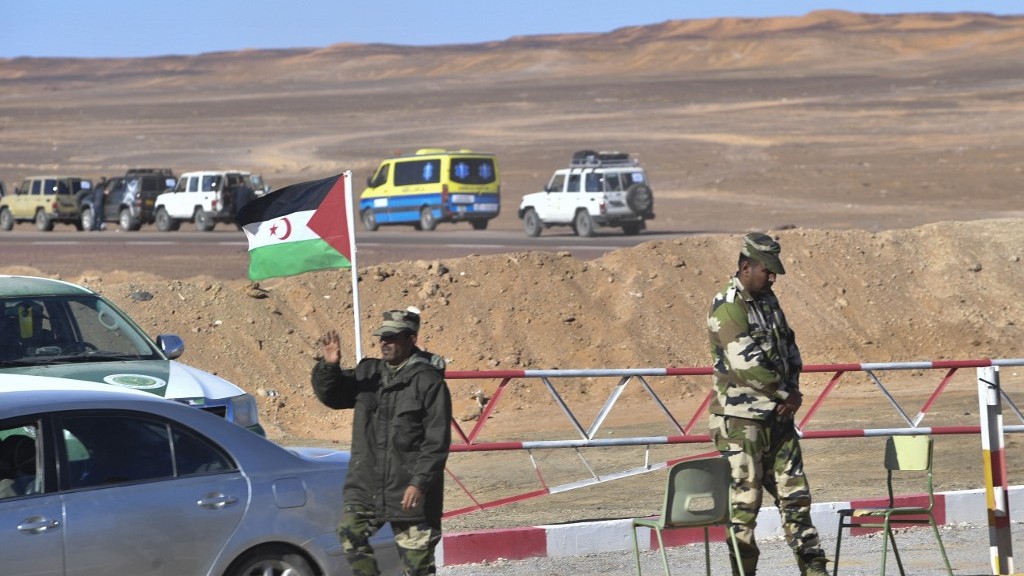
A landmark 35-year UN peacekeeping presence in Western Sahara came to an abrupt end last week, after the UN Security Council collapsed into gridlock and failed to extend the mandate of the United Nations Mission for the Referendum in Western Sahara (MINURSO), stoking widespread alarm that the long-running territorial dispute could spiral into open military conflict while fading entirely from global diplomatic attention.
First established in 1991, MINURSO was founded with two core mandates: to oversee a formal ceasefire between the Moroccan state and the Algeria-backed Polisario Front, the armed independence movement fighting for self-determination for the Indigenous Sahrawi population, and to lay the administrative groundwork for a long-promised independence referendum for the territory. Neither of those foundational goals was ever fully realized: the fragile 1991 ceasefire completely unraveled in 2020, and the self-determination vote was never scheduled, leaving the mission adrift in a diplomatic no-man’s-land for years.
The final death knell for MINURSO sounded on Sunday, when dueling vetoes from Russia and the United States scuttled competing resolutions aimed at extending the mission’s mandate. The U.S.-backed draft resolution would have stripped the word “referendum” entirely from MINURSO’s official name, rebranding it the United Nations Mission in Western Sahara, and enshrined Morocco’s widely criticized 2007 autonomy proposal as the sole legal framework for all future peace negotiations. That decades-old Moroccan plan offers the territory limited local self-governance while retaining full Moroccan sovereign control over Western Sahara, a framework that has won tentative backing from many UN member states and was described for the first time last year by the Security Council as “a most feasible outcome” for resolving the conflict, but has been repeatedly and categorically rejected by the Polisario Front.
For the Sahrawi Arab Democratic Republic (SADR), the Polisario-led governing body that administers five Sahrawi refugee camps in Algeria and roughly 20 percent of Western Sahara’s territory, the Security Council stalemate was framed as a unexpected win. “The Russian veto saved the legal basis of self-determination,” SADR Foreign Minister Mohamed Yeslem Beissat told Middle East Eye, noting that the longstanding Polisario view of MINURSO was that it was at best ineffective, and at worst actively complicit in advancing Morocco’s occupation of the territory. Beissat added that the now-dead U.S. push to prioritize Morocco’s autonomy plan had been completely neutralized by the veto gridlock, as Russia would block any future attempt to table that framework before the Security Council. “At least in the short to medium term future, they cannot bring it again to the Security Council,” he explained. “Now we are back to square one.”
Western Sahara is widely recognized as Africa’s last remaining formal colony, and remains listed on the UN’s official roster of non-self-governing territories. Morocco seized control of the vast, resource-rich desert territory in 1975 following the withdrawal of former colonial power Spain, triggering a decades-long armed conflict with the Polisario Front that displaced hundreds of thousands of Indigenous Sahrawi people, hundreds of whom still reside in refugee camps in southwestern Algeria. Independence activists living in the 80 percent of Western Sahara controlled by Morocco have long reported systematic state repression, including arbitrary detention and restrictions on peaceful protest.
The 2020 collapse of the 1991 ceasefire followed a U.S. diplomatic deal struck under the Trump administration, in which Washington formally recognized Morocco’s full sovereignty claim over Western Sahara in exchange for Morocco agreeing to normalize diplomatic relations with Israel, a position the Biden administration has retained with no major policy shifts, despite limited hopes for change following recent U.S. midterm elections. Beissat criticized both Washington and European Security Council members that backed the U.S. draft resolution for acting against their own national interests, warning that a return to large-scale conflict in North Africa would trigger widespread instability and refugee flows directly into the European continent. “The alternative to diplomacy is war. That’s the message the UNSC have sent to the world,” he said. “They didn’t care. It’s more important for them to rally with America than defend their own interests in the peace and stability of North Africa.”
The UN has already initiated the formal process of winding down MINURSO’s operations in the Western Sahara coastal city of Laayoune, transferring all remaining mission assets to Moroccan authorities. In a public statement released Wednesday, the Moroccan government insisted it would uphold its “voluntary” commitment to a ceasefire in the territory, while vowing to defend what it calls its national security and territorial integrity. Morocco controls its 80 percent share of Western Sahara behind a massive, 2,700-kilometer sand defensive barrier known as “the Berm,” which it constructed in the 1980s to separate its controlled territory from the smaller Polisario-held zone and the Algerian border.
Since the 2020 ceasefire collapse, low-level skirmishes have persisted across the demarcation line: the Polisario Front has launched repeated attacks on Moroccan military outposts along the Berm, while Moroccan forces have carried out targeted drone strikes against Polisario positions, displacing thousands of local civilians who have fled to safety in either Mauritania or Algeria’s refugee camps. Analysts warn that the total removal of UN monitoring personnel from the long-patrolled buffer zone between the two sides eliminates the last remaining guardrail against wider war. “The risk is that a military incident inside Western Sahara’s buffer zone, no longer monitored by the UN, could ignite a larger military escalation, with Rabat potentially taking over this area and the Polisario attacking Moroccan defence facilities directly from Algerian territory,” Riccardo Fabiani, North Africa project director at the International Crisis Group, explained. “It’s this kind of scenario that the disappearance of the Minurso will make more plausible from now on.”
For decades, the Western Sahara conflict has been largely sidelined in global diplomatic discourse, overshadowed by higher-profile crises including the Israel-Palestine conflict and other armed conflicts across the Middle East and North Africa. Sahrawi human rights activists warn that the full withdrawal of MINURSO will erase the last formal mechanism that kept the long-simmering dispute on the UN Security Council’s regular agenda. “For more than 30 years, Minurso kept Western Sahara on the Security Council’s agenda – it meant that the world’s most powerful states had to address our situation, and that the UN secretary-general had to report regularly on developments,” said Asria Taleb Mohamed, a Sahrawi artist and human rights campaigner. “Without that presence, I fear Western Sahara will become easier for the world to forget.”