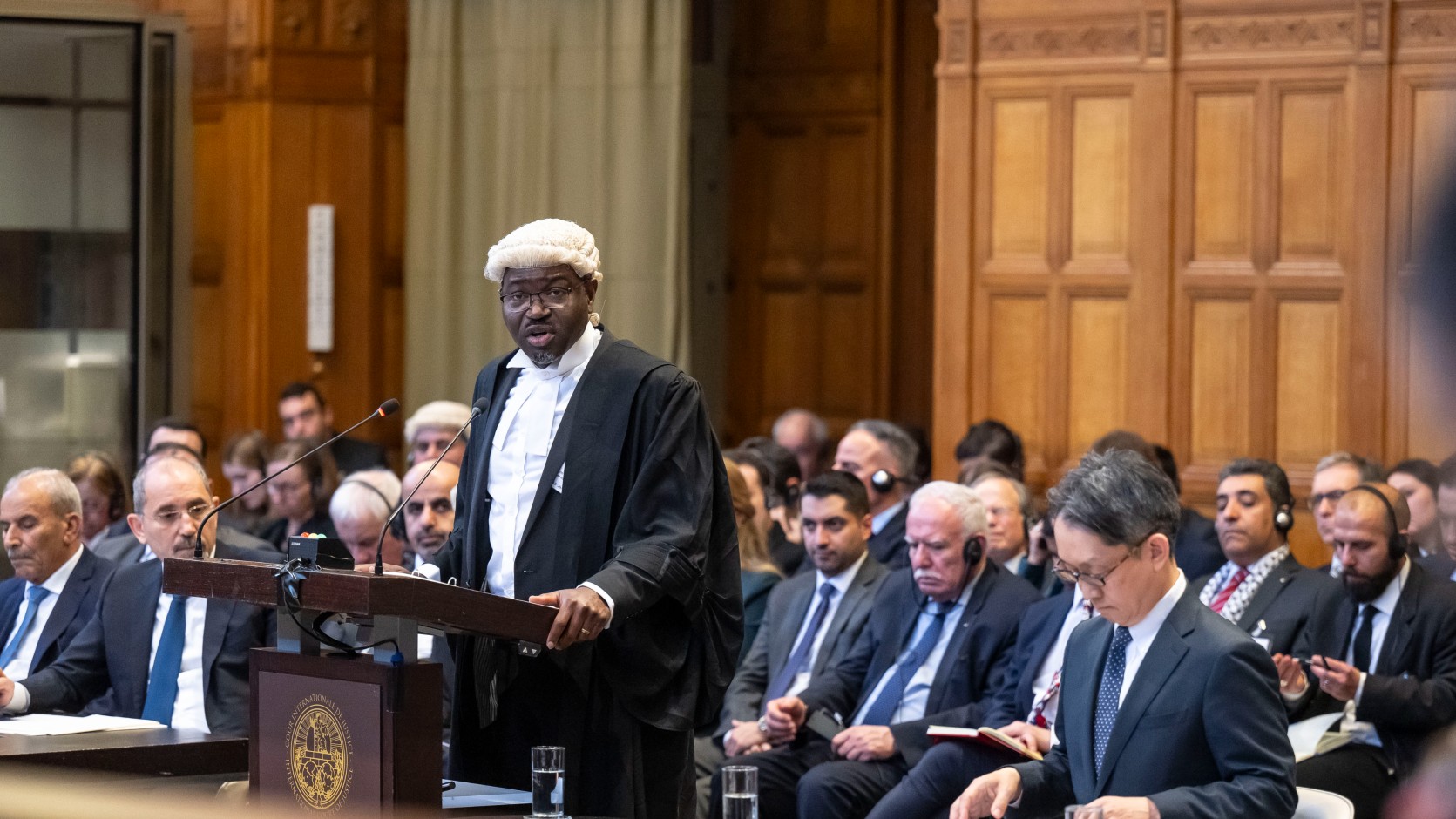
In a landmark judicial election at the United Nations, renowned British international legal expert Dapo Akande has secured a seat on the International Court of Justice (ICJ), marking the return of British representation to the UN’s highest judicial body after an almost 10-year gap. The Tuesday vote saw Akande elected alongside four other global legal figures: France’s Francois Alabrune, Singapore’s Rena Lee, Jordan’s Mahmoud Daifallah Hmoud, and Kenya’s Phoebe Okowa, with nine total candidates competing for the five open judicial seats. The new cohort will commence their nine-year terms on 6 February 2027; Hmoud and Okowa, who had previously served partial tenures to fill mid-term vacancies, have now earned full, regular terms on the bench.
Akande, currently the Chichele Professor of Public International Law at the University of Oxford and a sitting member of the UN International Law Commission, will be the first British national to serve as an ICJ judge since 2018. A widely respected jurist whose professional portfolio spans armed conflict regulation, international criminal law, human rights frameworks, intergovernmental organization governance, and interstate dispute resolution, he has built a distinguished track record of shaping landmark international legal arguments. His prior work includes developing rigorous legal frameworks for establishing genocide accountability and defining the illegality of de facto and formal annexation of Palestinian territories, positioning him to participate in the ICJ’s ongoing high-profile case brought by South Africa, which alleges Israel has violated the Genocide Convention in its military operations in Gaza.
UK Foreign Secretary Ed Miliband hailed Akande’s election as a resounding endorsement of the United Kingdom’s longstanding commitment to the international rule of law, noting it strengthens the nation’s ability to advocate for its core values on the global diplomatic and legal stage. Janina Dill, Akande’s co-director at the Oxford Institute for Ethics, Law, and Armed Conflict, praised his professional character in a post-election comment to Middle East Eye, describing him as a deliberate, nuanced jurist with exceptional communication skills, and highlighting his consistent even temperament and profound wisdom as qualities that will greatly benefit the court at a critical juncture for global human rights and conflict resolution.
The ICJ election process requires successful candidates to win an absolute majority in concurrent, separate ballots in both the UN General Assembly (97 votes required) and the UN Security Council (8 votes required), with a key procedural safeguard that bars the Security Council’s five permanent members from exercising their veto power over judicial appointments. Per ICJ foundational rules, all elected judges serve entirely independently of their national governments, with no binding obligation to advance their home state’s policy interests. Headquartered in The Hague, the ICJ functions as the primary judicial body for resolving formally submitted disputes between sovereign states and issuing authoritative, non-binding advisory opinions on critical international legal questions; unlike the separate International Criminal Court, it adjudicates state-level legal responsibility rather than prosecuting individual persons for crimes, and its judgments in interstate disputes are legally binding on the parties involved, though enforcement of rulings often depends on collective state action and the often politically divided Security Council.
Akande’s election arrives as the ICJ prepares to deliver its highly anticipated judgment on 19 November in The Gambia’s genocide case against Myanmar, which addresses widespread atrocities perpetrated against the country’s Rohingya Muslim minority. Akande previously served as lead counsel for the UK’s legal team in that case, alongside Alison Macdonald KC and Naomi Hart, when Britain intervened jointly with Canada, Denmark, France, Germany, and the Netherlands to submit coordinated arguments interpreting the Genocide Convention. The coalition of states pushed back against unreasonably high evidentiary thresholds for proving genocidal intent that would make securing genocide convictions functionally unachievable, and emphasized that genocide encompasses a far broader scope of prohibited acts than mass killing, including systematic sexual violence and the imposition of deliberately destructive living conditions that target civilian populations. Their submissions also underscored that the unique vulnerability of child populations must be central to judicial assessments of serious harm, systemic deprivation, and forced population displacement. This high-profile Myanmar genocide case has recently become a target of criticism from U.S. officials, with newly appointed U.S. ambassador to the UN Mike Waltz accusing the case’s ad hoc judge, Nobel Peace Prize laureate Navi Pillay, of attempting to lower genocide proof thresholds to enable future legal action against American and allied military personnel. Waltz publicly warned that Washington would closely monitor the ICJ’s handling of the proceedings, explicitly referencing the sweeping U.S. sanctions regime previously imposed against the International Criminal Court to signal potential retaliatory measures.
Akande’s prior ICJ appearances also include representing Japan during the court’s landmark advisory opinion proceedings on the illegality of Israel’s long-running occupation of Palestinian territories. During those hearings, he argued forcefully that a state cannot evade the international legal ban on seizing territory by force simply by declining to issue a formal public declaration of annexation, noting that sustained actions including mass population transfers, systematic land seizures, mass evictions of long-term residents, construction of permanent state infrastructure, and exploitation of shared natural resources such as water can collectively constitute de facto annexation, particularly when state officials explicitly frame those changes as permanent. He further rejected the legal claim that states can retain seized territory under the justification of self-defense, noting that international law frames self-defense as a mechanism to protect already sovereign territory, not to seize additional land, and concluding that “Permanent annexation can never be a proportionate response to an armed attack.”
Notably, Akande has a long track record of challenging the British government’s official legal positions before international judicial bodies, despite the UK’s formal support for his ICJ candidacy. During 2018 ICJ hearings on the Chagos Islands dispute, in which the UK separated the archipelago from Mauritius prior to the latter’s independence, he represented Zambia to directly refute core British legal arguments. The UK had claimed the case was a narrow bilateral territorial dispute between London and Port Louis that fell outside the ICJ’s purview without British government consent, but Akande countered that the proceedings centered on binding international legal obligations related to decolonization, and that the fundamental right of colonized peoples to self-determination was a universal concern for all UN member states, not just the two direct parties to the dispute. He further rejected the UK’s assertion that the principle of self-determination had not yet been enshrined in international law in 1965, when the Chagos Islands were formally severed from Mauritius, citing the UK’s own official public statements from that era that explicitly affirmed the universal right of all colonized peoples to self-governance.
His willingness to challenge official UK legal stances extends to military action as well: in a 2018 formal legal opinion commissioned by then-UK Labour Party deputy leader Tom Watson, Akande dismissed the British government’s legal justification for airstrikes against the Assad regime in Syria as “significantly flawed,” concluding that the military operation violated the UN Charter and established international law. He noted that international law does not recognize the unilateral, uninvoked right to “humanitarian intervention” that the British government had claimed, and that even if such a right were widely accepted, the 2018 airstrikes failed to meet the UK government’s own stated conditions for legitimate action. Akande also publicly challenged the legal basis for the UK’s participation in the 2003 invasion of Iraq: in 2010, he led a cohort of leading international law academics in a formal submission to the official Iraq Inquiry that rejected the UK government’s argument that a 1990 UN Security Council authorization to use force against Iraq following its invasion of Kuwait could be reactivated more than a decade later due to Iraqi breaches of 1991 ceasefire terms, describing that interpretation as “an untenable interpretation of the UN Charter.” The submission further argued that even if that contested legal argument were accepted, a November 2002 Security Council resolution did not meet the required conditions for authorizing military action, meaning then-UK Attorney General Lord Goldsmith’s formal conclusion that the invasion was lawful was legally unsound.
In his formal candidate statement submitted during the ICJ election process, Akande pledged full commitment to legal rigor, collaborative engagement across diverse global legal traditions, and uncompromising judicial independence. “If elected, I will decide cases on the basis of a faithful and impartial application of the law having listened carefully to the arguments of participants in the proceedings,” he stated. The election of Akande adds a widely respected, independently minded legal voice to the ICJ at a moment when the court faces unprecedented global scrutiny over high-stakes cases related to genocide, territorial occupation, and the limits of legitimate military action.
Dapo Akande elected as ICJ judge, restoring British presence inside highest UN court