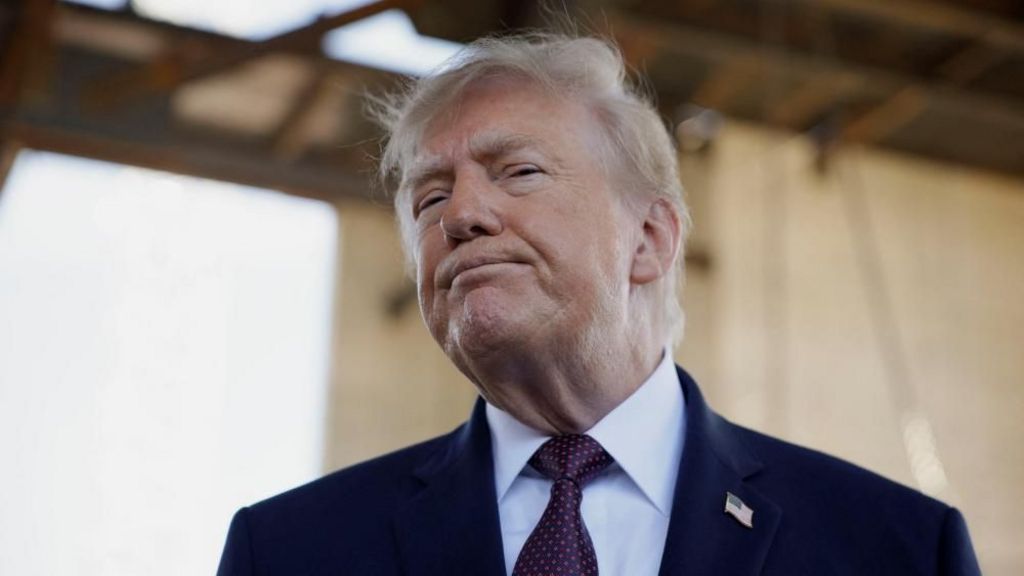
In the immediate aftermath of a historic Democratic sweep in the 2026 U.S. midterm elections, as electoral outcomes continued to be finalized, the official White House X account shared a stark, formal photograph of Donald Trump seated behind his Oval Office desk, accompanied by the blunt caption: “Trump is still your president.” The carefully curated message was a deliberate attempt to project an image of unshakable executive resolve, framing the sitting president as fully in command despite a devastating partisan setback at the polls. What the post omitted, however, was the dual reality of Trump’s remaining term: while U.S. chief executives retain sweeping unilateral authority even without congressional majorities, Trump has already established a track record of pushing the outer boundaries of executive power, yet the clock is rapidly winding down on his remaining two years in office, creating growing constraints on his ability to act unilaterally. Over his tenure, the president has relied far more heavily on presidential executive orders than formal legislation passed by the previous Republican-controlled Congress to advance his signature agenda: these actions include sweeping tariffs applied uniformly to both U.S. allies and geopolitical adversaries, unilaterally authorized military operations targeting Venezuela and Iran, and across-the-board cuts to congressionally approved federal agency spending. Even with Democrats now holding majority control of both the U.S. House of Representatives and the Senate, Trump retains the legal authority to continue pursuing many of these same unilateral actions, alongside additional unannounced policy moves, for the remainder of his term. Should Democratic legislators attempt to roll back his policies via new bills, the U.S. Constitution grants Trump a powerful defensive tool: the presidential veto, which cannot be overridden by the narrow Democratic majorities projected to take office in the new Congress. Still, formal legal authority alone does not guarantee Trump has the political capital and institutional support to execute his desired agenda. Incoming Democratic lawmakers have run explicitly on a platform of unyielding opposition to every element of his policy agenda, and the most significant barriers to his plans may emerge not from across the partisan aisle, but from within his own Republican ranks. For the first two years of his presidency, Trump maintained an ironclad grip on the Republican Party, keeping congressional Republicans and grassroots partisan supporters fully aligned through a shrewd mix of targeted political rewards and unapologetic, hardball threats. Recent signs, however, indicate that his once-unassailable hold on the party is beginning to fray. A growing number of Republican officials are now openly criticizing his policy decisions, a level of public pushback that was virtually unthinkable just a few months prior. Even Vice President JD Vance publicly published a lengthy social media post explicitly blaming the U.S.-backed Israeli military campaign in Iran, ordered by Trump, for the sweeping Republican electoral losses on midterm Tuesday. “If you’d like to argue it was worth it, that losing the Senate for the next six years was worth it, then do so,” Vance wrote. “But everyone knows why we lost. And any honest conversation about where we go from here must start there.” Unconfirmed reports have also begun circulating that senior members of Trump’s White House staff may face imminent dismissal. Per CBS News, the president has privately consulted close inner-circle advisors about whether to oust Defence Secretary Pete Hegseth, one of the primary architects of the Iran military campaign, though Trump has publicly denied these rumors. The scenario bears striking parallels to former President George W. Bush’s 2006 decision to remove Defence Secretary Donald Rumsfeld, the central figure behind the Iraq War, in direct response to a sweeping Democratic midterm landslide that handed the party full control of Congress for the first time in over a decade. “Republicans who think that they need to pivot away from Trumpism and from the Make America Great Again movement are going to either try to emphasise different policy issues, or they’re going to try to frame themselves in ways that show some daylight between themselves and Donald Trump,” noted David Miller, an assistant professor of government at American University. On the night of the midterm vote, Trump made a series of conflicting public statements across social media platforms and live media interviews, alternating between pledges of bipartisan cooperation with the incoming Democratic Congress and explicit threats to veto any progressive legislation the new chamber might pass. The following Wednesday, as construction crews installed the final structural beam for the new White House ballroom Trump has overseen building, even amid an ongoing legal lawsuit seeking to halt the project, he addressed reporters briefly about his political path forward. “I’ll get along probably with the Democrats, unless they want to be destructive,” he stated. “But I have the power of the veto.” The situation echoes the 1995 political moment, months after Republicans seized full control of Congress in a wave election that left Democratic President Bill Clinton politically isolated and on the defensive. At the time, Clinton famously insisted, “The president is still relevant here,” as he sought to reassert his political influence. Unlike Clinton, who was in his first term and had sufficient time to rebuild his public standing and win re-election the following year, time is not on Trump’s side. While he will likely attempt to make the same case for his continued relevance to Washington’s political class and the U.S. public, the man who has spent his entire political career dominating the U.S. media spotlight may soon find that both his formal powers, and the political authority required to wield them effectively, are steadily slipping from his grasp.
Anthony Zurcher: Midterm carnage weakens Trump but he still wields power for now