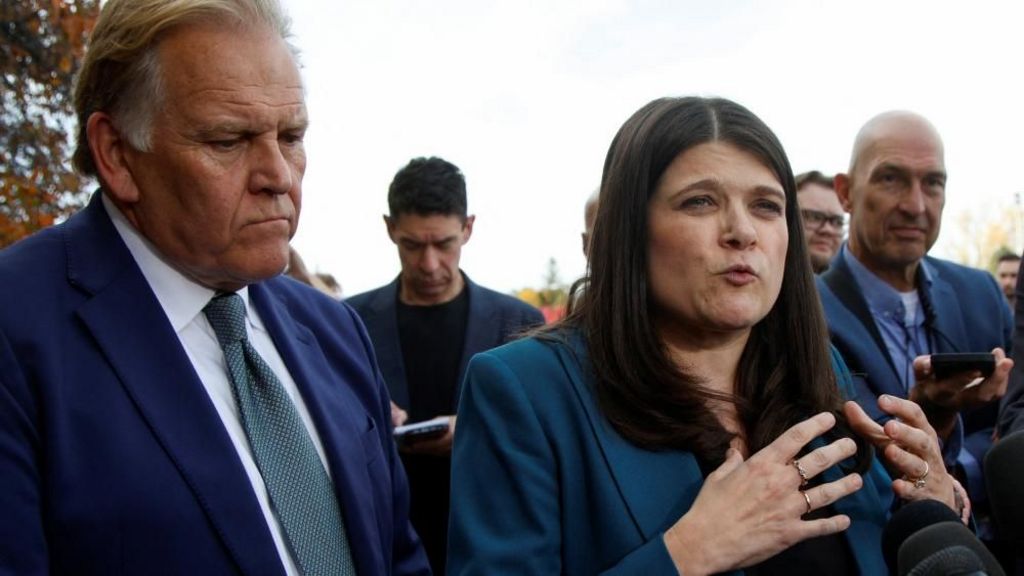
In a shocking break from partisan ranks just 48 hours ahead of Michigan’s high-stakes U.S. Senate midterm contest, incumbent Democratic congresswoman Haley Stevens formally threw her support behind Republican nominee Mike Rogers on Sunday, following a bitter public rift with the state’s Democratic Senate standard-bearer Abdul El-Sayed. Stevens, who was defeated by the progressive El-Sayed in a bruising Democratic primary earlier this year, appeared alongside Rogers during a public gathering at a Michigan church, a move that sent immediate shockwaves through both state and national Democratic leadership. In a video posted to her X account moments after the joint appearance, Stevens framed her unprecedented cross-party endorsement as a defense of Michigan’s core values, arguing, “I do not belong in Abdul’s campaign. The identity of Michiganders is not rooted in the kind of divisive rhetoric we are seeing coming straight from our Democratic nominee right now.” She further revealed that El-Sayed’s team had explicitly disinvited her from a planned joint campaign event scheduled for the same Sunday, after weeks of simmering tensions that boiled over in a dispute over a third-party liberal campaign ad that attempted to blame Israeli policy for rising local food costs. El-Sayed had publicly disavowed the ad and denied any involvement in its production, but the rift between the two former primary rivals only widened in the days leading up to the general election. Speaking to reporters outside the church, Stevens elaborated that El-Sayed had made it unambiguously clear she was not welcome to participate in any capacity on his campaign, despite widespread recognition that the Michigan Senate race is one of the narrowest battleground contests in the 2026 midterms, and will be a critical factor in determining which party holds majority control of the U.S. Senate for the next two years. The open seat is currently held by a retiring Democratic incumbent, and no Republican has won election to that specific Michigan Senate seat since 1994, even as the state has cemented its status as one of the nation’s most volatile swing states: it backed Joe Biden in the 2020 presidential race, then flipped to support Donald Trump’s successful 2024 re-election bid. Rogers, a longtime GOP figure, hailed Stevens’ endorsement as an act of extraordinary political courage during brief remarks to assembled press, while the fallout for Stevens and the state Democratic Party was immediate. Multiple members of Stevens’ congressional staff resigned within hours of her endorsement announcement, and Michigan Democratic Party chair Curtis Hertel issued a scathing statement condemning her decision, saying it proved she had abandoned every progressive and centrist policy priority she had campaigned on for years. “We fully reject these bad-faith efforts by Stevens and her allies to split our party and erode the momentum we have built across Michigan,” Hertel added. Top national Democratic leadership quickly moved to circle the wagons around El-Sayed, a former public health official and son of Egyptian immigrants who rose to prominence as a grassroots progressive outsider during the primary. Senate Majority Leader Chuck Schumer released an official statement affirming that the entire Senate Democratic caucus stood firmly behind El-Sayed, noting his track record of advocacy for working-class Michigan families, without directly referencing Stevens’ defection. A string of prominent Michigan state Democratic legislators also publicly criticized Stevens over the weekend, with high-profile state senator Mallory McMorrow telling CNN, “I have no grasp whatsoever of what Haley Stevens is even trying to accomplish with this.” The highly public feud has laid bare deep, unresolved ideological rifts within the Democratic Party, pitting the centrist, establishment-aligned wing that Stevens represented – which had the full backing of popular Michigan governor Gretchen Whitmer during the primary – against the rising progressive faction led by El-Sayed, who has centered grassroots anti-establishment anger and criticism of U.S. foreign policy ties to Israel in his campaign. Analysts note that the high-profile schism is likely to shape internal Democratic power struggles and policy direction all the way through the 2028 presidential election cycle, as the party grapples with competing priorities among its diverse voter base in critical swing states.
Democrat endorses Republican candidate in key Michigan Senate race as party spat escalates